The differences and applications of Copper Braided Flexible Busbar, flat bare copper wires and tinned pure copper jumpers
Apr 22, 2026
Copper Stranded Flexible Busbar such as copper braided wire soft connections, flat bare copper wires, and tinned pure copper jumpers are similar in appearance, but each has specific functions in engineering applications. This article starts from the material characteristics, applicable scenarios and selection points, and systematically sorts out the key parameters to help engineers avoid common problems such as low conductive efficiency, oxidation failure, and insufficient temperature resistance.

Product definition and structural differences
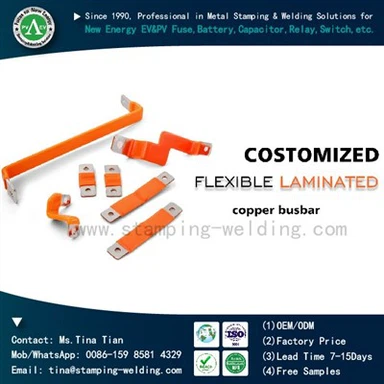
Copper braided wire soft connection is a flexible conductive tape made of multiple strands of fine copper wire (usually 0.10mm ~ 0.20mm) braided in a single or multiple layers. It has excellent flexibility and anti-fatigue properties and is suitable for occasions with frequent vibration or bending installation. Its structure is similar to Copper Braided Wire, but usually crimped terminals or welded copper tubes are used at both ends to form a complete Braided Wire Copper Bus Bar assembly.
Flat bare copper wire, also known as rectangular copper busbar, is a flat conductor rolled from solid or stranded copper material. It has a rectangular cross-section and common specifications such as 30×4mm, 40×6mm, etc. It has high mechanical strength and is mainly used for fixed main circuit connections, such as distribution cabinets, transformer outlets, etc. This type of product is a rigid alternative to Flat Copper Braided Wire, but cannot compete with braided structures in terms of flexibility.
Tinned pure copper jumpers are made by plating a layer of tin alloy on the surface of pure copper braided wires to form a Flexible Braided BusBar, which has both high conductivity and oxidation resistance. The tin plating layer can effectively prevent copper from oxidizing in humid and corrosive environments and extend its service life. It is especially suitable for grounding and bridging in outdoor or harsh industrial environments.

Analysis of core performance parameters
Conductivity: Twisted Copper Wire has a conductivity of approximately 58 MS/m, which is much higher than that of aluminum (approximately 35 MS/m). The use of high-purity oxygen-free copper (copper content ≥99.9%) can further improve conductive efficiency and reduce temperature rise.
DC resistivity: According to the JB2572-79 standard, the DC resistivity of Copper Braided Wire (TZ) at 20°C is not greater than 0.022 Ω·mm²/m, and that of tinned copper braided wire (TZX) is not greater than 0.0234 Ω·mm²/m. Cross-sectional area and carrying capacity: Common specifications include 10mm², 25mm², 50mm², 100mm², etc. When designing, it is recommended to select a current density of 1.5~2.5 A/mm² to avoid overload heating. Coating thickness: The thickness of high-quality tin plating should be ≥10μm to ensure strong adhesion and resistance to salt spray corrosion, and to avoid an increase in contact resistance due to the peeling off of the tin layer.

application scenarios
Different working conditions have significantly different requirements for conductive connectors, and incorrect selection may lead to system failure: Charging piles and fast charging ports for new energy vehicles: Copper Stranded Flexible Busbar or Flexible Braided BusBar is recommended because of its high flexibility, resistance to high-frequency vibration, and low contact resistance, which ensures charging efficiency. Internal connections of low-voltage power distribution cabinets and control cabinets: suitable for Copper Stranded Wire or Braided Wire Copper Bus Bar, which facilitates bending installation and adapts to complex wiring spaces.
Photovoltaic power generation sets connected in series and parallel, inverter terminals: Flat Copper Braided Wire or Twisted Copper Wire should be used, which have strong current carrying capacity, direct connection and high efficiency, reducing energy loss. Grounding of high-voltage switch cabinets and GIS equipment: It is recommended to use Copper Braided Busbars For Electrical or insulated flexible copper bars and meet the grounding standard requirements. Important note: All conductive connection points should be pressed or bolted first, and welding is strictly prohibited. Welding will destroy the metal lattice structure and easily cause thermal fatigue cracks, posing safety risks.

contact us
We specialize in providing high-performance electrical connection solutions. Copper Braided Flexible Busbar is manufactured using high-quality materials and strict processes, and are committed to providing stable and efficient connection guarantees for various electrical equipment, new energy systems and industrial applications. If you need to know more product details or obtain professional selection support, please feel free to communicate with us further.