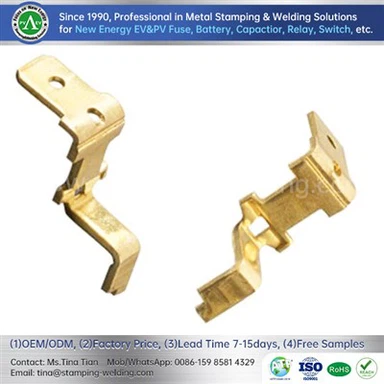
Upgraded sheet metal and brass stamping processes empower high-end manufacturing, with demand from multiple application fields continuing to rise
Jan 19, 2026
Driven by the miniaturization of electronic devices and the electrification of new energy vehicles, Sheet Metal Brass Stamping technology, with its advantages of efficient mass production and stable product performance, is becoming one of the core processes in high-end manufacturing, providing key support for the supply of core components in many industries. Brass Sheet Metal Parts Terminal uses 0.1 mm to 3.0 mm thick brass sheets or strips as raw materials, and completes cold processing such as shearing, bending, and stretching under the action of a press using stamping dies. It is a process that mass-produces parts with specific geometric shapes and functional characteristics, giving full play to the excellent electrical and thermal conductivity, corrosion resistance, and cold forming ability of brass, and is widely used in industrial scenarios with high requirements for performance and reliability.

Material selection
1.The core material system offers diverse adaptability
Using mainstream brass grades such as C26000, H62, and H65 as its core, covering various stamping needs and laying the foundation for precision machining.
2.Grade characteristics are precisely matched to processes
C26000's excellent ductility is suitable for complex stamping, while C28000's resistance to seawater corrosion is suitable for special working conditions, improving the adaptability of finished products.
3.High-quality materials ensure molding quality
The stamping process maintains fiber continuity, avoids stress concentration and material waste, and ensures consistent mechanics and surface integrity of the finished product.

Process characteristics
Compared to brass machining, stamping can achieve a material utilization rate of over 85% in mass production, offering advantages in cost, efficiency, and consistency. Compared to casting, it effectively avoids internal defects such as porosity and shrinkage, making it more suitable for manufacturing thin-walled structural parts. However, this process demands high standards for mold design and process control, requiring precise management of issues such as springback, burrs, cracking, and surface oxidation. For example, setting a mold clearance of 5%–8% of the material thickness, optimizing the bending radius to be at least 0.5 times the material thickness, and matching the feeding direction to the rolling texture of the brass strip are all crucial for ensuring forming quality. Furthermore, the innovative application of composite processes such as Sheet Metal Brass Stamping further expands the applicability of this technology.

Industry Trends
- Accelerated environmental transformation has led to a surge in demand for lead-free brass materials, which are becoming the mainstream market trend to meet stringent environmental regulations.
- Upgrades in functional integration are driving the research and application of specialty brass and composite materials, expanding the application boundaries in high-end equipment.
- A parallel approach of green recycling and precise management is being implemented, improving the utilization rate of recycled copper and ensuring material stability through end-to-end digital management.

Conclusion
With the continuous miniaturization of electronic products, the widespread adoption of high-voltage systems in new energy vehicles, and the pursuit of green manufacturing in industrial equipment, sheet metal and brass stamping is evolving from traditional hardware parts to high-precision, multi-functional integrated components. Its value lies not only in efficient manufacturing but also in providing high-performance, reliable, and sustainable metal solutions for the global engineering field through deep collaboration between materials, processes, and design.
contact us