white server cabinet Selection Guide: Balancing Aesthetics, Heat Dissipation, and Scene Adaptability
Apr 26, 2026
In data center and IT room construction, server rack color is no longer simply a matter of visual preference, but has become a crucial selection factor influencing operational efficiency and room lighting. White server cabinet, with their high reflectivity, modern appearance, and comparable load-bearing capacity to black racks, are gaining increasing attention from enterprise users. This article, from a selection perspective, outlines the key parameters, applicable scenarios, and matching suggestions for white server racks.

Size and capacity selection
The first step in selecting a server cabinet is to determine its height, width, and depth. Height is measured in U (1U = 44.45mm), with common specifications including 42U server cabinets, 18U data cabinets, and 12U network cabinets. 42U is suitable for centralized data centers or server rooms, accommodating a large number of standard 19-inch devices; 18U is suitable for branch offices or medium-sized network cabling rooms; and 12U is often used in 12U wall-mounted data cabinets or in-wall network cabinets, saving floor space. Width is typically 600mm or 800mm: 600mm fits most servers, while 800mm allows for side cable management space. Depth needs to be selected based on device length: 600mm is suitable for network switches, 800mm~1000mm is suitable for servers with a depth ≤700mm, and 1200mm provides leeway for long-bodied devices or double-sided cabling.
Installation methods and mobility requirements
Depending on the site conditions, floor-standing, wall-mounted, or mobile data cabinets can be selected. Floor-standing data cabinets are suitable for dedicated server rooms due to their strong load-bearing capacity; 12U wall-mounted network cabinets are suitable for low-voltage electrical rooms in office areas or retail stores, saving floor space and keeping the space clean; for frequent maintenance or temporary deployment, server racks on wheels are recommended for easy relocation. For outdoor or semi-outdoor scenarios (such as smart light poles and edge computing nodes), outdoor server cabinets or outdoor data cabinets with higher protection levels should be selected, typically requiring IP54 or higher dust and water resistance, and equipped with heating or sunshade components.
Heat dissipation and airflow management
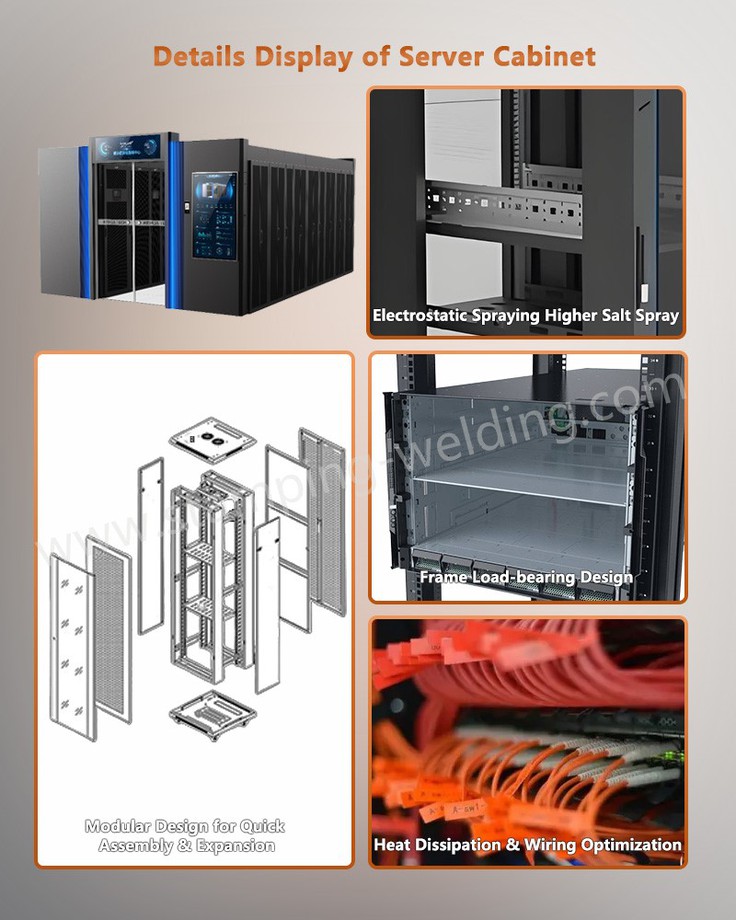
White server racks, while having high reflectivity which can reduce localized hotspots, still require more robust active cooling design. Enclosed server racks, such as those with built-in fans or air conditioning units, are suitable for high-density deployments. Optional server rack fans enhance internal airflow and are typically installed at the top or rear door. If the data center already has adequate air conditioning, a front and rear mesh door design can be chosen, allowing natural convection to meet the needs of low to medium-density equipment. Note: Wall-mounted small-capacity racks, such as 6U comms cabinets or small comms cabinets, require adequate side and front ventilation clearances due to space constraints.
Scene matching and cost considerations
- For open office spaces in tech companies: white server cabinets with glass front doors are the preferred choice, offering an aesthetically pleasing look and easy visibility of equipment operation.
- For low-voltage electrical rooms in high-rise office buildings: in-wall network cabinets or 12U network racks with embedded installation are recommended to avoid obstructing passageways.
- For remote edge sites: outdoor server racks are recommended, paying attention to temperature range and security features.
- For budget-sensitive projects: focus on server rack price rather than color. White racks are generally similar in cost to black racks, but racks with special depths or wheels may be slightly more expensive.
Summary and Recommendations
When selecting a server rack, priority should be given to meeting equipment size, heat dissipation requirements, and site constraints, followed by consideration of the ease of maintenance offered by color. White server cabinets are particularly suitable for dimly lit server rooms or those requiring frequent front- and rear-end maintenance, as their highly reflective surfaces make internal cables and port status easier to identify. For hybrid deployment scenarios, a combination of black and white can be used-for example, black for core data areas and white for edge office nodes-to improve overall visibility without requiring additional lighting. The final solution should be determined after a comprehensive evaluation based on physical samples and the server rack price list provided by the supplier.
Contact Us
For further suggestions on white server cabinet configurations tailored to specific data center sizes or heat dissipation scenarios, please contact our technical team to obtain a customized selection table.