The public charging network continues to improve, and High-power DC charging fast charging strengthens the foundation for charging infrastructure for new energy travel
Apr 26, 2026
With the continuous increase in the number of new energy vehicles across the country, the infrastructure for public transportation charging is entering a window of opportunity for large-scale upgrading and expansion. High-power outdoor ground-mounted charging equipment has become a core and essential supporting equipment for the integrated layout of urban and rural charging networks. High-power DC charging, as the core power supply system for mainstream public fast charging, relies on an integrated ground-mounted architecture to complete the closed-loop conversion of AC power across the entire grid, directly supplying high-voltage charging power to the vehicle's power battery. It is fully compatible with the all-weather, centralized charging conditions of urban trunk lines and intercity road networks, and has now become the core main facility for improving the public new energy charging ecosystem across the country, continuously optimizing the charging experience for car owners in all scenarios of short-distance commuting and long-distance intercity travel.

Technical Principle Analysis
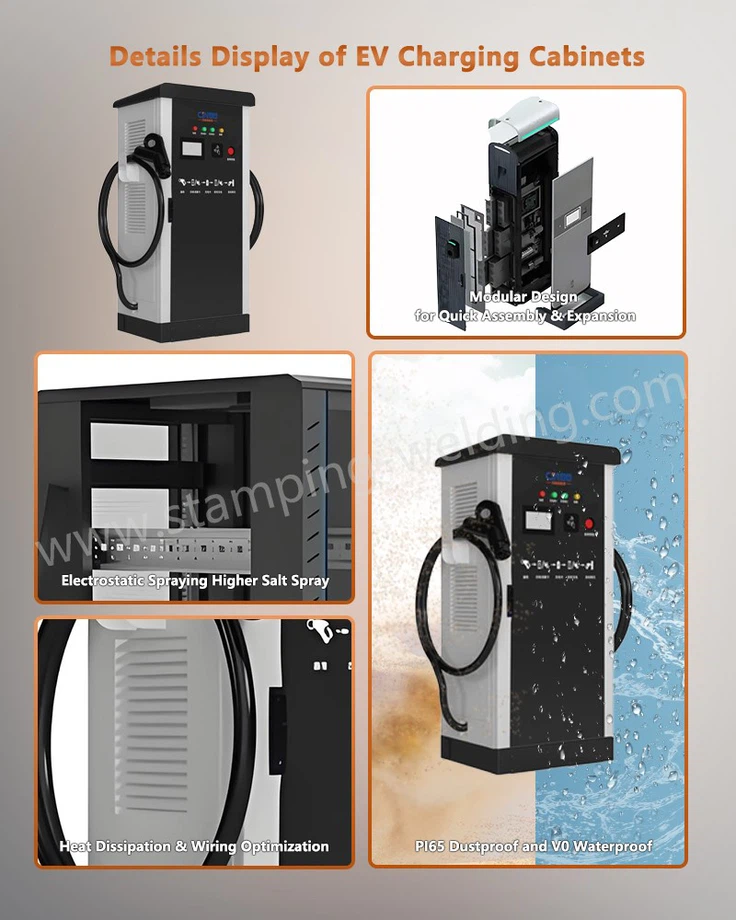
DC fast charging departs from the traditional household AC slow charging architecture. It integrates a power rectifier unit, eliminating the need for secondary conversion by the vehicle's OBC (On-Board Charger), directly converting AC power into the high-voltage DC power required by the battery, thus reducing energy loss. The device features an integrated floor-mounted structure, integrating all core components such as control, power, power distribution, and fast charging cables. Ground-anchored for stability, it has a small footprint and high protection level, making it suitable for long-term stable operation in outdoor public charging stations. The device automatically matches the vehicle model via vehicle CAN communication, intelligently adjusting the charging voltage and current. It operates stably within the normal range of 310V to 720V, and with Level 3 charging multiple protection mechanisms, it effectively prevents charging safety risks such as overvoltage, overcurrent, and overheating.
Fast charging core advantages
- Outstanding Charging Efficiency: Compared to traditional low-speed charging infrastructure, the base-mounted DC fast charger significantly improves charging efficiency. Under normal operating conditions, vehicle charging takes only one to two hours, far faster than the five-hour or more charging time of AC slow charging. This fully meets the emergency rapid charging needs of various vehicles, including ride-hailing vehicles, logistics vehicles, and private cars.
- High-Power, Universal Compatibility: The equipment offers comprehensive power coverage, with a standard 60kW base power specification, while also being compatible with 120kW and 160kW high-power models. It is adaptable to mainstream high-voltage platform vehicles and future ultra-high-voltage fast charging upgrades, offering stronger compatibility across operating conditions.
- Easy Installation and Maintenance: The integrated charging pile design simplifies and expedites on-site wiring. Modular, zoned maintenance is possible later, enabling rapid troubleshooting and effectively reducing the cost of manual maintenance and daily on-site staffing. This caters to the needs of large-scale, batch-built charging stations.
- Intelligent safety management: The device is equipped with a high-definition interactive screen and multiple payment channels such as QR code scanning and card swiping. The background monitors the charging status of the entire area in real time and automatically warns and starts/stops the device in response to risks such as power outages, leakage, and high temperatures. Relying on the EV fast charger closed-loop protection system, it comprehensively ensures the safe and compliant operation of charging in public charging stations.
Full-domain implementation scenarios
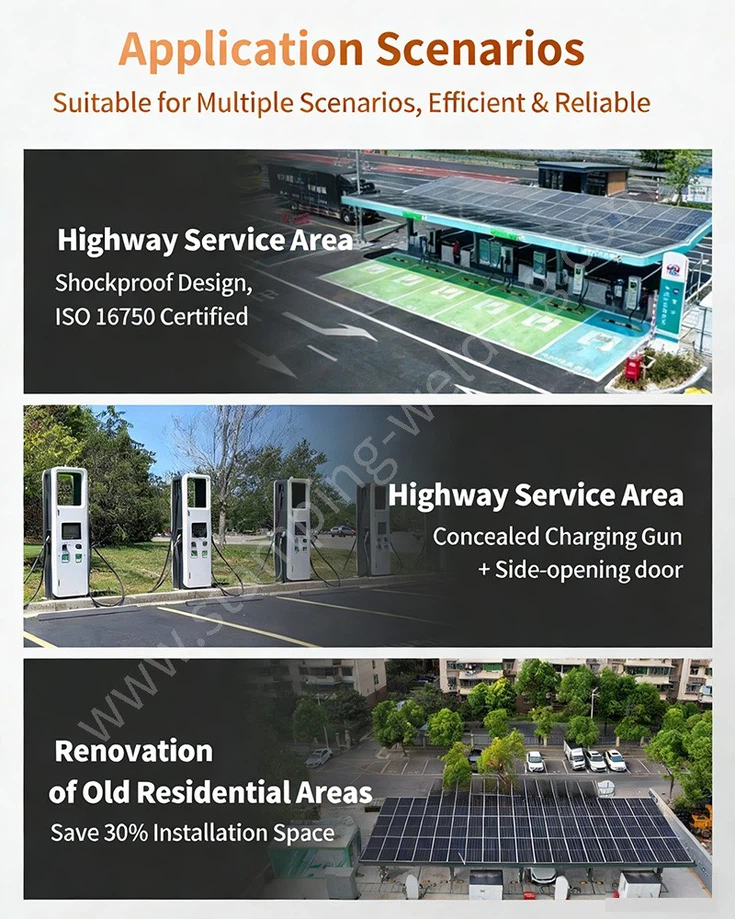
- Highway Network Support: Prioritize the deployment of base-mounted DC fast charging equipment in service areas along highways throughout the region, establishing a main charging network for long-distance travel. This will effectively alleviate range anxiety for new energy vehicle owners traveling long distances across cities and improve the charging infrastructure along trunk roads.
- Urban Hub Layout: Concentrate fast charging equipment in key areas such as core urban business districts, public parking lots, and transportation hubs to meet the high-frequency, short-term, and rapid charging needs of ride-hailing and logistics vehicles, ensuring the efficient and orderly flow of urban public transportation capacity.
- Community Integrated Support: New large-scale commercial and residential areas will have dedicated fast charging locations planned in advance, scientifically combined with existing slow charging spaces to form a complementary and comprehensive community charging system, aligning with the overall construction layout requirements of integrated urban and rural infrastructure.
Industry Trends
Industry infrastructure analysts indicate that urban and rural public charging networks will continue to expand and densify, with High-power DC charging fast chargers remaining the core and primary equipment for public energy replenishment. Leveraging multiple core advantages such as high-voltage direct charging, rapid energy replenishment, integrated and easy maintenance, and universal compatibility, coupled with standardized and collaborative backend energy storage cabinets, the integrated urban and rural new energy mobility energy replenishment ecosystem will be continuously improved, contributing to the stable and high-quality development of the entire automotive electrification industry.
Contact Us
If you have any needs for planning, equipment selection, and supporting solutions for High-power DC charging stations, you can contact our professional team at any time to obtain one-stop technical implementation support.