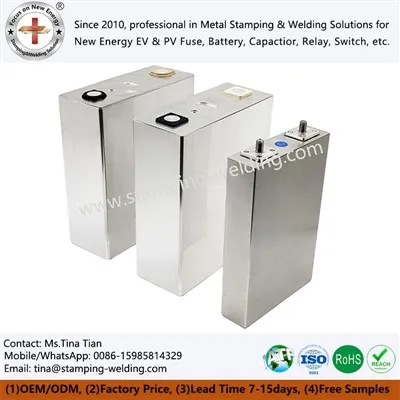


Prismatic Cell Aluminum Battery Case
The Prismatic Cell Aluminum Battery Case is a metal housing component designed for prismatic lithium-ion cells, providing a stable mechanical enclosure and external protection for the internal electrode assembly, electrolyte, and related structures. Unlike pouch cells, which utilize aluminum-plastic laminate packaging, prismatic cells employ a rigid metal casing; factors such as structural stability, dimensional consistency, weldability, and the quality of sealing interfaces directly impact subsequent cell assembly and battery system integration.
- Fast Delievery
- Quality Assurance
- 24/7 Customer Service
Product Introduction
The aluminum casing for prismatic lithium-ion batteries is essentially a precision deep-drawn metal housing, primarily consisting of the main body and a matching top cover assembly.
During the cell manufacturing process, internal components-such as electrode sheets and separators-must be securely positioned within the casing before subsequent steps like top cover attachment, electrolyte filling, sealing, and formation take place. Consequently, the aluminum casing serves not merely as a protective shell but as an integral part of the cell's structural system.
From an engineering procurement perspective, key considerations typically include:
Compatibility of casing dimensions with the cell design
Structural stability of the sidewalls and bottom following the deep-drawing process
Suitability of the casing edges for subsequent sealing/capping
Consistency in the machinability of welding zones
Adequacy of internal space for the assembly of cell components
Compliance of surface and internal conditions with cell manufacturing environment standards
Consistency in dimensions and appearance during mass production
Therefore, the design of the aluminum casing must be considered in tandem with the cell structure, rather than being developed in isolation based solely on external dimensions.

Detailed Inspection
Wall Thickness Distribution
Ultrasonic measurements along the sidewall height show no abnormal thinning at the corners or the bottom transition zone; the wall thickness profile is smooth, free from abrupt changes.
Opening
Clean trimming, controlled burrs, and compliant flatness; the welding surface is free of oil and oxidation discoloration, with surface energy (dyne levels) meeting requirements for coating and welding.
Internal Cavity
Smooth inner walls free of scoring or scratches-scratches on the inner wall can damage the separator or electrode sheets during insertion into the casing; this is a defect that should never occur yet is frequently overlooked.
Bottom
Flat and free of wrinkling; the exterior surface is free of dents or impact marks, with a continuous transition at the rounded corners.

Products Workshop
As an original manufacturer, we employ industry-leading progressive die continuous deep-drawing technology-a core competitive advantage in our production capabilities.
Unlike traditional single-stroke processes, which suffer from low efficiency and poor consistency, our multi-station progressive die system integrates over a dozen operations-including blanking, deep drawing, punching, and coining-into a single machine. This not only significantly boosts production efficiency but, more importantly, ensures that every casing is formed under identical thermal and mechanical conditions, thereby guaranteeing batch-to-batch consistency.
For post-production processing, we utilize a fully automated ultrasonic cleaning and vacuum drying line. Metal dust on the inner walls of aluminum casings poses a critical risk of short circuits in lithium batteries. Our cleaning process combines multi-stage pure water spraying with ultrasonic oscillation, followed by hot-air circulation drying in a cleanroom environment; this ensures the products meet the "dust-free, oil-free, and debris-free" cleanliness standards required for power battery applications. Finally, every casing undergoes comprehensive inspection using high-precision optical measuring equipment to eliminate any defective units that fall outside dimensional specifications.

FAQ
Q1. What material is used for the Prismatic Cell Aluminum Battery Case?
Aluminum alloy materials with excellent formability are typically used for prismatic lithium battery aluminum cases. Specific alloy grades are selected based on factors such as cell structure, deep-drawing requirements, strength, welding methods, and customer technical specifications.
Q2. Can the prismatic battery case be customized?
Yes. Apollo offers customization based on customer-provided 2D engineering drawings, 3D models, or cell dimension requirements. This includes specifications for case length, width, height, opening structure, bottom structure, and other forming features.
Q3. What manufacturing processes are used for aluminum battery cases?
Key processes include blanking, deep drawing, re-striking (forming), trimming, precision forming, and quality inspection. The specific process flow is adjusted based on case dimensions, material properties, and structural complexity.
Q4. Can the aluminum battery case be supplied for EV and ESS projects?
Yes. Products can be developed for applications such as power batteries for new energy vehicles, energy storage system (ESS) batteries, UPS units, and other prismatic lithium-ion battery projects. However, specific structural, material, and validation requirements must be confirmed based on the final application and customer technical specifications.
Q5. What information should be provided for a customized battery case quotation?
We recommend providing 2D drawings or 3D models of the battery case, material specifications, target dimensions, tolerance requirements, projected volume, and intended welding or assembly methods. If the product is still in the development stage, providing the cell structure and basic dimensions allows our engineering team to conduct a preliminary manufacturability assessment.

Contact us
If your project requires balancing Prismatic Cell Aluminum Battery Case structure compatibility, deep-draw forming, dimensional consistency, and subsequent welding and assembly, please send us your drawings or 3D models. Our engineering team will evaluate manufacturability-considering materials, tooling, and mass production processes-rather than simply comparing prices.

Hot Tags: Prismatic Cell Aluminum Battery Case, Prismatic Battery Aluminum Case, Lithium Battery Aluminum Shell, Prismatic Lithium Ion Battery Case, Aluminum Battery Cell Case