Resistance Spot Weld
Jul 24, 2023
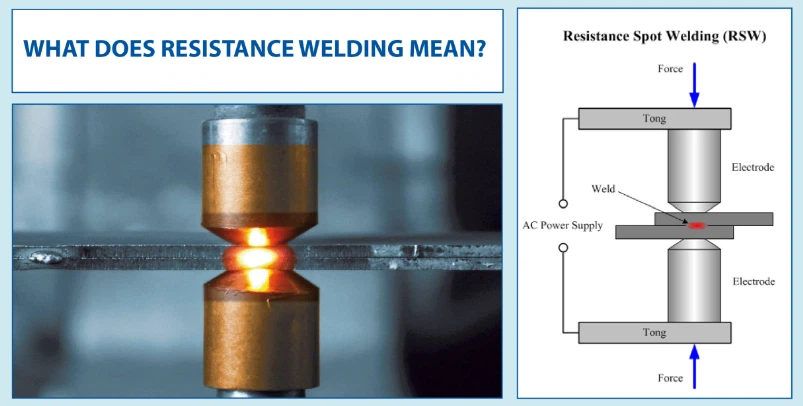
Resistance spot welding (RSW) is a widely used welding process employed in various industries, including automotive, aerospace, electronics, and manufacturing. It is a type of electric resistance welding that joins metal parts together by applying heat and pressure at localized points. The process is particularly suitable for joining thin sheet metals and is highly efficient, producing strong and consistent welds.
- Working principle
- Preparation: The metal pieces to be joined are first prepared by cleaning the surfaces to ensure proper contact and removing any contaminants. The thickness of the materials and the welding parameters determine the strength and quality of the resulting weld.
- Clamping: The two metal pieces are positioned precisely against each other and securely clamped between two copper alloy electrodes. The electrodes conduct the electric current and apply pressure during the welding process.
- Electrode Contact: When the welding cycle begins, the electric current flows through the electrodes and passes through the metal pieces at the desired welding points. As the current passes through the metals, a high amount of resistance generates localized heat at the contact points.
- Heat Generation: The resistance to the electric current causes the metals' temperature to rise rapidly at the welding points, leading to softening or melting of the metals. The heat is concentrated at the interface between the two metal pieces, and a small molten pool is formed.
- Pressure Application: Simultaneously, a controlled force is applied by the electrodes to ensure intimate contact between the molten metal surfaces. The pressure helps in forging and solidifying the weld joint.
- Cooling: After a specific welding time, the electric current is switched off, and the electrodes continue to apply pressure to allow the molten metal to solidify and form a strong bond. This cooling phase completes the welding process.
- Weld Evaluation: The resulting weld is usually a small, circular weld nugget at each welding point. The quality of the weld is assessed through non-destructive testing methods or destructive tests, depending on the application requirements.
- Advantages
- Speed and Efficiency: RSW is a high-speed welding process that can create welds in a fraction of a second. It is well-suited for mass production and assembly line applications, making it an efficient choice for joining large quantities of components.
- Consistent and Repeatable Results: The process is highly automated, ensuring consistent weld quality across multiple welds. This repeatability is essential in industries where uniformity and reliability are critical.
- No Filler Material Required: RSW does not use additional filler materials, fluxes, or shielding gases, which simplifies the welding process and reduces material costs.
- Minimal Heat Affected Zone (HAZ): Since the welding process is short and localized, the heat input is limited to the weld area, resulting in a small Heat Affected Zone (HAZ) compared to other welding methods. This reduces the risk of distortion or metallurgical changes in the surrounding material.
- Strong and Durable Joints: Resistance spot welds produce strong and durable joints that can withstand significant mechanical stress. The welds are typically as strong as the base metal and can meet the required load-bearing criteria.
- Applicable to a Wide Range of Metals: RSW can be used to join a variety of metals, including steel, aluminum, copper, brass, and their alloys. It is versatile and can accommodate different material combinations.
- Environmentally Friendly: RSW does not produce harmful fumes, gases, or arc radiation, making it a cleaner and safer welding process. This is especially important in industries where worker safety and environmental regulations are a concern.
- Automated Process Integration: RSW can be easily integrated into automated welding systems, allowing for seamless integration with robotic arms and other industrial automation equipment.
- No Post-Weld Cleanup: The absence of filler material and minimal spatter results in clean welds that require little to no post-weld cleanup.
- Cost-Effective: The combination of high welding speed, minimal material usage, and low post-welding costs contributes to the overall cost-effectiveness of the RSW process.
- Application
- Automotive Industry: RSW is extensively used in the automotive sector for joining various components, such as body panels, chassis, brackets, and reinforcements. It is a preferred method for creating strong and reliable welds in car bodies, as it allows for efficient mass production on assembly lines.
- Aerospace Industry: In the aerospace sector, RSW is used to join thin and lightweight materials like aluminum and titanium alloys. It is employed in the assembly of aircraft components, including fuselage sections, wing structures, and interior fittings.
- Electronics and Electrical Industry: RSW is commonly used in the electronics and electrical industries to create reliable connections for components like connectors, terminals, and busbars. It is employed in the manufacturing of electrical appliances, circuit boards, and power distribution systems.
- Sheet Metal Fabrication: RSW is widely utilized in sheet metal fabrication for a range of products, including cabinets, enclosures, HVAC components, and household appliances. It allows for quick and efficient assembly of sheet metal parts with strong welds.
- White Goods Manufacturing: The production of white goods such as refrigerators, washing machines, and ovens often involves RSW. It is used to join various metal parts, ensuring structural integrity and longevity of the appliances.
- Pipe and Tube Manufacturing: RSW is employed in the production of pipes and tubes, especially in the HVAC and plumbing industries. It enables the creation of leak-tight and robust joints for fluid-carrying systems.
- Railway Industry: In the railway sector, RSW is used for manufacturing train carriages and components like doors, panels, and frames. It ensures the structural integrity and safety of the rail vehicles.
- Metal Furniture Production: RSW is utilized in the production of metal furniture, including chairs, tables, and cabinets. It allows for rapid and strong assembly of metal components.
- Metal Containers and Drums: RSW is used in the manufacturing of metal containers and drums, ensuring secure and leak-proof joints for holding liquids or gases.
- Heat Exchangers: RSW is employed in the production of heat exchangers used in various industrial and commercial applications, including HVAC systems and refrigeration units.
- Battery Manufacturing: In the battery industry, RSW is used to assemble battery packs for various applications, including electric vehicles and energy storage systems.
However, RSW does have some limitations, primarily related to the thickness of the materials being welded and the need for proper electrode maintenance to ensure quality welds over time. Nevertheless, resistance spot welding remains a popular and efficient method for joining metals in various industrial applications.
Our company is focused on top quality Copper End Cap, Fuse Terminal Contacts, (ELECTRICAL VEHICLE) EV Film Capacitor BusBar, (SOLAR POWER) PV Inverter BusBar, Laminated BusBar, Aluminum Cases for new energy batteries, Copper/Brass/Aluminum/Stainless Steel Stamping Parts, and other electrical products Metal Stamping and Welding Assembly for over 18 years in China. We started as a small operation, but now have become one of the leading suppliers in the EV and PV industry in China.
If you have any needs, please feel free to contact us and we will reply as soon as possible!