A brief discussion on Power battery cover plate for new energy vehicles
Mar 04, 2026
Classification and composition of structural components for power batteries
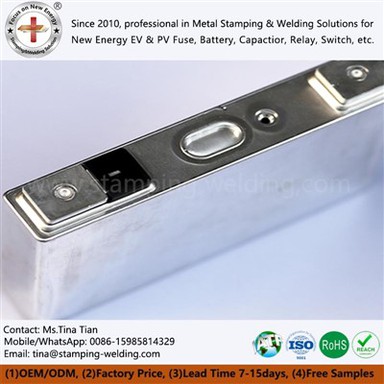
According to the different packaging forms, power batteries are mainly divided into three categories: cylindrical, square, and soft pack, and the corresponding structural components are also distinguished. Both cylindrical and square batteries belong to hard shell batteries, and their structural components are mainly composed of a shell and a Power battery cover plate; Soft pack batteries are mainly packaged with aluminum-plastic film. In mainstream industry applications, square batteries are widely used in the field of new energy vehicles due to their high space utilization, stable structure, and ease of grouping. A complete square battery is mainly composed of a Battery aluminum safety cover set, positive and negative electrode systems, insulation film, electrolyte, and battery housing. The top cover and housing are laser welded to form a closed cavity, providing a stable and reliable working environment for the internal battery cells.

Core structure composition of power battery cover plate
The square Aluminum cover plate for batteries is not a single component, but a functional assembly integrated from multiple precision parts, mainly including top cover plate, positive and negative pole columns, adapter plate, explosion-proof device, flip plate, sealing ring, and upper and lower plastic parts. These components are assembled and welded together through precision assembly, and then welded to the battery casing to form a complete battery structure. Lithium battery top cap integrates various functions such as mechanical protection, electrical connection, pressure control, safety protection, etc. in a limited space, and is one of the components with the highest technical requirements and strictest processing accuracy in battery structures.

Key components and functions of Prismatic lithium battery lid
The components of Prismatic lithium battery canopy have clear division of labor and work together to ensure the normal operation of the battery. The top cover and sealing ring are mainly responsible for sealing, forming a high-strength sealed structure with the shell through laser welding, protecting the internal battery cells and electrolyte from external environmental influences. The pole and adapter plate undertake the function of current conduction. On the one hand, they are welded to the internal pole ears to achieve charging and discharging of the battery cells. On the other hand, they are connected to the busbar when the batteries are grouped, forming a series parallel circuit.
The core function of the explosion-proof valve in Prismatic lithium battery annex is pressure release. When the internal pressure of the battery reaches a threshold, it automatically opens to release pressure, avoiding danger caused by continuous pressure rise. The flip chip serves as a fuse protection function, triggering an action when the internal air pressure rises abnormally, achieving short-circuit protection and cutting off the current, further enhancing the safety level. The upper and lower plastic parts are mainly used for insulation and anti-corrosion, reducing the potential difference and extending the battery life through material selection.
Technical Key Points and Development Trends
Among the structural components of hard shell batteries, Top lid for prismatic battery cells have the most outstanding technical content and safety level, among which explosion-proof valves and flip plates are key safety components with extremely high requirements for sensitivity, stability, and consistency. The cover plate has comprehensive functions such as current conduction, explosion-proof pressure relief, fuse protection, and anti-corrosion. The material system is also continuously upgrading, gradually transitioning from traditional stainless steel to high-performance materials such as copper aluminum composite.
As the core safety structure of Aluminum battery cover, explosion-proof valve usually controls its opening pressure in the range of 0.4~0.8MPa. The precision and stability of pressure opening are the core technical indicators for measuring the quality of the cover plate and the safety level of the battery, and also the key direction of industry manufacturing and research and development.
contact us
If you have any technical questions or cooperation needs in the production or selection of Power battery cover plates, please feel free to contact us at any time. We will provide you with professional technical support and customized solutions.