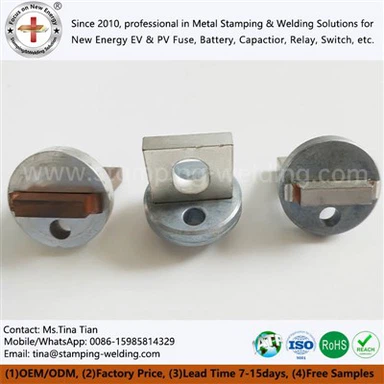
Analysis of Brass Sheet Metal Stamping Parts Forming Process
Apr 27, 2026
Brass plates are widely used in electronics, electrical appliances, hardware, decoration, machinery manufacturing and other fields due to their good ductility, electrical and thermal conductivity and corrosion resistance. Deep drawing forming is a key plastic forming technology in brass plate processing. It aims to transform the flat blank into an open hollow part or further change its shape and size through a mold under the action of a press. This article systematically analyzes the core links, technical points and influencing factors of this process.

The influence of brass material properties on technology
Brass is a copper-zinc alloy, and its processing performance is closely related to the composition and state of the alloy. Commonly used deep drawing brasses, such as H68 and H65 have a zinc content of about 30%-35% and have excellent cold working plasticity, making them the preferred material for deep drawing; leaded brass has good machinability but reduced deep drawing performance. The material state usually adopts a soft state (O state or M state) brass plate. After sufficient annealing, the grain structure is uniform, the yield strength is low, and the elongation is high, which is conducive to complex deformation. The deep drawing process requires the material to have a high strain hardening index and thickness anisotropy coefficient to facilitate uniform deformation and flow of flange material into the mold cavity and reduce thickness thinning. The surface of the blank should be smooth and clean, without defects such as scale and cracks, to prevent it from becoming a stress concentration point during the stamping process. As far as the Electrical Brass Switch Socket Part is concerned, a reasonable selection of material properties is the basis for ensuring molding quality.

Technology principles and processes
Deep drawing forming is essentially a material plastic flow process. The basic principle is to use a punch to press the flat blank into the cavity of the die, forcing the material to plastically deform under the combined action of radial tensile stress and tangential compressive stress to form the side wall, while the flange part of the blank gradually flows into the die, eventually forming a cup-shaped or shell part. A typical deep drawing process includes the following stages: In the initial stage, the punch contacts the center of the blank, causing bending and slight stretching in the middle of the billet; in the forming stage, the punch continues to move downward, the flange material flows toward the die hole, and the side wall gradually forms. The material flow is the most intense at this stage. Strong, the flange area is prone to wrinkles; at the end of the molding stage, the punch reaches the bottom dead center, the part is basically finalized, and the joint between the bottom of the side wall and the fillet of the punch becomes thinner most significantly, which is a potential rupture risk area; in the demoulding stage, the punch returns and the molded part is separated by the ejection device. For parts with large height or complex shape, multiple deep drawings are required, and annealing treatment is arranged between processes to restore the material's plasticity.
Process parameters and controls
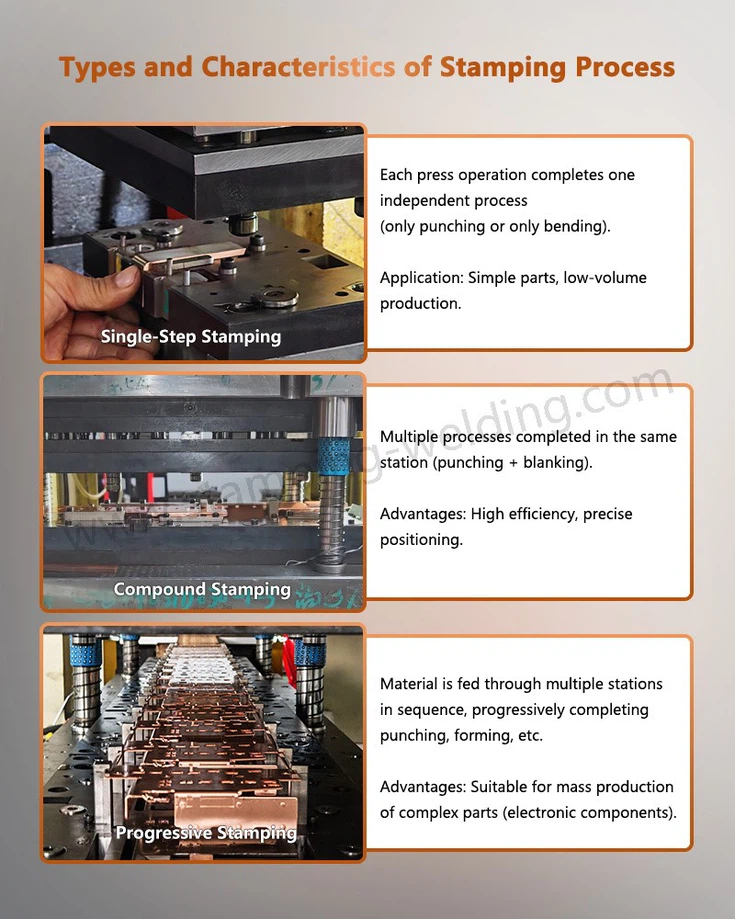
If the Sheet Metal Brass Stamping speed is too high, the deformation rate of the material will be accelerated, which may lead to a decrease in plasticity and dimensional instability. Brass can generally use a medium stamping speed. Good lubrication can significantly reduce the friction between the blank and the mold, reduce tensile stress, and improve the uniformity of material flow. Special stamping oil or emulsion suitable for copper alloys can be selected. The size of the blank is calculated and determined based on the principle of constant volume of the part, and the trimming allowance is taken into consideration. Between multiple passes of deep drawing, due to cold work hardening of the material, intermediate recrystallization annealing needs to be arranged to eliminate work hardening and restore plasticity. At the same time, temperature and time need to be controlled to prevent excessive grain growth. In the production of products such as Electrical Brass Press Parts For Switch Socket, fine control of process parameters is particularly critical.

contact us
Relying on the in-depth understanding and long-term practice of the Brass Sheet Metal Stamping Parts forming process, our products strictly follow the process specifications and implement systematic management from material selection, mold design to stamping parameter control. We are committed to providing reliable and precise brass stamping solutions for electrical fields such as switches, sockets, and relay connectors.