Complete analysis of core knowledge of Electrical system cabinet for high-voltage switchgear, ring main unit and central cabinet
Apr 08, 2026
The core positioning and industry value of Electrical system cabinet
Among the three major disciplines of mechanical and electrical engineering (water, heat, and electricity), electrical engineering has distinct characteristics. The core equipment of the water supply and heating industry mainly relies on power devices such as water pumps and fans, which transmit matter and energy through pressure; The five major links of electrical engineering, namely transmission, transformation, distribution, and consumption, all rely on various Outdoor weatherproof enclosure cabinet boxes (also known as "boxes" or "enclosures" depending on their size) in practical applications. Especially in the power distribution and consumption process, electrical cabinets play a core load-bearing role, forming a pattern of "no cabinet, no system".
Various Outdoor electrical cabinets form a complex power distribution system that delivers electrical energy to various end users. For non electrical professionals, outdoor rainproof cabinets are only presented in the form of component combinations or boxes on the drawings, which creates a certain sense of mystery; But for electrical professionals, the electrical equipment, components, and circuit structure inside the cabinet are the core, and the cabinet itself mainly undertakes installation and support functions.
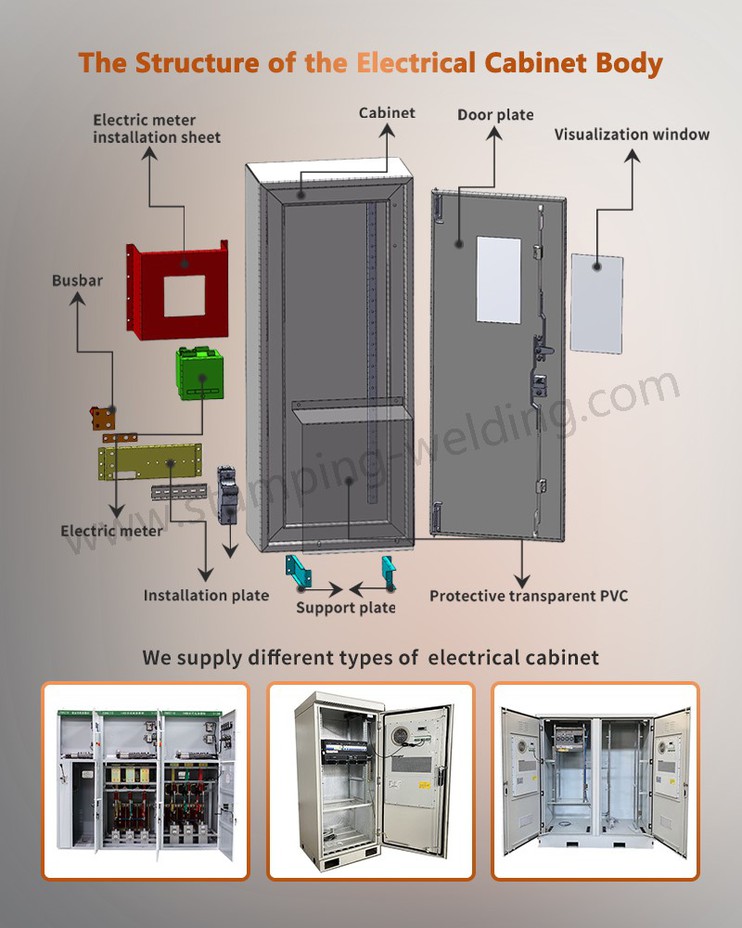
With the development of technology, the Electrical enclosure cabinet, as a key carrier for fully integrated electrical systems, is endowed with more functions. Except for the core components of the main circuit, auxiliary components, control circuits, secondary monitoring devices, etc. must be uniformly configured by the complete cabinet manufacturer to ensure the integrity of the electrical system. Therefore, mastering the names, functions, and characteristics of various complete sets of electrical cabinets is the key to avoiding confusion in use and preventing safety hazards.

High voltage switchgear: classification and core definition
High voltage switchgear is a general term in the field of high voltage (medium voltage) power supply and distribution, covering various types of high/medium voltage distribution and breaking equipment, including ring main units, central cabinets (mid mounted cabinets), high voltage incoming cabinets, high voltage outgoing cabinets, etc. The core commonality of this Electrical system cabinet is the control of the on/off function of high and medium voltage circuits, which occupies a core position in the power supply and distribution system.
According to the structural form, high-voltage switchgear is mainly divided into fixed and mid mounted types. Among them, fixed type (such as GG-1A type) is gradually being replaced by mid mounted metal enclosed switchgear (such as KYN-18 series), which is widely used due to its excellent mechanical performance and high safety and reliability.
Electrical cabinet outdoor with different structures are suitable for different installation scenarios and usage requirements. In practical applications, high-voltage switchgear and ring main unit usually focus on power distribution functions, while mid mounted cabinets (also known as handcart cabinets) focus on load protection. The three types of cabinets have clear division of labor to jointly ensure the stable operation of the power supply and distribution system.

Mid mounted cabinet: core parameters and structural characteristics
Mid mounted switchgear, also known as metal armored mid mounted withdrawable switchgear, belongs to high-voltage distribution equipment. As an important type of high-voltage Electrical cabinet assembly, its maximum operating voltage is 3.6/7.2/12kV, suitable for indoor full distribution of three-phase AC 50Hz, single bus segmented or double bus segmented systems. Mainly used for transmission of small and medium-sized generators in power plants, transmission of secondary substations in power systems, power distribution in industrial and mining enterprises and municipal areas, as well as start-up of large high-voltage motors. Common models include KYN28, KYN18, KYN61, etc.
Its core structural feature is a three-layer design: the upper layer is the busbar room and instrument room (isolated from each other), the middle layer is the circuit breaker room, and the lower layer is the cable room. Named after the circuit breaker located in the middle layer, it facilitates the operation and maintenance of Power control cabinet.
The central cabinet is divided into high and low structures and equal height structures: the high and low structures have a front height of 2300mm and a rear height of 1920mm, with busbars arranged in a cross shape and a detachable instrument room; The height of the structure is consistent before and after, and the busbars are arranged vertically and in a straight line. The instrument room is integrated with the Metal electrical cabinet, providing a larger installation space and facilitating production and operation.
The prominent feature of the current central cabinet is the configuration of a microcomputer protection device, which integrates protection, measurement, monitoring, communication and other functions. It adopts a modular design and can replace traditional relays and measuring instruments, simplify secondary design and construction, save installation space and control cables, and significantly improve the intelligence level of the electrical cabinet.
The core difference between central cabinet and high-voltage switchgear
Although there are intersections between mid mounted cabinets and common high-voltage switchgear, their application scenarios and functional positioning have their own focuses, and Electrical control cabinets need to be selected reasonably according to actual needs. The differences are mainly reflected in the following five aspects:
Firstly, the meanings are different. Mid mounted switchgear specifically refers to armored removable mid mounted metal enclosed switchgear, while high-voltage switchgear is a general term for electrical products with a working voltage of 3.6kV to 550kV, used for the on/off, control, and protection of power systems, with a wider range.
Secondly, the fixed method is different from the switch characteristics. The central cabinet is a detachable circuit breaker (handcart type), while the high-voltage switchgear is mostly a fixed load switch.
Thirdly, the functions are different. The central cabinet focuses on high-voltage load protection, used to protect the back-end transformer and high-voltage load; High voltage switchgear is mainly used for high-voltage distribution, distributing one or two high-voltage power sources into multiple outgoing lines. The two functions complement each other and work together.
Fourthly, the structure is different. The central cabinet adopts a three-layer partition structure, and most high-voltage switchgear is connected to copper busbars through ordinary SF6 load switches to form a system.
Fifth, there are different forms of existence. High voltage switchgear has two forms: air insulated and fully enclosed gas filled cabinets. The fully enclosed gas filled cabinets are connected to each other in a complete gas chamber filled with SF6 gas, and there are no exposed live parts except for special connectors for incoming and outgoing lines.
In summary, although the three types of equipment belong to the category of high-voltage External electrical cabinets, each has its own emphasis and needs to be selected reasonably according to actual working conditions.
Contact us
If you need to further understand the selection scheme and technical parameters of high-voltage switchgear, ring main unit and central cabinet, please feel free to contact us at any time. We will provide you with professional complete Electrical system cabinet configuration suggestions and technical support.