Copper Cap for In-line PV Fuse: a core component for DC protection of photovoltaic systems
Mar 21, 2026
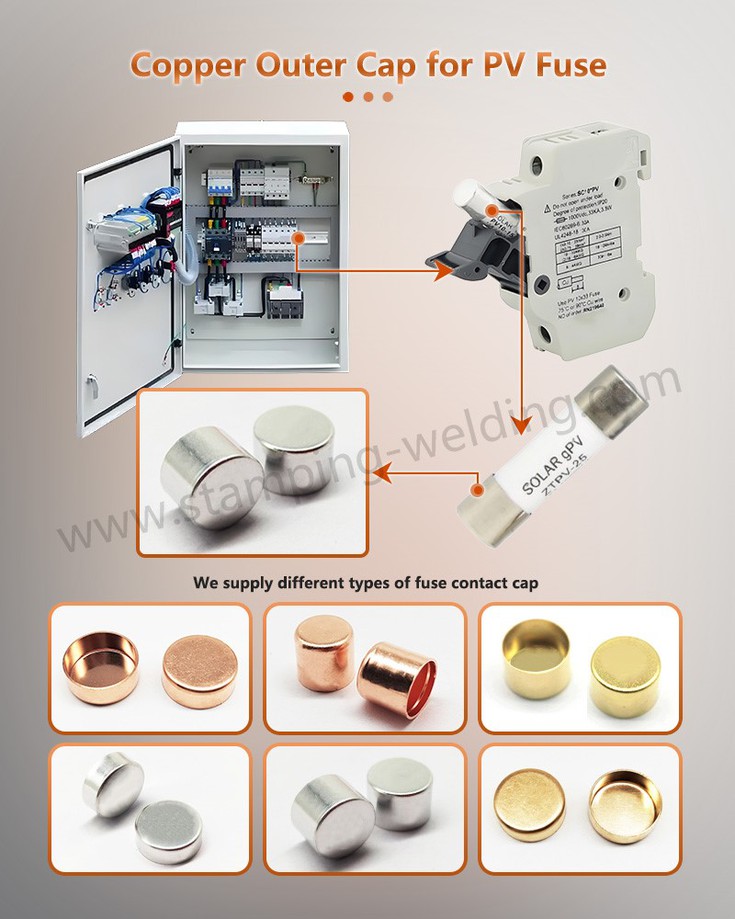
With the continued growth of the global photovoltaic industry, the demand for safety protection of photovoltaic systems is becoming increasingly prominent. As a DC current protection device specifically designed for solar photovoltaic systems, the integrated photovoltaic cap fuse is playing an increasingly important role. Also known as the Copper Cap for In-line PV Fuse, its core advantage lies in its integrated structural design, organically combining the traditional fuse element with the contact cap (end cap). This completely breaks the limitations of traditional modular structures, making it an indispensable protective component in core equipment such as photovoltaic combiner boxes and inverters. It effectively protects photovoltaic modules, cables, and related equipment from damage caused by overload and short-circuit currents, building a solid safety barrier for the stable operation of photovoltaic systems.

Core Advantages: Breakthroughs in both Design and Performance
Compared to traditional protective components, the core competitiveness of integrated photovoltaic (PV) end cap fuses lies in their unique product design and superior performance. Their integrated cap design eliminates any joints at the connection between the contact cap and the fuse tube. This design not only significantly reduces contact resistance and improves conductivity but also facilitates wire crimping or sheathing. The key component, the Copper End Cap, provides robust support for this stable performance. In terms of voltage adaptation, these fuses typically support DC voltages up to 1500V, perfectly meeting the operational requirements of modern high-voltage PV systems. Simultaneously, their compact design allows for enhanced current protection within a smaller space, greatly improving the flexibility of PV system design.
Environmental adaptability and multiple security features
Considering that photovoltaic systems are mostly deployed outdoors, the integrated photovoltaic fuse has been specifically optimized for environmental tolerance, easily withstanding severe temperature fluctuations from -40°C to +80°C, while also possessing excellent UV resistance, making it suitable for various harsh outdoor conditions. Its functions cover multiple key aspects of the safe operation of photovoltaic systems. When a photovoltaic string malfunctions and generates an abnormally large current, the fuse element inside can quickly melt using its own heat, achieving efficient overcurrent protection. In multi-string systems, if a sub-array fails, the fuse can quickly isolate the faulty section, ensuring that the remaining normal photovoltaic arrays continue to generate electricity, effectively preventing the accident from escalating and causing a fire. Furthermore, it can also provide reverse current protection, preventing current from flowing back from the normal strings in multiple parallel strings to the faulty strings.

Application scenarios and industry standards and specifications
From the perspective of application scenarios and industry standards, integrated photovoltaic (PV) cap fuses are mainly installed inside PV combiner boxes, connected to the output terminal of each solar panel string, and are a critical node for PV system circuit protection. According to the IEC 60269-6 international standard, these fuses are typically marked as gPV, indicating that they have full-range DC breaking capacity and are protective devices specifically tailored for solar PV systems. It is worth noting that with the technological upgrade of the PV industry, related Copper Cap products are also constantly being optimized. Customized products such as Custom Copper Caps are gradually becoming a market hotspot, better adapting to the personalized needs of different PV system specifications, and further promoting the refined development of the PV protection field.
Market Outlook: Rising Demand Boosts Industry Development
Currently, the global photovoltaic (PV) market continues to expand. According to QYResearch data, the PV fuse market is projected to reach $2263 million by 2032, with a compound annual growth rate of 6.5%. As a core product in this niche market, Copper Cap for In-line PV Fuse are experiencing continuously rising market demand. Leveraging their integrated design, high voltage support, and strong environmental tolerance, combined with the performance support of key components such as the Copper End Cap, they not only meet the safety protection needs of modern PV systems but also provide crucial support for the high-quality development of the PV industry. In the future, with the iteration of PV technology, they are expected to play a more significant role in various niche applications.
contact us
If you would like to learn more about Copper Cap for In-line PV Fuse and related Copper Cap products, as well as customized solutions, please feel free to contact us for professional product consultation and technical support.