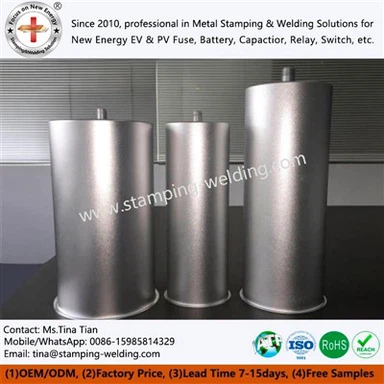
In-depth analysis of the core component of high-voltage circuits in new energy vehicles: the Copper Cap Contact for Electric Vehicle Fuse
Mar 15, 2026
Against the backdrop of the rapid technological evolution of new energy vehicles towards higher voltage and higher current, the Copper Cap Contact for Electric Vehicle Fuse, as a key structural component inside high-voltage fuses, directly affects the reliability and safety of the vehicle's circuit protection. The contact cap assembly typically consists of a contact, a cap body, and connecting components, undertaking multiple functions such as conductive introduction, structural sealing, and mechanical support. It is the core interface for energy exchange between the fuse and the external high-voltage system. With the mass production of 800V high-voltage platform vehicles, unprecedentedly stringent requirements have been placed on the material system, manufacturing precision, and environmental adaptability of this component.

Definition and Structural Composition
In electric vehicle fuses, the contact cap assembly plays a dual role as both a "current gateway" and a "structural end cap." Physically, a Copper Cap Contact for Electric Vehicle Fuse typically consists of three core parts: the contact blade, serving as the conductive lead-in end, uses a high-purity copper substrate with a silver-plated surface to ensure extremely low contact resistance and temperature rise under high current conditions; the cap body, acting as the encapsulation end cap, tightly nests within the ends of the insulating tube to form a sealed cavity, preventing leakage of the internal arc-quenching medium; and the connecting plate or bracket is responsible for reliably fixing the contact blade to the cap body, maintaining structural integrity under short-circuit impacts. In high-voltage power distribution systems, the design of the Cap and Contact for Electric Vehicle Fuses must comprehensively consider the balance between conductive cross-section, creepage distance, and mechanical strength. The contact blade cross-section is optimized through thermal simulation based on the rated current, and the fit between the cap body and the insulating tube must be verified through airtightness testing. For fuses used inside battery packs, the Cap and Contact for Battery Pack Fuse must also meet IP67 or higher dust and water resistance requirements.

Technical challenges and performance requirements
The operating conditions of new energy vehicles place stringent requirements on contact cap assemblies that exceed those of traditional industrial fuses. In applications such as Copper Cap Contact for High Voltage Low Current EV Fuse, system voltages can reach 800V to 1000V, posing challenges to the design of electrical clearances and creepage distances between contacts. Simultaneously, the anti-sulfurization and anti-oxidation performance of the silver plating layer within the sealed space of the battery pack requires close attention to prevent increased contact resistance. Thermal management is a core design consideration. Under fast charging conditions, Copper Cap Contact for Electric Car Fuse must withstand current surges several times its rated current, making heat accumulation at the contact-bus connection point easy. Increasing the cross-sectional area or optimizing the path is necessary to reduce temperature rise. Furthermore, vibration reliability is equally critical. Cap and Contact for Fast Acting EV Fuse must withstand random vibrations throughout its entire lifespan, and connection points must be optimized through fatigue analysis to prevent stress cracking.
Industry standards and testing verification
The performance verification of the contact cap assembly must comply with international and national industry standards such as ISO 8820 and GB/T 31465, which clearly stipulate key indicators such as tensile strength, bending durability, vibration reliability, power frequency withstand voltage, and insulation resistance. In actual testing, the temperature rise test must be conducted at rated current and 1.35 times the overload current to ensure that the temperature at the monitoring point is below the material limit; the temperature cycling test repeatedly verifies the thermal stability of the connection interface within the range of -40℃ to 125℃; the vibration test simulates the actual vehicle road spectrum by applying triaxial random loads and dynamically monitors the fluctuation amplitude of contact resistance to ensure that it is always controlled within the specified threshold.
in conclusion
With the continuous upgrading and increasing integration of voltage platforms in new energy vehicles, the contact cap assembly, as the core carrier of high-voltage fuses, is evolving towards higher current carrying capacity, better thermal management, and longer service life. Mastering the technical aspects and selection logic of this key component can not only help electrical engineers avoid safety risks caused by connection failures, but also provide solid underlying support for the reliability design of the entire vehicle's high-voltage system.
contact us
If you have any needs for purchasing, customizing, or technical consulting for the Copper Cap Contact for Electric Vehicle Fuse mentioned in this article, please feel free to contact us at any time to obtain professional support and targeted solutions.