


Analysis of the technology and application of the Fuse End Blade Ferrules, the core conductive component of the fuse
Mar 15, 2026
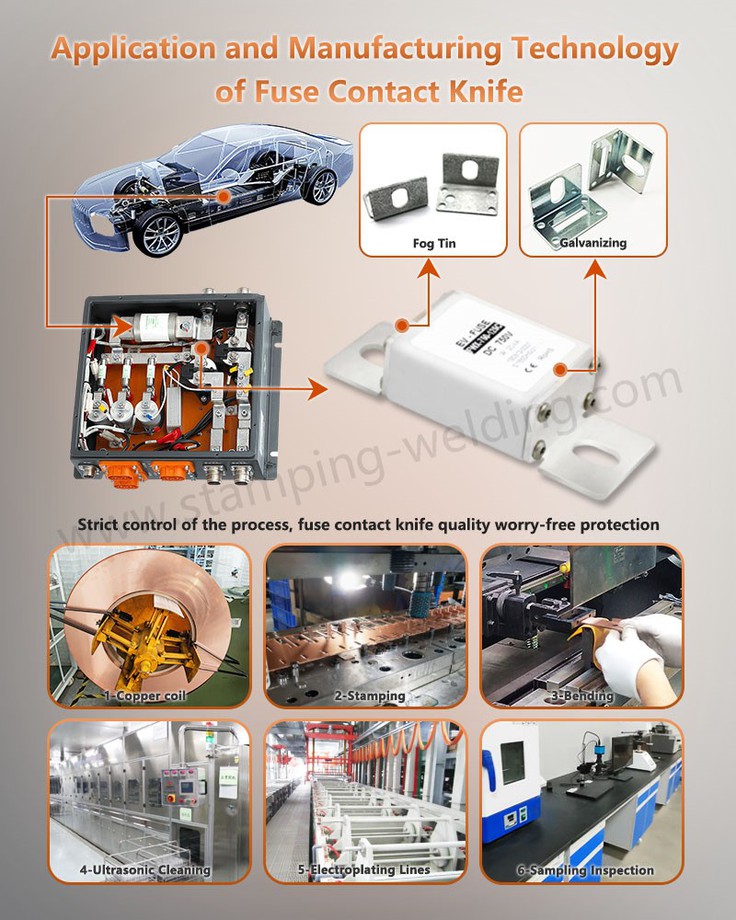
Within the protection systems for new energy power and industrial electrical circuits, the core performance of fuses relies heavily on the quality of their internal critical conductive parts. As an irreplaceable core component, Fuse End Blade Ferrules undertake the dual tasks of maintaining stable circuit connectivity and delivering safety protection, also serving as high-profile precision conductive fittings in modern high-voltage electrical applications. Defined by industrial standards, these end blades are not generic conductive connectors, but dedicated components tailored exclusively for circuit protection devices; particularly for EV and HEV new energy vehicle applications, they stand as a key part that defines the overall reliability of the assembly. Paired dedicated conductive structures work in tandem with these end blades to fulfil circuit connection and overload protection functions efficiently.

Structural Design: Advantages of L-shaped Configuration and Fixed Equipment
This core component adopts a classic L-type terminal structure design, which differs from conventional industrial conductive contacts. Its unique shape and layout enable a more robust electrical connection, ensuring efficient and smooth current transmission when the circuit is normally closed. In the event of overload, short circuit, or other abnormal conditions, it can quickly work with the fuse to cut off the circuit, fundamentally preventing safety risks such as equipment burnout and circuit failure. Simultaneously, the Securing Lug (Fixing Slot) structure and the customized Copper Securing Lug (Fixing Slot) design further enhance the stability of the component's installation and fixation, adapting to the long-term operational needs under various complex conditions. This is also a key supporting structure for the Fuse Terminal Contact to achieve long-term stable conductivity.

Material and Process: Copper-based Material Selection and Surface Treatment Standards
In terms of materials and manufacturing processes, the Fuse End Blade Ferrules and related conductive accessories are consistently developed and produced with high conductivity and low contact resistance as the core requirements. Mainstream products use high-purity pure copper or copper alloys as the base material, resulting in a variety of copper core accessories such as Fuse Link Contact Copper, End Blade Ferrules Copper, and End Tag Copper. They also cover a full range of copper-based conductive components, including Copper Electrical Contacts and Copper Sheet Fuse Parts, comprehensively ensuring basic conductivity. To further optimize performance, these components are often tin-plated or silver-plated. Silver Plated Copper Contacts and Silver Plated Brass Contacts, with their excellent oxidation resistance and lower contact resistance, are the preferred solutions for high-voltage and high-protection applications. They are processed entirely through precision metal stamping and bending processes to ensure dimensional accuracy and structural strength meet standards.
Application scenarios: covering new energy and industrial electrical fields
Leveraging its robust technical parameters and structural characteristics, the contact blade and its accompanying Fuse End Tag are applicable to a wide range of demanding electrical fields, becoming a core standard component in green energy and industrial electrical equipment. In the new energy vehicle sector, it is primarily used for circuit protection of battery packs, drive motors, and power conversion devices, adapting to the harsh vibration and shock environments of vehicles. In photovoltaic (PV) systems, it provides circuit protection for photovoltaic panels and energy storage charging facilities, adapting to high-voltage DC conditions. It is also widely used in various distribution cabinets as the moving contact of disconnect switches and knife switches, providing a clearly visible circuit disconnection point and meeting industrial operation and maintenance safety standards.
contact us
In actual engineering applications, the structural selection, material ratio, and process customization of the Fuse End Blade Ferrules must be precisely matched to the on-site working conditions. Only by optimizing a customized solution can the long-term stability of the circuit system be guaranteed. You are welcome to contact us for customized products and professional technical support.


