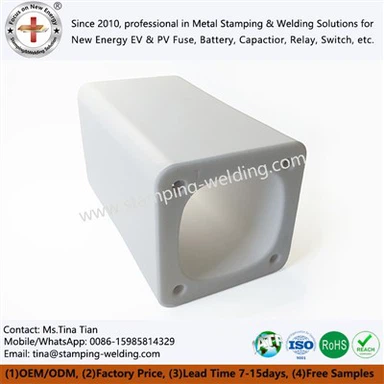
Deep Dive into the Industry: Air Cooled Capacitor Aluminium Can Technology Explained
Dec 12, 2025
In modern power electronics and industrial control systems, Air Cooled Capacitor Aluminium Can plays an essential role as a core power component. Whether used for power filtering, DC link energy storage, or high-voltage power conversion systems, these capacitors are favored in the industry for their high capacitance density, effective heat dissipation, and cost efficiency.

Core Materials and Manufacturing Process
Key Materials Overview
- An Cylindrical Aluminium Can Energy storage pulse filter capacitor relies on high-quality materials and precise manufacturing techniques to ensure performance:
- High-Purity Aluminum Foil – Etched to increase surface area and form the anode and cathode electrodes.
- Aluminum Oxide Dielectric Layer – Created by anodizing the aluminum, this thin layer serves as the capacitor's dielectric.
- Electrolyte and Separator Paper – Facilitate conduction and ensure electrode contact.
- Aluminium Can for High Voltage Film Capacitors Casing and Seals – Provide effective shielding, environmental protection, and thermal conductivity.
Critical Manufacturing Steps
- The typical production process of an Aluminium Can for Metalized Film DC Filter Capacitors includes:
- Foil Etching and Oxidation – Increasing surface roughness and forming the dielectric layer.
- Electrode Winding – Interleaving the anode foil, separator, and cathode foil.
- Electrolyte Impregnation – Immersing the wound element in electrolyte.
- Metalized Film Cylindrical AC Shunt Capacitor Aluminium Can Canning and Sealing – Placing the assembly into the aluminum can and sealing it to complete the product.

Typical Applications
Power Systems and Power Supplies
In power conversion equipment, an Water Cooled Capacitors Aluminium Can is widely used for:
DC Link Capacitors – Storing energy and absorbing ripple to stabilize the DC bus.
Filtering and Voltage Regulation – Reducing voltage ripple and improving overall power quality.
Industrial Automation and Control
Industrial controllers, PLCs, variable frequency drives, and servo systems often employ Aluminium Can for Metalized Film Cylindrical AC Shunt Capacitor components to ensure reliable operation of both control logic and power stages.
Renewable Energy and Transportation
In renewable energy systems and rail transit power electronics, AC Safety Capacitors Aluminium Can devices serve as high-capacity energy storage units within inverters, photovoltaic converters, and charging infrastructure, where large energy throughput and durability are required.

Visual Reference Suggestions
To support GE Protective Capacitors Aluminium Can with illustrative content, consider pairing these visuals with the corresponding sections:
Material and Structure
Cylindrical Aluminium Can Energy storage pulse filter capacitor's Aluminum foil with etched surface microstructure.
Cross-section of dielectric oxide layer and separator.
Production Line Images
Industrial foil etching and oxidation station.
Winding and assembly Aluminium Can for High Voltage Film Capacitors processes for capacitor elements.
Application Scenarios
Aluminium Can for Metalized Film DC Filter Capacitors' DC link module within a power converter.
Air-cooled capacitor banks in renewable energy inverters.
Industrial drive units showing integrated capacitors.

Conclusion
As a fundamental component in power electronics, the Air Cooled Capacitor Aluminium Can combines high capacitance density, excellent heat dissipation capability, and cost effectiveness to meet the needs of modern high-power systems. Its applications span from power supplies and industrial controls to renewable energy and transportation infrastructure, making it a crucial element in reliable and efficient electrical systems. Understanding its materials, manufacturing processes, and performance advantages provides valuable insight for engineers, designers, and technical decision makers in the industry.
contact us