Detailed explanation of brass stamping technology
May 23, 2026
Brass is a binary alloy with copper and zinc as its basic components. In actual industrial applications, small amounts of other elements are often added to improve specific properties. Copper content typically fluctuates between 60% and 95%, with corresponding zinc content ranging from 5% to 40%. As the zinc content increases, the strength and hardness of brass show an upward trend, while the plasticity first increases and then decreases when the zinc content is about 30% (the famous 73 brass), the alloy obtains the best room temperature plastic fit and is suitable for deep stamping and complex forming processing. The crystal structure of brass changes as the composition changes: when the zinc content is less than 35%, it is a single α phase with a face-centered cubic structure and has good cold working properties; when the zinc content is between 35% and 45%, it is an α+β dual-phase structure. The β phase has good thermoplasticity at high temperatures and is suitable for hot extrusion and hot forging. The electrical conductivity of brass is about 25% to 45% of that of pure copper and decreases as the zinc content increases, but its tensile strength can be more than twice that of pure copper. For electrical applications that require both electrical conductivity and mechanical strength, Silver Plated Brass Terminal uses brass as the base material and uses silver plating on the surface to obtain low contact resistance. At the same time, the high strength of brass is used to ensure the rigidity of the terminal structure.
Material characteristics
Brass is regarded as a material with good processing adaptability in the field of metal stamping, which is due to its comprehensive performance of multiple physical and mechanical properties. Excellent cold forming performance: The elongation of brass can reach 40% to 60% in the annealed state, which is much higher than the work hardening rate of copper. This characteristic allows brass to withstand large deformations in a single stamping process without cracking, and is particularly suitable for the forming of deep drawing, multi-bending and complex curved surface parts. Compared with copper, brass has a lower tendency to adhere to the mold during the stamping process and produces less built-up edge, which helps maintain the smoothness and dimensional stability of the working surface of the mold.
Moderate strength and hardness: The hardness of brass is about 60 to 90HBS in the annealed state, and can be increased to more than 150HBS after cold work hardening. This controllable mechanical property enables it to not only meet the stamping requirements of complex shapes, but also obtain the required stiffness of the final part by controlling the degree of work hardening. For copper stamping parts that need to withstand certain mechanical loads - such as elastic clamping structures in switch sockets - the strength properties of brass allow them to directly meet the usage requirements without additional heat treatment. Good corrosion resistance: Brass shows good corrosion resistance in the atmosphere, fresh water and a variety of weak acid and weak alkali environments, thanks to its ability to form a dense oxidation protective film on its surface. For brass with a high zinc content, it should be noted that "dezincification corrosion" may occur in certain humid environments - that is, zinc is preferentially eroded and leaves a porous copper-rich layer. Dezincification corrosion can be effectively inhibited by adding trace amounts of arsenic, antimony or phosphorus, and is suitable for brass stampings in sanitary ware and marine environments.
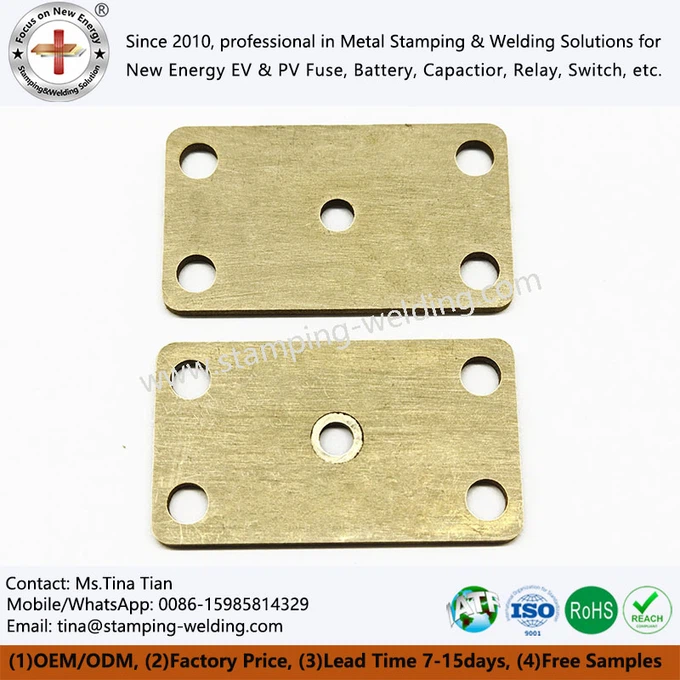
Excellent cutting and connecting performance: Brass has high cutting efficiency, and the chips are in the shape of chips rather than long rolls, and are not easy to wrap around the tool. Brass shows good connection adaptability during subsequent welding, soldering and riveting processes. These properties make it an ideal base material for manufacturing multi-process composite parts. After stamping, it can be directly entered into the assembly process without the need for extensive secondary processing. In the production of Brass Sheet Metal Stamping, the choice of material state is the key to the success or failure of the process - annealed (soft) brass is suitable for deep drawing parts with high deformation, semi-hard brass is suitable for general bent parts and blanking parts, and hard brass is usually only used for flat blanking parts that do not require forming or blanks as elastic components.

Application scenarios
Brass stamping parts are used throughout many industrial fields such as electrical, construction, automotive and communications. Electrical and electronics industry: Conductive components in wall switches and sockets - including sockets, clips, terminal blocks and converter springs - are one of the most concentrated application areas for brass stampings. Brass assumes the dual tasks of current transmission and elastic clamping in such scenarios: its conductive properties meet the temperature rise requirements under rated current, while its elastic modulus and stress relaxation resistance ensure the plugging and unplugging life. In industrial connectors, brass stamped terminals and contacts need to meet the contact force maintenance requirements after multiple plugging and unplugging, and the surface is usually tin-plated or silver-plated to optimize the contact interface. In the design of Electrical Brass Switch Socket Part, the collaborative optimization of material thickness, bending fillet and contact pressure is the core to ensure that the product passes the durability test.
Construction and sanitary ware industry: Door handles, lock cores, hinges, faucet valve cores, shower components and other building hardware are largely manufactured using brass stamping processes. The golden color of brass gives it an aesthetic advantage in exposed decorative parts, while its corrosion resistance and antibacterial properties make it suitable for bathroom scenarios in contact with water. For architectural hardware with complex shapes, stamping is often combined with subsequent polishing and electroplating processes to obtain mirror or brushed surface effects. Automobile industry: Sensor housings, solenoid valve parts, fuse box terminals, air conditioning pipe joints and small structural parts in door lock mechanisms in automobiles can all be formed by brass stamping. Automotive applications have high requirements on the temperature resistance, vibration resistance and long-term reliability of brass stamping parts. Specific grades of brass are usually selected - such as lead brass to improve machinability, or aluminum brass to improve corrosion resistance. In new energy vehicles, brass stamping parts are also widely used in the signal terminals and low-voltage connectors in the charging interface.
Communications and industrial equipment: Ground shrapnel in radio frequency connectors, fixed buckles of shielding covers, wiring strips in industrial control cabinets, pointer bushings and gear brackets in instruments and meters, etc., all belong to the application scope of brass stamping parts. These parts tend to be small in size and have strict tolerances, which impose higher requirements on mold accuracy and stamping process stability. The core challenge of Customized Brass Stamping Contact Parts For Wall Socket Plug products is to ensure that the mechanical properties of the contact piece (such as insertion and extraction force, contact resistance) comply with the design specifications while maintaining batch consistency, which requires precise control of the material's hardness range, mold wear compensation, and stamping speed.

Processing process
The manufacturing characteristics of brass stamping parts are concentrated in three dimensions: precision level, production efficiency and customization capabilities. Dimensional accuracy and consistency: Under reasonable mold design and process control, brass stamping parts can achieve high dimensional accuracy. The linear tolerance of blanking parts can usually reach IT10 to IT11 level, the angular tolerance of bent parts can reach ±0.5° to ±1°, and the wall thickness deviation of deep drawn parts can be controlled within ±10% of the plate thickness. In mass production, statistical process control methods are used to monitor the fluctuation trend of critical dimensions, which can provide timely warning and adjustment when process parameters drift, ensuring consistency within and between batches. For precision electronic brass stamping parts, the tolerance requirements for some key dimensions even reach ±0.01 mm, which requires the stamping equipment to have good rigidity, the mold to adopt a precision guide mechanism, and to be produced in a high-precision constant temperature environment.
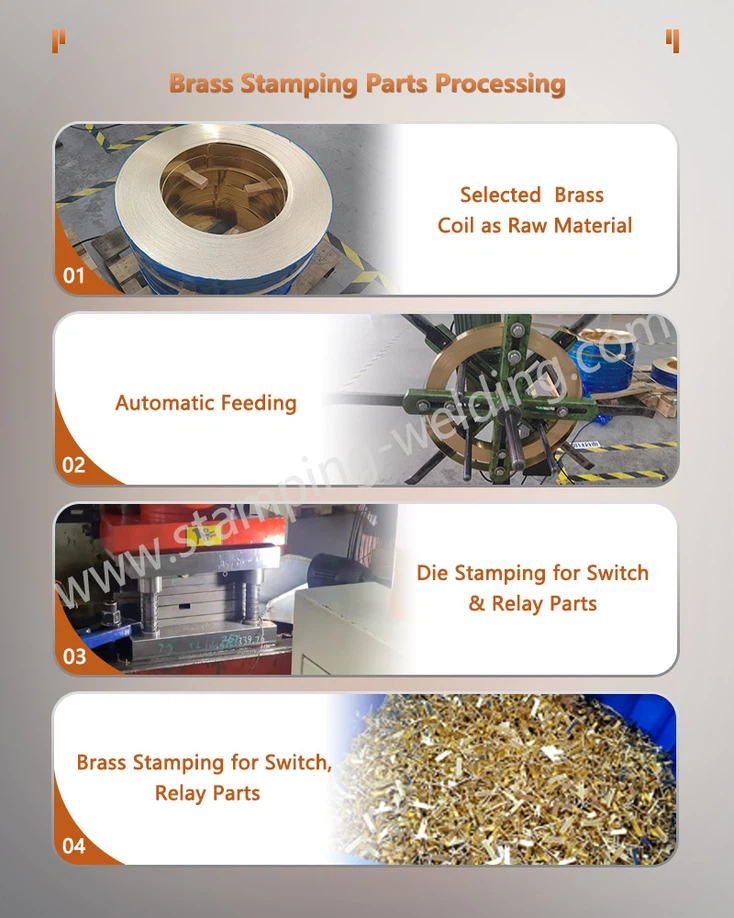
Production efficiency and process integration: Due to its good forming properties, brass is particularly suitable for high-speed continuous stamping using multi-station progressive dies. In a progressive die, multiple processes such as punching, blanking, bending, embossing, tapping, and riveting can be completed in sequence. The raw material is a rolled brass strip, and the finished product is a neatly arranged strip or an automatically separated single part. The stamping speed can reach tens to hundreds of punches per minute, depending on the complexity of the parts, and the daily output of a single set of molds can reach hundreds of thousands of pieces. This high efficiency is a core factor in keeping brass stampings competitive in cost-sensitive high-volume applications. Customized manufacturing capabilities: Brass stamping parts are mostly non-standard customized products and need to be designed specifically according to the customer's assembly space, force direction, flow capacity and cost objectives. The customization process usually includes stages such as demand analysis, product structure design, mold plan review, sample trial production, small batch verification and mass production. For brass stamping parts with special environmental adaptation requirements-such as industrial equipment used in high-temperature environments or in the presence of corrosive gases-the requirements can be met by selecting appropriate brass grades (such as arsenic-added brass, tin brass) or adding surface plating (nickel plating, tin plating).
The precision control in the field of Electrical Brass Metal Stamping for Socket Switch is particularly strict: the entrance width deviation of the plug sleeve directly affects the plug-in and pull-out force, the initial angle deviation of the contact piece will lead to inconsistent plug-in and pull-out life, and the position deviation of the threaded hole of the terminal block will affect the assembly efficiency. The management and control experience of excellent manufacturers shows that regular preventive maintenance of molds and accurate calibration of stamping equipment are more important than subsequent inspections.
contact us
If you want to evaluate Plug Socket Brass Stamping solutions or request samples for your electrical products, please fill out the inquiry form below to inform us of the drawing requirements, material grade and estimated annual usage. The engineering team will provide a process feasibility analysis and cost estimate within working days.