EV Fuse Copper Contact Usage Guide: Adapted for High-Voltage Scenarios, Ensuring Vehicle Circuit Safety
Mar 22, 2026
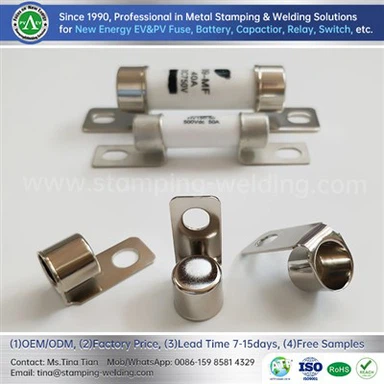
As electric vehicles upgrade towards higher voltage and higher current, the reliability of on-board high-voltage protection systems becomes increasingly critical. EV Fuse Copper Contact, as the core conductive components of fuses, directly determine the timeliness and stability of circuit protection. Their correct use and characteristic adaptation are crucial prerequisites for ensuring the safety of core on-board components. As a core subcategory of Fuse Terminals, fuse copper contacts are the metal terminals at both ends of fuses in electric vehicle high-voltage protection systems. They are widely used in various on-board high-voltage circuits. Their functional characteristics, usage adaptation, and scenario specifications need to be precisely controlled in conjunction with the on-board high-voltage environment. The following provides detailed guidance for the industry from a usage perspective.

Core Functions: Basic Usage Effects
From the perspective of core usage requirements, the proper functioning of the three core functions of the EV fuse contacts is the foundation for ensuring its effectiveness and a key basis for selection and installation, as follows:
- Current Transmission
As the connection interface between the high-voltage circuit and the fuse, this contact must stably introduce high-voltage current into the fuse to ensure smooth current transmission. This requires the use of a highly conductive material to avoid overheating due to poor contact. This is the core advantage of Copper Contact compared to ordinary metal contacts.
- Physical Connection
For physical connection, the contact must be securely fixed to the power distribution unit (BDU) or maintenance switch (MSD) using bolts or plugs. During installation, ensure a tight connection to prevent loosening due to vibration during vehicle operation, which could affect circuit protection.
- Heat Dissipation
Heat dissipation is also crucial. The contact must effectively dissipate the heat generated when large currents pass through, preventing oxidation and performance degradation caused by high temperatures, ensuring long-term stable use.
Feature Adaptation: Adaptable to harsh environments
Adapting to the demanding environments of automotive high-voltage (typically 400V or 800V) and high-current (hundreds of amperes) applications, the core characteristics of EV fuse copper contacts directly determine their applicability. Therefore, material and manufacturing precision are crucial considerations during use. For material selection, pure copper or phosphor bronze (such as CuSn6) are preferred as the contact substrate. Copper's excellent conductivity effectively reduces contact resistance and heat generation. In some scenarios, Brass/Copper Contact can be used, balancing conductivity and cost control. The surface plating should be chosen based on application requirements. Silver plating is suitable for high-performance applications, with a plating thickness of at least 15 micrometers to ensure long-term stability. Tin plating focuses on oxidation prevention and is suitable for ordinary high-voltage circuits, aligning with the characteristics of Fuse Blade Contact. Regarding manufacturing precision, EV-grade products offer higher consistency and precision compared to household fuse contacts. When using them, it is essential to select products that meet automotive standards to withstand the severe vibrations and temperature changes during vehicle operation, avoiding poor contact due to insufficient precision.

Scenario adaptation: Targeted use
Depending on the different scenarios of the vehicle's high-voltage circuit, the use of copper contacts for EV fuses needs to be specifically adapted to ensure the accuracy and reliability of circuit protection. In the BDU (Battery Distribution Unit) inside the battery pack, the contacts need to be adapted to the compact space of the battery pack, while possessing excellent temperature resistance and oxidation resistance to avoid the impact of high temperature and humidity inside the battery pack on its use. In the DC fast charging circuit of the charging system, the contacts need to withstand instantaneous high current surges, so products with high conductivity and high heat dissipation, such as Copper Blade for Fast Fuse, are selected to adapt to such high-frequency, high-current scenarios, ensuring rapid response and circuit disconnection in case of overcurrent. In high-voltage auxiliary systems such as air conditioning compressors and DC/DC converters, the contacts need to be adapted to medium current transmission requirements, emphasizing connection stability; Blade-type Fuse Contacts can be selected, balancing practicality and economy.

Summary: Use core specifications
In general, the correct use of EV fuse copper contacts hinges on matching the performance requirements of high-voltage vehicle scenarios and ensuring proper installation and scenario compatibility. As a key component of the vehicle's high-voltage protection system, its material selection, plating specifications, and installation methods must strictly adhere to usage specifications to avoid circuit protection failure due to improper selection or installation oversights, which could damage core components such as the battery pack and motor controller. In the future, with the upgrading of electric vehicles towards higher voltage and lighter weight, the application scenarios for niche products like Fuse Knife Contact will further expand, and their usage specifications will continue to improve, providing more reliable protection for vehicle circuit safety.
Contact Us
If you have any questions or needs regarding the selection and use of EV Fuse Copper Contact, please feel free to contact us for professional technical support and solutions.