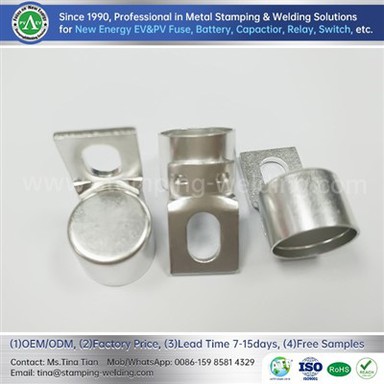
Fuse Cap and Contact Resistance welding process empower new energy power protection
Feb 11, 2026
With the rapid development of the power system and new energy industry, fuses, as core components for circuit safety protection, directly impact the safety and stability of power system operation through the performance and manufacturing process of their key component, the Fuse Cap and Contact. This is especially true in emerging fields such as new energy vehicles and photovoltaic energy storage, where its importance is increasingly prominent. The contact cap assembly typically refers to the key conductive and protective component used in power fuses. It is assembled from contacts and end caps through precision welding or riveting processes. Widely applicable to various scenarios such as photovoltaic systems, energy storage battery protection, electric vehicles (EVs), and low-voltage power distribution systems, it has become an indispensable core component in the field of power protection.

Core components: Materials and processes determine adaptability
From a core component perspective, the precision of the contact cap assembly determines its compatibility, and the materials and processes of each component adhere to strict standards. Contacts are mostly made of high-conductivity copper (T2 copper), often with silver or tin plating to reduce contact resistance, enhance corrosion resistance, and ensure smooth current conduction. End caps, as metal covers fitted onto both ends of ceramic or composite material tubes, are primarily made of copper. Copper End Caps and Fuse Contacts, with their excellent sealing and conductivity, are the mainstream compatibility choice. The connection points between the contacts and end caps are achieved through laser welding, brazing, or precision riveting. The Fuse Cap and Contact Resistance Brazing process effectively improves the mechanical strength and conductivity stability of the connection, meeting the needs of complex operating conditions. In some scenarios, Outer Cap and Terminal Welded Components standards are also adopted to ensure the overall reliability of the assembly.

Core technology: Resistance spot welding enables efficient component production
It is worth noting that resistance spot welding, as a highly efficient and reliable metal joining process, has become a core process in the production of fuse cap assemblies, especially fuse assemblies for new energy vehicles. This process utilizes the heat generated by the current passing through the workpiece to melt and connect it. In production, it is commonly used to connect components such as copper contacts, copper caps, and terminal contacts. Compared with traditional welding processes, it has significant advantages in terms of high efficiency, good welding quality, and high degree of automation. It can be combined with automated production lines to achieve automated and intelligent production, greatly improving component production efficiency and product consistency, while effectively meeting the high-temperature adaptation requirements of Fuse Cap High Temperature Soldering.

Application Value and Future Development Trends
Resistance spot welding is widely used in the production of fuses for new energy vehicles. It effectively ensures the reliability of connections for components such as thecopper contacts and fuse caps, guaranteeing stable operation of the components under high pressure and high temperature environments, thus providing a guarantee for the safe operation of new energy vehicles. Industry insiders say that the Fuse Cap and Contact, as the "hand" and "cover" of the fuse, directly determines whether the power system can safely and quickly cut off the current in the event of a short circuit fault, especially in terms of its manufacturing process, welding strength, and plating quality. The optimization and upgrading of the resistance spot welding process will further promote the performance improvement of the contact cap assembly, helping it to better adapt to the development needs of the new energy and power protection fields. In the future, with continuous breakthroughs in precision welding technology, the contact cap assembly will develop towards higher stability and better adaptability.
contact us
If you have any needs regarding the selection of Fuse Cap and Contact, adaptation of resistance spot welding processes, or related customization, please feel free to contact us. We will provide professional and precise solutions and technical support tailored to your application scenarios.