Insight into the Film Capacitor Aluminium Cans – Structure, Advantages and Engineering Applications
Nov 01, 2025
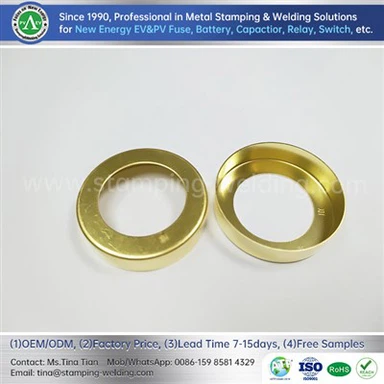
In modern power-electronic systems, the Film Capacitor Aluminium Can plays a critical role in enabling high reliability, efficient energy storage and noise suppression. The core construction of the it comprises a cylindrical aluminium-shell housing that contains wound metalized film or foil dielectric elements, sometimes resin- or oil-filled for enhanced insulation and thermal management. Over time, engineers have favoured the Power Converter Capacitor Aluminium Can for its superior performance under harsh conditions compared with traditional electrolytic designs. The Filter Capacitor Aluminium Can excels in smoothing DC links, filtering high-frequency switching noise and stabilizing voltage-bus systems in demanding applications. Because of its robust housing and carefully engineered internal film dielectric, the product provides high ripple current capability, excellent thermal behaviour and long operational life.

Structure & working principle
- It uses a metallic film (often aluminium-metallised film) or foil wrapped around or layered within insulating plastic film and then sealed within an aluminium "can" housing. Such a design ensures structural integrity, shielding, and efficient heat dissipation.
- Inside the Water Cooled Capacitors Aluminium Can, alternating layers of dielectric film and electrode are wound into a compact form; the aluminium can serves as both mechanical cover and part of the grounding or casing system.
- When voltage is applied, the stores energy across its dielectric film, and in high-frequency or ripple conditions it efficiently shunts unwanted components or absorbs transient loads. The aluminium can enclosure supports stable behaviour.
- Particularly for the Aluminium Can for High Voltage Film Capacitors, its film-dielectric self-healing characteristics (in a metallised version) help maintain operation even when micro-breakdowns occur in the film layers.
- The combined low ESR/ESL, high voltage tolerance and durable packaging mean it is a strong candidate for power-electronics environments where reliability matters.

Material & technological advantages
The use of metallised polypropylene or other modern film dielectrics contributes to stable capacitance, minimal drift and resistance to temperature- and frequency-induced changes.
The aluminium housing of the Power Converter Capacitor Aluminium Can offers mechanical strength, improved heat-dissipation pathways and helps in grounding/EMI shielding - features less well provided by simple plastic enclosures.
Because it is non-polarised and engineered to handle high ripple currents and high voltage stress, it offers a reliability advantage over many electrolytic capacitors in the same role.
For applications where surge, dv/dt or environmental stress are present, the Filter Capacitor Aluminium Can delivers consistent performance and longevity - particularly relevant as switching frequencies and demands in power electronics continue to rise.
As system designers look for smaller size, higher performance and longer life, the product is increasingly considered the "premium" choice where cost-benefit justifies it.
Material & technological advantages
High-Thermal & High-Current Tolerance
The device is engineered to withstand substantial thermal loads and large current flows, and to perform reliably in challenging dynamic environments-such as mechanical vibration, repeated temperature cycling or grid-voltage fluctuation. Its packaging and internal film construction support these conditions.
Suitability for Large-Scale Industrial Systems
In large-scale systems such as data centres, rail/metro traction, renewable‐energy inverters (wind/solar) and heavy variable-speed drive equipment, the Filter Capacitor Aluminium Can offers strong suitability thanks to its robust design and long lifetime.
Maintenance Efficiency & Modularity
Designed for modular systems, the unit enables rapid plug-in or swap-out installation, significantly reducing on-site maintenance labour and downtime. This capability helps maintain system continuity and keeps operational disruption to a minimum.
Enhanced Safety Margin
With high insulation, strong arc-resistance and low contact/resistive losses built into the Power Converter Capacitor Aluminium Can, the overall system safety margin is elevated and the risk of fault propagation through protective components is reduced.
Typical Use-Case Examples
- In a distribution-panel main busbar, the unit can serve as the primary fuse-base link in a high-current fuse bank; its modular design accommodates future upgrades or expansion.
- In industrial control systems protecting motors or high-power supplies, it ensures quick interruption of overloads or short-circuits, thereby safeguarding system assets.
- In rail/metro electrical power systems where very high reliability and minimal service intervention are required, it meets both electrical and mechanical demands.
- In wind/solar installations-paired with fuse-link stacks or DC-link circuits-it remains reliable even under harsh ambient conditions.

Industry trends & future outlook
As electrification, power-conversion demands and system switching speeds continue rising, the role of the Water Cooled Capacitors Aluminium Can becomes even more significant. With new film dielectric materials (such as PPS, PEN) and higher-voltage/compact aluminium-can packaging, the performance envelope of it is steadily expanding. Engineers and procurement specialists who understand the structure, advantages, selection criteria and practical implementation of the Aluminium Can for High Voltage Film Capacitors are better equipped to deliver stable, reliable, and cost-effective system designs.
contact us