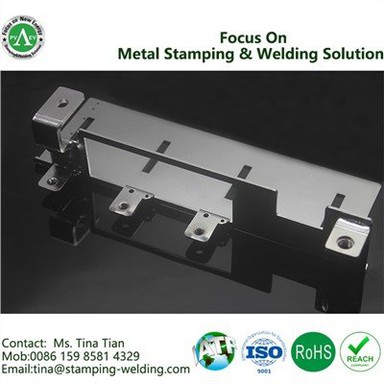
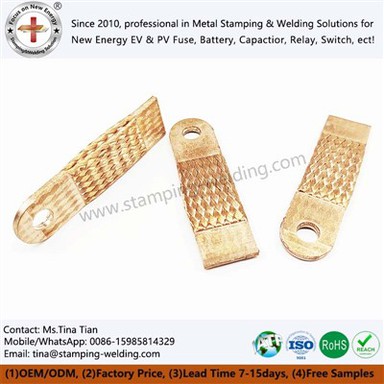
Production solution for copper busbar
Mar 02, 2025
product definition
Electrical busbar is a rigid conductive component used to conduct concentrated current in power distribution systems. It usually has a rectangular or flat cross-section and is made of copper or aluminum materials with high conductivity. The core function of the busbar is to distribute the power from the input power to multiple output branches with high efficiency and low loss, while also serving as a convergence point to collect power from different sources. Compared with traditional wiring methods that use multiple cables connected in parallel, busbars have significant advantages such as high current-carrying density, small space occupation, good heat dissipation conditions, low parasitic inductance, and easy standardized layout. In switch cabinets, power distribution cabinets, frequency converters, inverters and battery energy storage systems, the busbar plays the role of "power highway", connecting transformers, rectifier modules, inverter units and loads with low impedance.
Bus Bar Connectors are special accessories used in busbar systems to achieve quick connections between sections or between busbars and electrical terminals. Their design must ensure constant contact pressure and be able to compensate for displacement caused by thermal expansion and contraction. As the core product provided by Busbar Suppliers, electrical busbars can be subdivided into main busbars (used to collect total current), branch busbars (used to distribute power to various feeder circuits), as well as neutral busbars and grounding busbars. For application scenarios that need to withstand short-term current (such as peak 50kA or 100kA), the cross-sectional size and material purity of the busbar must undergo strict dynamic and thermal stability checks to prevent deformation or fusion in the event of a short-circuit fault.

Material advantages
The base material of the electrical busbar is mainly copper or aluminum alloy with high conductivity. The specific selection depends on the comprehensive requirements of conductivity, weight, cost and application environment. Pure copper busbar (copper content ≥99.9%, conductivity ≥98% IACS) has the lowest DC resistance and excellent corrosion resistance and is suitable for high-current scenarios that are sensitive to losses or have compact space. The common grade of copper bus bar for sale is T2 copper, which can be provided in semi-hard state (1/2H) or hard state (H) according to demand to meet different bending and drilling processing requirements. When purchasing bus bar copper, you need to pay attention to the conductivity certification report of the material, because some low-price products may be mixed with recycled copper, resulting in excessive impurity content (especially phosphorus, iron, and sulfur elements), thereby significantly reducing the conductivity and increasing the risk of heating.
For applications where weight reduction is required (such as electric vehicle battery packs), aluminum busbars (pure aluminum or 6101 aluminum alloy) have become the preferred solution with a density of about 2.7g/cm³ (only one-third of copper), but the disadvantage of low conductivity (about 50-60% IACS) needs to be compensated by increasing the cross-sectional area. In order to improve the stability and corrosion resistance of the contact interface, silver-plated copper bus bar is a common solution for connection terminal processing - the silver plating layer (usually 3-10μm in thickness) utilizes the high conductivity (higher than copper) and anti-oxidation properties of silver to form a low-resistance, long-life contact interface under bolt tightening pressure. Silver-plated copper busbars are widely used in high-voltage switchgear, GIS (gas-insulated switchgear), offshore wind power converters and other places that require strict contact reliability. In addition, for cost-sensitive outdoor equipment that requires salt spray resistance, tinned copper busbars or epoxy powder-coated busbars are also options.

Manufacturing process
The manufacturing process of electrical busbars covers raw material inspection, leveling and sizing, blanking, bending and forming, drilling and tapping, surface treatment, insulation coating and finished product testing. The first step is raw material inspection - use a conductivity tester (eddy current principle) to conduct sampling inspection on incoming copper or aluminum rows to ensure that the conductivity is not lower than the order requirement (such as copper busbar ≥ 98% IACS), and use a hardness tester to check whether the material condition meets the bending processing requirements. The second step is leveling and sizing - use a leveling machine to eliminate the residual bending stress of the copper bar, and then cut it to length according to the designed length. The length tolerance is usually controlled within ±1mm. The third step is punching and blanking - using CNC turret punching or laser cutting equipment to process mounting holes, phase sequence marking holes and weight-reducing waist-shaped holes. For large-volume orders, progressive dies are used for efficient stamping.
The fourth step is bending - the CNC bending machine bends the busbar once or multiple times according to the set angle. During bending, a soft protective layer (such as a polyurethane gasket) needs to be placed between the mold and the copper busbar to prevent surface indentation. For applications that need to withstand vibration, the inner corner radius of the bend should not be less than twice the thickness of the busbar to avoid micro-cracks on the outer arc surface. The precision drilling process in Busbar Fabrication is a key quality control point - the hole position tolerance must be controlled within ±0.2mm. After drilling, a chamfer should be used to remove the hole burrs to prevent scratching the operator or cutting the wire insulation layer during installation. The fifth step is surface treatment: silver plating, tin plating or spraying insulating powder according to customer requirements.
The thickness of the silver plated layer is monitored by an X-ray fluorescence thickness gauge to ensure that it reaches the design value (partial silver plating can be controlled at 3-5μm, and full silver plating can reach 8-15μm). The sixth step is insulation coating - for areas that require insulation protection, heat shrink tubes (made of PVC or polyolefin) can be covered and heated and shrunk, or epoxy powder electrostatic spraying can be used to form an 80-150μm insulation layer. Finished product testing includes: full dimensional inspection (key hole positions and bending angles), coating adhesion cross-cut test, withstand voltage test (AC 3000V/60 seconds without breakdown) and contact resistance sampling test. Bus Bar Manufacturers also need to clean and degrease the busbar before shipment, and coat the exposed copper surface with an antioxidant protective agent (such as benzotriazole solution) to prevent oxidative discoloration during storage and transportation.

FAQ
Q: How to choose copper busbar and aluminum busbar?
A: Under the same cross-sectional area, the current carrying capacity of copper busbar is about 1.6 times that of aluminum busbar, but the weight of copper is about three times that of aluminum. Copper is preferred when space is tight, and aluminum is preferred when weight reduction is required. For indoor dry environments, tin plating or no plating plus conductive paste can be used. Silver plating is recommended for high-voltage or corrosive environments.
Q: How to verify whether the purchased copper busbar conductivity meets the standard?
A: High-voltage busbars (≥1000V AC or 1500V DC) require thicker insulation layers, significantly increased electrical clearances and creepage distances, and connection terminals require rounded corners and edge chamfering and deburring to prevent partial discharge.
Q: DO YOU TEST ALL YOUR GOODS BEFORE DELIVERY?
A: You can ask the supplier to provide material certification and conductivity test reports, or use a portable eddy current conductivity meter for non-destructive testing. Qualified T2 copper conductivity should be ≥98% IACS.
contact us
We take full-process Electrical Bus Bar process control, online coating thickness measurement and batch-traceable quality reports as the core delivery guarantee. Welcome to submit electrical parameters and structural drawings, and our engineers will provide cross-section calculations and process plans, along with sample delivery confirmation.