Technical Specifications and Power Electronics Applications of Copper Busbars
Jul 04, 2026
As a fundamental material in modern electrical conduction systems, copper busbars are widely used in power connection structures requiring high current-carrying capacity and low power loss. Composed primarily of high-purity copper, they achieve excellent electrical conductivity, thermal stability, and machinability through controlled impurity levels and processing techniques, serving critical conduction and connection functions across various industrial electrical systems.

Within the realm of high-performance conductive materials, these components are often defined as "electrolytic copper busbars." This designation emphasizes their high purity and low oxygen content-characteristics that reduce electrical resistivity and enhance long-term operational stability-making them ideal for high-reliability power transmission environments.
In the classification of conductive materials, the term "electrical copper busbar" refers to copper conductor products that meet electrical system standards; they must comply with rigorous engineering specifications regarding current-carrying capacity, thermal management, and structural stability.
Regarding dimensions and engineering compatibility, the specifications of copper busbars are optimized based on current density and installation space. This involves balancing multiple parameters-such as width, thickness, and length-to meet the structural requirements of diverse power systems.
Bending is a critical step in the manufacturing and forming process; precision bending allows for complex routing while maintaining the integrity of the conductive cross-section and ensuring mechanical strength.

During structural fabrication, the bending process focuses on controlling stress distribution across various bend radii. This prevents micro-cracking and degradation of electrical conductivity, thereby ensuring long-term operational reliability.
In electrical grounding system design, copper ground busbars facilitate unified grounding potential management. They provide a low-impedance path to safely channel system currents into the grounding grid, thereby enhancing overall electrical safety.
Within power distribution and energy management structures, electrical ground busbars establish standardized grounding and return paths, ensuring potential balance across different electrical circuits and maintaining system stability.
To address specific insulation and safety requirements, isolated ground busbars incorporate insulating structures to minimize electromagnetic interference and ground noise, making them suitable for high-precision electronic equipment and sensitive control systems.
In telecommunications infrastructure, telecom ground busbars ensure a low-noise grounding environment for communication equipment, effectively enhancing signal integrity and reducing the risk of high-frequency interference. In high-current power transmission and energy storage systems, copper power bars are utilized to construct conductive paths with high power density; their structural design prioritizes low energy loss and superior heat dissipation to meet the demands of high-load operating environments.
For applications involving complex bends and space-constrained configurations, bent copper busbars offer multi-angle forming capabilities, allowing them to adapt to compact equipment layouts while maintaining stable electrical performance.
Within systems comprising diverse conductive components, copper ground busbars are frequently employed in multi-point grounding distribution systems, where their centralized conductive structure enhances grounding consistency and overall system reliability.
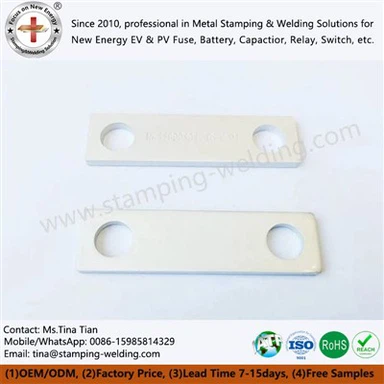
In new energy battery systems, battery busbar connectors facilitate electrical connections between battery modules, establishing low-impedance, highly reliable energy transmission paths that are critical to energy storage systems.

In applications involving prismatic cells, copper busbars are primarily used to connect cell tabs, enabling efficient current collection and compact structural designs that boost the battery pack's overall energy density.
In the integration of lithium battery systems, copper busbar connectors for prismatic lithium cells facilitate series and parallel connections at the cell level, with designs that balance electrical conductivity, thermal management, and long-term cycle stability.
Overall, thanks to their excellent electrical conductivity, stable mechanical properties, and adaptability to various manufacturing processes, copper busbars have become fundamental conductor materials in power electronics, energy storage, and industrial power distribution systems, playing an indispensable role in high-reliability electrical engineering.
contact us