Trendsetter: PVC Dipping Insulated Battery Busbar Connector empower upgrades in the new energy and power distribution sectors
Apr 11, 2026
Product positioning and core value under industry trends
Against the backdrop of the deepening implementation of the "dual carbon" target and the accelerated construction of new power systems, the demand for high-voltage, high-reliability, and environmentally friendly conductive connection components in fields such as new energy vehicles, energy storage systems, and industrial power distribution continues to rise. PVC Dipping Insulated Battery Busbar Connector, with their mature technology and excellent performance, have become core conductive components suitable for multiple scenarios. Their technological iterations and product upgrades are closely following industry development trends, helping downstream sectors achieve efficient, safe, and green development. As a key component specifically designed for battery packs, power distribution systems, and new energy fields, this product uses high-purity metal as the conductive base material and a uniform and dense PVC insulation layer covered by a professional dip-coating process, achieving a dual improvement in conductivity and insulation protection, thus meeting the industry's high-quality development needs.

Core Components and Process Upgrade Directions
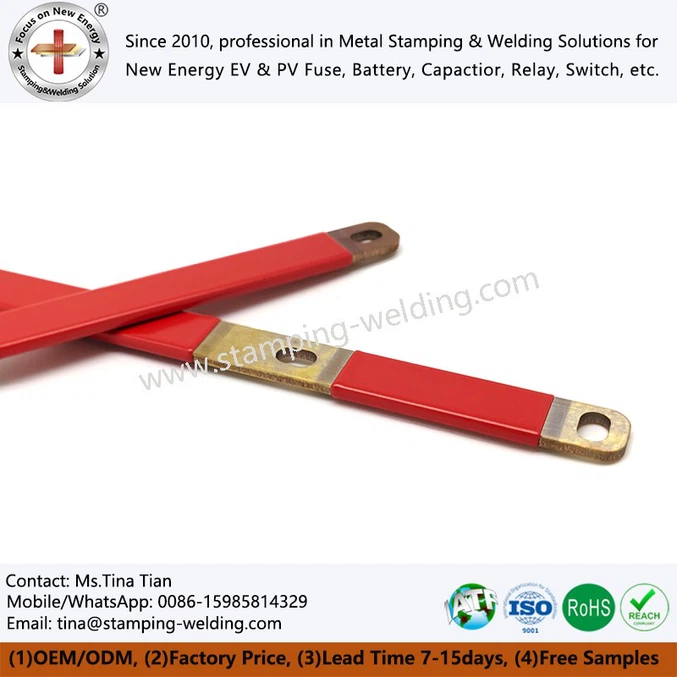
From the perspective of core product components and manufacturing processes, the quality control and process upgrades of PVC dip-molded insulated battery busbar connectors are key supports for aligning with the future development of the industry. Its conductive substrate is primarily T2 copper or high-purity aluminum, ensuring excellent conductivity and low resistance loss, which is also a core material requirement for battery bus bars. The insulation layer utilizes dip-molding technology, immersing a preheated metal substrate in powdered or liquid PVC, allowing the insulating material to adhere and solidify, forming a seamless protective layer. This process is the core technological highlight of PVC dip-molded insulated busbars. To adapt to actual installation needs, the product connection ends undergo precision peeling treatment, facilitating bolt connections or welding. The insulation protection standards of insulated busbars also provide a clear direction for process optimization. Currently, with the iteration of process technology, precision dip-molding achieves closed-loop temperature control, resulting in uniform and controllable coating thickness. Upgrades in surface pretreatment technology further enhance the bonding strength between the insulation layer and the metal substrate, driving product performance towards higher standards.
Product core features and trend alignment
The product's core features align perfectly with future industry trends, becoming its core competitive advantage for market expansion. Its superior insulation performance can withstand thousands of volts of high voltage, effectively preventing electrical short circuits, electric shocks, and arcing risks, aligning with the trend of high-voltage development in new energy. Compared to traditional heat shrink tubing, the PVC dip coating offers excellent geometric adaptability, perfectly fitting complex curved shapes such as L-shaped, U-shaped, and Z-shaped, without wrinkles or air gaps, adapting to the trend of miniaturized and compact equipment. Simultaneously, the coating bonds tightly to the metal substrate, resisting peeling and possessing excellent impact resistance, moisture resistance, corrosion resistance, and aging resistance, making it suitable for complex outdoor and humid conditions. Environmentally, it complies with RoHS and other environmental standards, meeting the development requirements of the green energy industry. Furthermore, the emergence of niche products such as the Insulated Flexible Copper BusBar for Power Battery Pack further caters to the specific needs of the power battery field, driving product upgrades towards scenario-based and refined solutions.
Multi-domain applications and demand growth
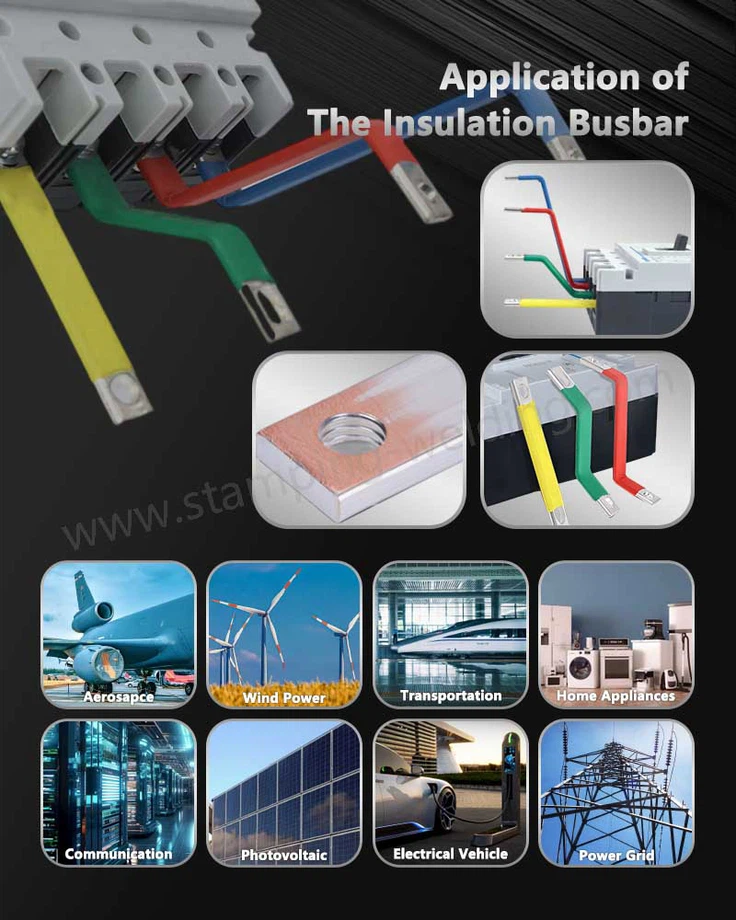
From an application perspective, the market demand for PVC dipped insulated battery busbar connectors is continuously growing with the expansion of downstream sectors and is deeply intertwined with industry development trends. In the new energy vehicle sector, PVC dipped nickel plated copper busbars for EV batteries are specifically designed for automotive applications, used for power connections between battery modules, high-voltage power distribution units, and motor controllers, aligning with the trend of widespread adoption of 800V high-voltage platforms in new energy vehicles. In the energy storage system sector, they are used to connect the internal cells of energy storage battery cabinets, ensuring the stability and safety of high-current transmission and contributing to the large-scale development of the energy storage industry. In the industrial power distribution sector, they are compatible with high and low voltage switchgear, transformers, UPS power supplies, and power distribution in data center server racks, catering to the explosive growth in high-density power distribution needs of data centers. In the photovoltaic and wind power sectors, they act as conductive pillars in solar inverters and wind power generation equipment, supporting the continuous expansion of renewable energy installations.
Future Iterative Upgrading Trends in the Industry
Looking ahead, the PVC Dipping Insulated Battery Busbar Connector industry will iterate and upgrade towards material modification, process precision, product customization, and green technologies. This is also the core development trend in the global conductive connection field. Specific development directions are as follows:
- Material Modification: Optimizing Performance to Align with Environmental Trends
PVC materials are being optimized towards low-filler modification, low-temperature toughening, and weather and corrosion resistance, improving hydrophobicity and service life. Meanwhile, low-smoke halogen-free and bio-based dip coatings will become new hotspots, aligning with ESG development requirements.
- Process Refinement: Upgrading Production Lines to Enhance Product Consistency
Automated dip coating production lines will become more widespread. The application of technologies such as closed-loop temperature control and multi-layer composite dip coating will continuously improve product consistency and reliability. Upgrading the process of PVC Coated BusBars will be a key focus.
- Product Customization: Adapting to Scenario Needs to Meet Specific Requirements
Demand for products such as Insulated Custom Copper BusBars with PVC Dipping will continue to grow. Designs can be optimized according to the voltage, current, and installation size requirements of different scenarios, adapting to the development of specific market segments.
- Intelligent Extension: Upgrading Functionality to Align with Smart Power Distribution Trends
Products will gradually extend towards intelligence, integrating functions such as temperature sensing and fault warning, aligning with the development trends of smart grids and smart power distribution.
Contact Us
For inquiries regarding PVC Dipping Insulated Battery Busbar Connector product compatibility, customized solutions, or industry trends, please feel free to contact us for professional technical support.