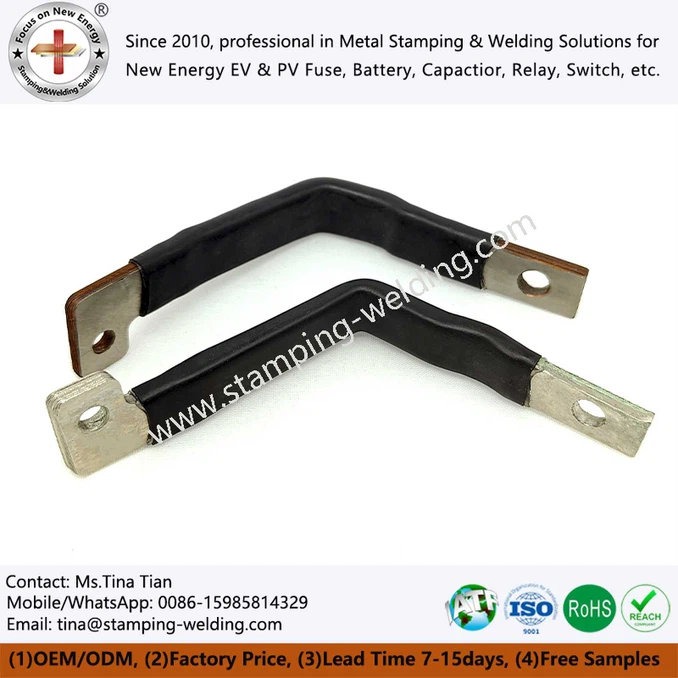
Copper Foil Flexible Busbar Connectors: a key component for solving the pain point of high current transmission
Apr 11, 2026
With the rapid development of new energy vehicles, energy storage systems, and industrial automation equipment, the requirements for connection components in power transmission systems are becoming increasingly stringent. Traditional rigid copper busbars or cables often fall short when facing high-frequency vibrations, thermal expansion and contraction, and complex spatial layouts. Copper Foil Flexible Busbar Connectors, as a high-performance power conduction device, are becoming a core solution in the field of high-current transmission due to their unique "multi-layer stacked" structure and "molecular-level" connection technology.
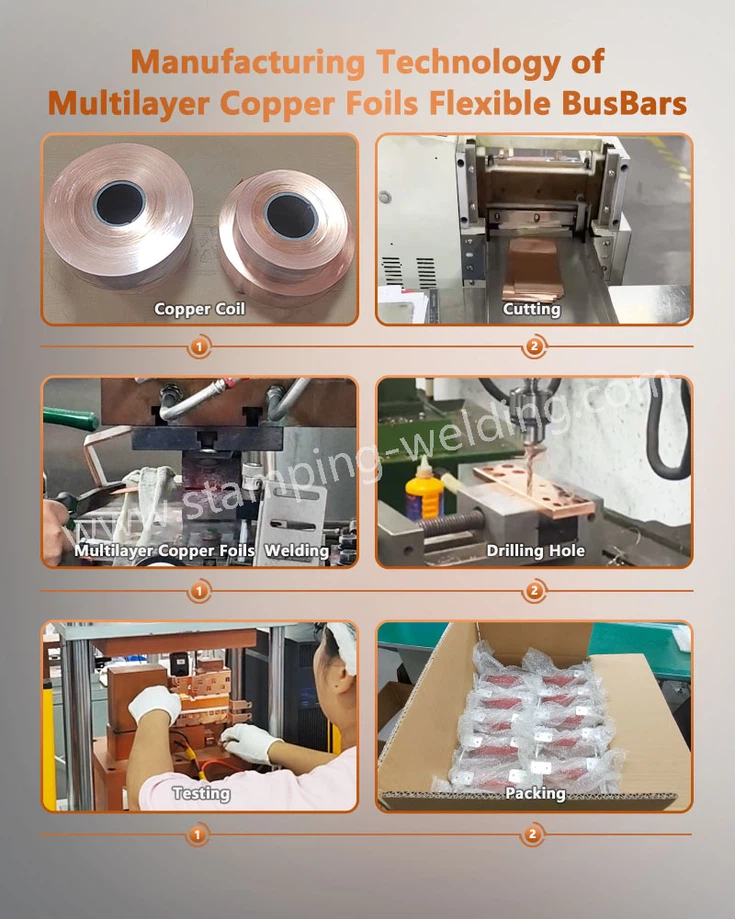
Technological Innovation: Multilayer Lamination and Molecular Diffusion Welding
The core of copper foil flexible bar connectors lies in their unique structure and manufacturing process. They are not made from a single solid copper busbar, but rather from multiple layers of ultra-thin T2 copper foil (typically between 0.05mm and 0.3mm thick) precisely laminated together. To ensure extremely high conductivity, the copper content of the raw materials typically needs to reach over 99.95%.
In terms of forming processes, the industry mainstream adopts advanced molecular diffusion soldering technology. This technology, under high temperature and pressure, allows the atoms of multiple layers of copper foil to interpenetrate, achieving solderless fusion at the end contact surfaces. This process not only reduces contact resistance to extremely low levels (almost equivalent to the base copper block) but also ensures the mechanical stability of the connection during long-term operation. For terminal parts requiring rigid connections, brazing or pressure welding processes are often used as supplementary methods, and tin plating, silver plating, or nickel plating can be applied according to customer requirements to enhance oxidation and corrosion resistance.
Core advantages: Flexible adaptation and efficient heat dissipation
Compared to traditional connection methods, copper foil flexible busbar connectors exhibit significant engineering advantages:
- Exceptional Flexibility and Stress Absorption: Its multi-layer foil structure endows the component with exceptional flexibility, capable of withstanding millions of bending cycles. This allows it to effectively absorb mechanical vibrations generated during the operation of transformers, generators, or rail transit equipment, as well as thermal expansion and contraction stress caused by drastic changes in ambient temperature, thereby preventing fatigue fracture at connection points and significantly improving system safety.
- High Current Carrying and Heat Dissipation: The multi-layer foil structure has an extremely high surface area to volume ratio, a characteristic that greatly optimizes heat dissipation efficiency. With the same cross-sectional area, it can carry higher currents (up to tens of thousands of amperes) than solid copper busbars, effectively reducing temperature rise.
- Flexible Spatial Layout: In space-constrained scenarios such as new energy vehicle battery packs or high-density distribution cabinets, this connector can be bent and folded arbitrarily according to installation requirements, enabling flexible wiring in three-dimensional space and solving the problem of the inability to install rigid busbars.

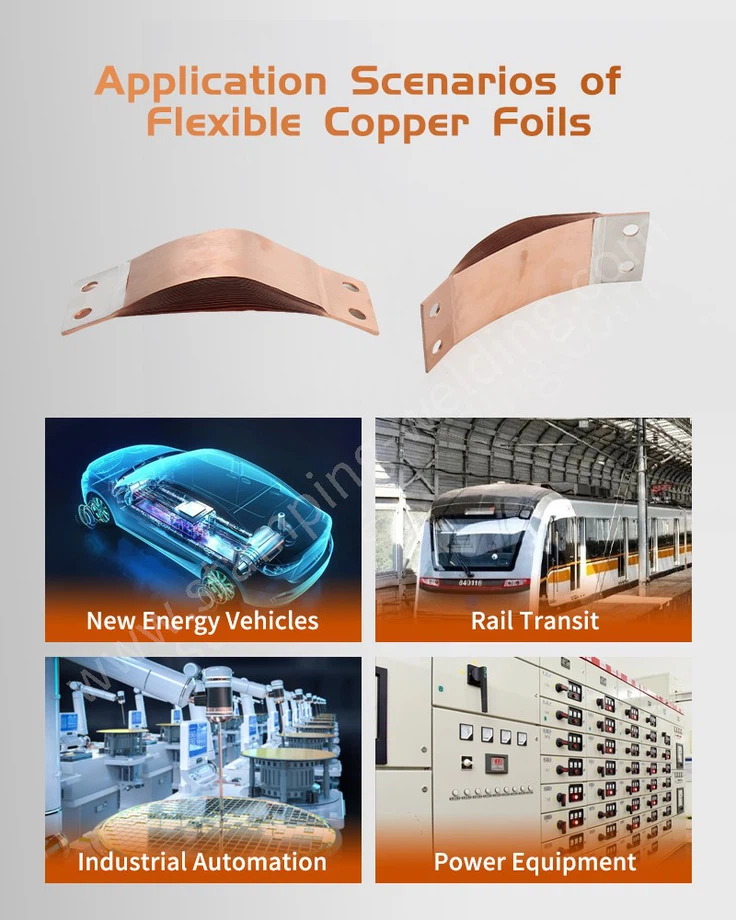
Wide range of applications: Empowering high-end equipment manufacturing
Currently, copper foil flexible busbar connectors are widely used in fields with extremely high reliability requirements. In the new energy vehicle industry, they are the preferred solution for connecting lithium battery modules and high-voltage power distribution units (PDUs). In the power infrastructure sector, they are widely used for flexible transition connections in transformers, generators, high and low voltage switchgear, and enclosed busbar trunking. Furthermore, in high-density power distribution systems in electrolytic aluminum, rectifier cabinets, industrial electric furnaces, and data centers (IDCs), these connectors play an irreplaceable role, providing solid underlying support for the electrification and intelligentization of modern industry.
Contact Us
In practical engineering applications, the above technical principles ultimately need to be implemented through specific product design. Different structural and material combinations will directly affect the long-term stability of the system. Please contact us to discuss your specific needs and obtain a suitable Copper Foil Flexible Busbar Connectors product solution.