Analysis Of Cold And Hot Processing Technologies For Copper: Selection And Application Of Cold Working, Hot Working, And Precision Forming Techniques
Sep 27, 2026
Pure copper is a metal material widely used in industry due to its high electrical and thermal conductivity, as well as its excellent ductility, plasticity, and corrosion resistance. It finds extensive application in fields such as electrical equipment, electronic components, heat dissipation systems, mechanical parts, and new energy equipment. Given its high plasticity and low tendency for work hardening, pure copper offers versatile processing options; cold or hot working processes can be selected based on factors such as product dimensions, shape, precision requirements, mechanical properties, and production volume.
In actual manufacturing, the processing of pure copper rarely relies on a single method; instead, it involves a combination of stages-such as breakdown (roughing), forming, finishing, and heat treatment-tailored to the product's structure. For instance, large copper components may undergo significant deformation via hot rolling or hot extrusion first, followed by cold rolling, cold drawing, or precision stamping to achieve final dimensions, thereby balancing material utilization, production efficiency, and dimensional accuracy.
Cold Working Processes for Pure Copper and Their Characteristics
Cold working is typically performed at room temperature or below the material's recrystallization temperature. When pure copper undergoes plastic deformation-such as rolling, drawing, stamping, or extrusion-it experiences a degree of work hardening, which increases its strength and hardness while ensuring superior dimensional accuracy and surface quality. Consequently, cold working is particularly well-suited for thin-walled components, precision parts, and electrical connectors that demand high dimensional consistency.
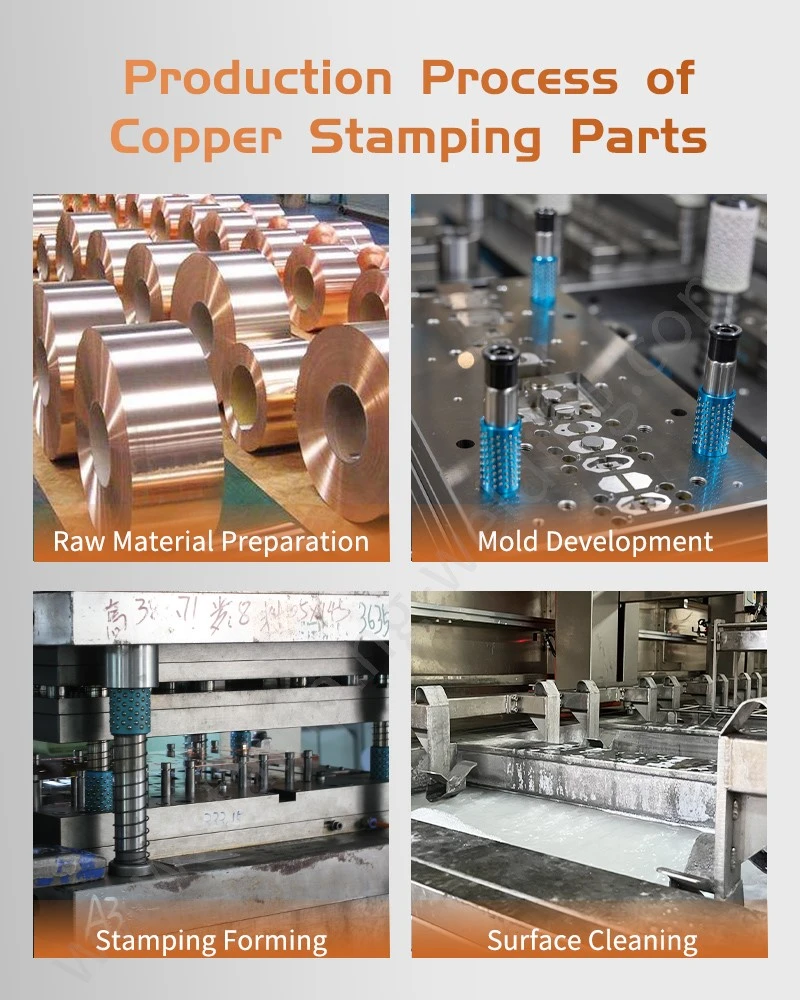
Cold stamping is a common forming method for pure copper sheets and strips. During the process, the material undergoes localized or overall plastic deformation under the action of a press and die, enabling operations such as blanking, punching, bending, deep drawing, and flanging. For mass-produced electrical connectors, precision dies allow for continuous forming, ensuring consistent profile dimensions and hole-position accuracy. Stamping processes using copper sheet as raw material are characterized by high material utilization, rapid production cycles, and suitability for automated manufacturing.
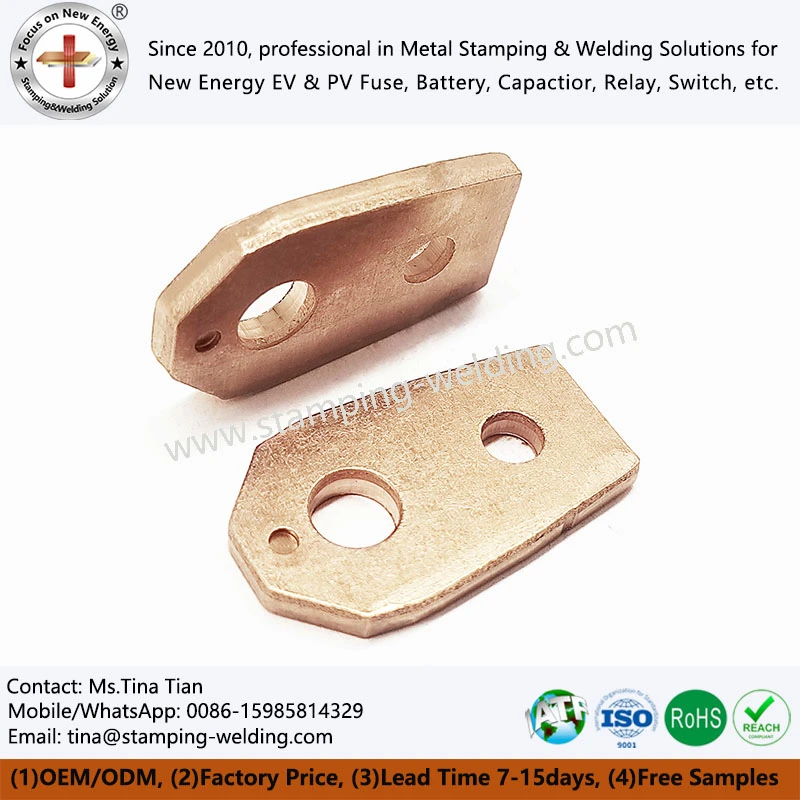
In the electrical manufacturing sector, copper stamping is frequently employed to produce terminals, conductive strips, elastic contact structures, and connectors. Depending on the product structure, localized forming can be achieved through stamping, while burr formation and edge quality are controlled by adjusting die clearance, blanking parameters, and the material's temper state.
For sheet metal parts requiring high dimensional precision, stamping copper sheet necessitates a careful consideration of material thickness, hardness, elongation, and die structure. While pure copper possesses good plasticity, it is relatively soft; therefore, the blanking clearance and die wear must be carefully controlled during stamping to prevent significant edge rollover, burrs, or deformation.
Cold drawing is primarily used for processing rods, tubes, and wires. The basic principle involves pulling a pure copper blank through a die opening with specific dimensions and angles, thereby reducing its cross-sectional area and increasing its length. This process improves dimensional consistency and induces work hardening, making it suitable for precision copper tubes, wires, rods, and certain machining blanks.
Cold rolling is mainly employed in the manufacture of sheets and strips. By continuously applying pressure via rollers, the thickness of the pure copper material can be gradually reduced while improving flatness and surface quality. For thinner copper strips or foils, cold rolling offers superior dimensional control, meeting the thickness requirements for products in electronics, electrical engineering, and thermal management.
Cold extrusion involves forcing a pure copper blank through a die cavity or opening under high pressure at room temperature to form the desired cross-section. Compared to machining, cold extrusion minimizes material waste and preserves continuous metal grain flow, making it ideal for producing components such as bushings, connectors, parts with complex cross-sections, and precision parts.
Cold heading is primarily used for forming the ends of rods; a punch and die induce localized plastic deformation to create a specific head shape. For items like copper rivets, terminal ends, and certain fasteners, cold heading enables continuous, high-efficiency forming while reducing the need for subsequent machining.
Hot Working Processes for Pure Copper and Their Applications
Hot working offers distinct advantages when producing pure copper components that are large in size, have thick walls, or require significant deformation. Typically performed above the material's recrystallization temperature, hot working allows for recovery and recrystallization during deformation, thereby mitigating the limitations that work hardening imposes on continuous forming.
Hot rolling is a key method of hot working for pure copper. After being heated, pure copper ingots or billets undergo continuous deformation via rollers to produce plates, strips, and copper products with various cross-sectional profiles. Compared to cold rolling, hot rolling accommodates greater deformation in a single pass; consequently, it is frequently employed for producing thick plates or as a breakdown process prior to subsequent cold working.
Certain copper plates intended for electrical applications require additional cold rolling, leveling, shearing, or finishing after hot rolling to achieve more consistent thickness and surface quality. Combining hot and cold working helps avoid work-hardening issues that would otherwise arise from excessive cumulative deformation during cold working alone.
Hot forging involves the plastic deformation of heated pure copper billets using a forging hammer or press. Depending on the product's configuration, either open-die forging or closed-die forging may be employed. Open-die forging is suitable for large shafts, flanges, and similar blanks, whereas closed-die forging is better suited for parts with specific shape and dimensional requirements.
Hot forging improves the material's internal microstructure through plastic deformation and helps mitigate issues such as porosity and microstructural inhomogeneity often found in cast billets. For large pure copper components, factors such as forging temperature, degree of deformation, and cooling method significantly influence the final properties.
Hot extrusion is primarily used to produce tubes, rods, and profiles. Heated pure copper billets are forced through a die under pressure to form a continuous cross-section. For large-diameter tubes or complex profiles, hot extrusion enables significant changes in cross-section with fewer processing steps, resulting in high production efficiency.
Combined Application of Casting and Hot Working
For large or complex pure copper products, relying solely on machining or cold working can result in low material utilization; therefore, production processes often combine casting with hot working.
Continuous casting allows for the direct production of continuous copper billets that can be fed directly into subsequent rolling or drawing operations, thereby eliminating intermediate steps associated with traditional ingot casting, reheating, and breakdown rolling.
This process route enhances production continuity and material utilization for products such as continuous copper strips, rods, and certain types of tubing.
Cast billets can undergo further processing-such as hot rolling, hot forging, or hot extrusion-to refine their microstructure and dimensions before final finishing via cold working. This combined processing method is highly adaptable for copper products that require a balance between production efficiency and dimensional precision.
Pure Copper Stamping and Precision Forming Processes
In the electrical and electronics industries, pure copper sheets often require further processing into parts featuring holes, bends, steps, protrusions, or localized contact structures. In such cases, the stamping process goes beyond simple material separation to encompass complex three-dimensional plastic forming.
Custom copper stamping requires design considerations spanning material condition, product structure, die longevity, and production volume. For precision copper parts produced in continuous runs, processes such as feeding, punching, forming, and cutting must be strategically planned so that multiple operations are executed sequentially within a single die system.
Copper sheet stamping is suitable for the mass production of copper sheet and strip products. When working with thin materials, particular attention must be paid to feeding stability, material warping, and deformation during blanking; for thicker pure copper sheets, stamping force and die clearance must be adjusted based on material hardness and product structure.
In the electrical sector, stamped copper parts often must simultaneously meet requirements for electrical conductivity, dimensional precision, and assembly stability. Consequently, product design cannot focus solely on external dimensions but must also account for contact area flatness, connection hole positioning, bending angles, and surface condition.
For connection structures requiring high electrical conductivity, stamped copper parts can undergo further operations-such as bending, riveting, welding, or surface treatment-to form complete electrical connection assemblies.
Work Hardening and Annealing Control During Cold Working
Although pure copper possesses excellent plasticity, continuous cold working increases internal dislocation density, gradually raising hardness and strength while reducing plasticity. Once cumulative deformation reaches a certain threshold, further heavy deformation processing may lead to issues such as cracking, edge damage, or compromised dimensional stability.
Therefore, during continuous cold drawing, cold rolling, or multi-stage stamping, intermediate annealing steps can be scheduled based on the material's condition and the extent of cumulative deformation. Annealing reduces work hardening through recovery and recrystallization, restoring a degree of plasticity to the material and ensuring a stable condition for subsequent processing. For precision copper strips, plates, and complex stamped parts, the annealing parameters must align with the required final mechanical properties.
Excessive annealing can render the material too soft, while insufficient annealing may restrict subsequent forming operations. Therefore, actual production requires process validation that accounts for the material grade, thickness, degree of deformation, and final temper.
Surface Quality Control in Pure Copper Processing
Pure copper is highly sensitive to surface conditions and is easily affected during processing by factors such as die condition, lubrication, oxidation, and handling methods. During cold working, in particular, die surface roughness and lubrication directly impact the surface quality of the copper.
Cold working typically requires lubrication methods tailored to copper to minimize friction between the material and the die, thereby reducing issues such as scoring, die sticking, and localized deformation. In stamping operations, the wear status of punches, dies, and guide components must be regularly monitored to prevent increased burr formation caused by changes in die clearance.
During hot working, controlling oxidation is critical. Pure copper readily forms an oxide layer at high temperatures; therefore, heating temperature, duration, and furnace atmosphere must be carefully managed. For products requiring high surface quality and electrical conductivity, minimizing excessive oxidation-and the dimensional loss associated with subsequent surface cleaning-is of practical importance.
Selection Logic for Processing Methods
There is no absolute superiority of cold working over hot working (or vice versa) for pure copper; the choice depends primarily on product dimensions, material temper, degree of deformation, precision requirements, and production volume.
For thin sheets, strips, precision tubing, and small connectors, cold working generally offers superior dimensional control and surface quality, while also providing a strength boost through work hardening. Conversely, for large plates, thick-walled tubes, large-section profiles, and products requiring significant deformation, hot working reduces deformation resistance and enhances processing efficiency.
In practice, hot and cold working are often combined. For instance, initial breakdown-involving significant deformation-may be achieved through hot rolling, hot extrusion, or hot forging, followed by cold rolling, cold drawing, stamping, or finishing operations to achieve final dimensions. For electrical connectors, additional post-forming steps such as trimming, deburring, cleaning, surface treatment, and dimensional inspection may also be included.
Application Characteristics of Copper Stamping Connectors
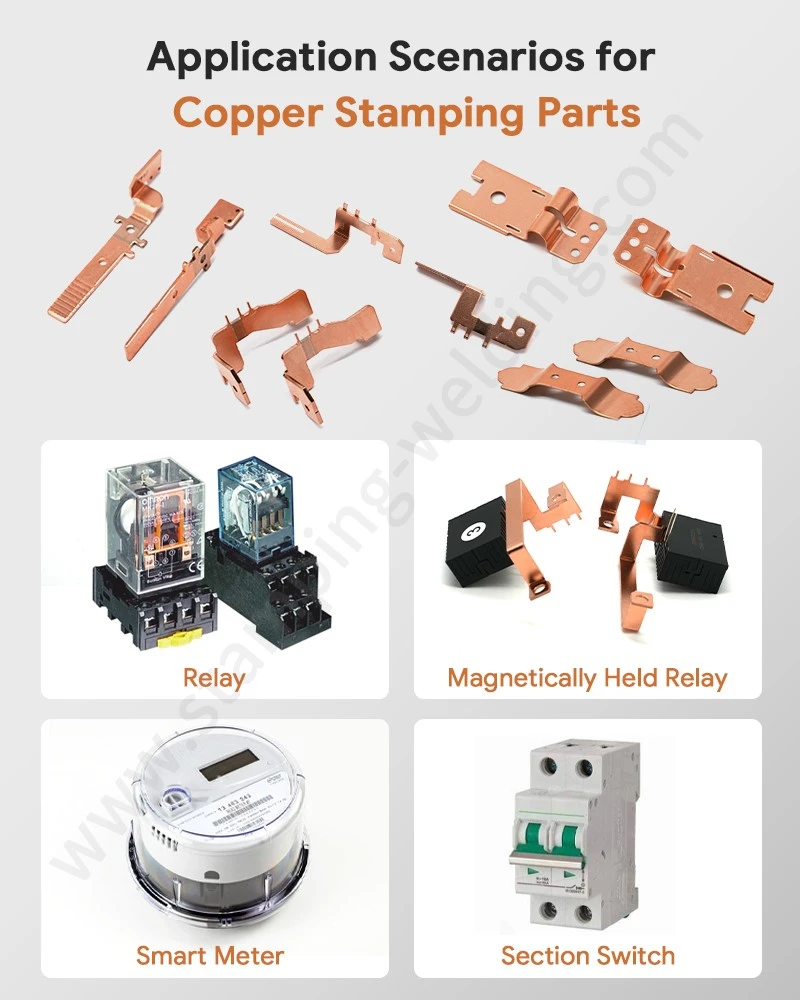
With the advancement of electrical equipment, new energy vehicles, energy storage systems, and industrial automation equipment, processed copper products are increasingly evolving from simple single-material parts into precision electrical connection assemblies.
Through processes such as stamping, bending, riveting, or welding, copper materials can be transformed into components that provide specific conductive paths and mechanical connection functions.
Copper stamping parts are commonly found in electrical connection structures; their design requires simultaneous consideration of material thickness, current-carrying capacity, mechanical strength, and assembly methods. For products requiring multiple bends, mold design must also account for material springback and the accumulation of dimensional errors during continuous forming processes.
In the case of copper strip products, high-speed processing can be achieved using progressive dies, allowing for the creation of features such as punched holes, cutouts, bends, and localized formed sections. For mass-produced electrical parts, this method reduces manual labor and improves dimensional consistency.
Some complex electrical connectors are manufactured by combining stamping with subsequent processes-such as welding, riveting, or surface treatment-to transform the stamped part into a fully functional assembly ready for installation.
Material Selection and Process Matching in Copper Processing
Different grades of copper vary in chemical composition, oxygen content, mechanical properties, and workability; therefore, processing parameters cannot be standardized across the board. During material procurement, it is essential to verify the grade, temper (hardness state), thickness or diameter, and relevant material standards, while selecting the appropriate processing state based on the intended end-use.
For products requiring complex plastic deformation, the material's elongation and work-hardening characteristics are key considerations; for electrical connectors, both electrical and thermal conductivity are critical. If the product requires subsequent welding, plating, or heat treatment, the material selection must also account for the impact of these processes on final performance.
For mass-produced custom copper parts, process planning-whether for OEM-customized stamped components-requires a holistic approach that considers product drawings, material specifications, mold structure, production cycle times, and inspection protocols, rather than determining the manufacturing method based solely on the 2D dimensions of an individual part.

Composite Processing of Precision Copper Connection Structures
In actual industrial production, copper parts often require the simultaneous execution of multiple processing steps, such as stamping, bending, and joining. For this category of products, copper stamping and bending components can achieve complex spatial geometries through progressive forming or multi-station processing.
For products requiring integration with other conductive parts, the copper stamping and connection process must account for dimensional stability in the connection zone, contact pressure, and requirements for subsequent welding or riveting. In electrical connection components specifically, localized deformation can directly impact the final contact quality; therefore, structural compensation and process validation are essential during the die design phase.
Some products require the formation of intersecting or irregularly shaped connection structures-such as cross-shaped copper stampings-where manufacturing challenges typically center on spatial bending, localized forming, and maintaining dimensional consistency across multiple axes.
Manufacturing Requirements for Pure Copper Electrical Contacts
In switches, relays, contactors, and other electrical equipment, pure copper stamped parts serve functions such as conduction, interconnection, and structural support. For elastic contact structures, the material must possess appropriate mechanical elasticity and dimensional stability while maintaining excellent electrical conductivity.
For instance, when manufacturing copper stamped spring contacts for electrical switches, critical control points include the bend radius, forming angle, and spring-back of the elastic zone, alongside the prevention of cracking or significant edge burrs during the stamping process.
For connection structures fabricated from copper rods or thicker copper stock, the production of custom stamped and bent copper rod components typically involves a combination of stamping, localized coining, and bending processes. The final dimensions of the product are influenced not only by die precision but also by the material's condition and the processing sequence.
Certain electrical connection products require composite structures incorporating materials such as silver contacts; in such cases, processes involving copper stamping combined with silver contact integration may be employed.
contact us