Application Of Resistance Spot Welding in New Energy Vehicle Fuses: Analysis Of The Joining Process For Copper Contacts, End Caps, And Terminals
Aug 03, 2026
As critical protective components in high-voltage electrical systems, electric vehicle (EV) fuses must operate reliably under conditions involving high voltage, high current, elevated temperatures, and prolonged vibration. Consequently, metal connection components-such as internal copper contacts, end caps, and terminals-require not only excellent electrical conductivity but also robust connection strength and long-term reliability. Resistance spot welding, an efficient metal joining process, generates heat by passing current through the contact interface to create a stable welded joint; it is widely employed in the manufacturing of EV fuse assemblies.
In the production of EV fuses, resistance spot welding is primarily used to securely join components such as copper contacts, fuse terminals, end caps, and fusible link assemblies. For instance, the resistance welding process for fuse caps and contacts ensures a stable bond between these parts, thereby enhancing the assembly's overall electrical conductivity and mechanical reliability while meeting the stringent safety requirements of EV high-voltage systems.

Key Components Utilizing Resistance Spot Welding in New Energy Vehicle Fuses
New energy vehicle fuses typically contain multiple conductive connection structures, with copper contacts and terminals handling the primary task of current transmission. Given the continuous current surges and mechanical vibrations experienced during vehicle operation, traditional mechanical connections are prone to loosening or resistance fluctuations; in contrast, stable welded connections effectively enhance product consistency.
Connection of Copper Contacts to Fuse Terminals
Copper contacts are critical components for current transmission within the fuse; they must maintain low contact resistance to prevent excessive temperature rise during prolonged operation. Resistance spot welding minimizes impedance variations in the connection zone, thereby improving the stability of current transmission.
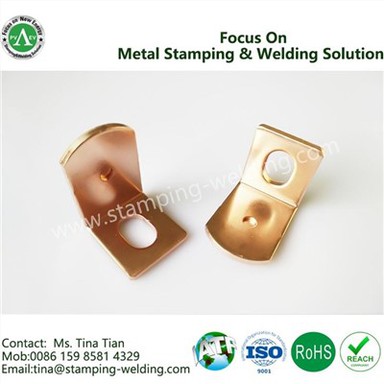
Copper contacts may utilize different connection configurations depending on the fuse structure. For instance, copper contacts for bolted-tag fuses are designed for bolted connections and require high terminal connection strength, whereas copper contacts for round-type fuses are used in cylindrical structures, relying on stable welding to ensure reliable terminal conductivity.
From an engineering procurement perspective, the quality of the fuse terminal connection directly impacts the product's service life. As core components at the fuse ends, the Copper Cap and Fuse Contact require precise control of current, time, and pressure parameters during welding to ensure robust joints and stable electrical performance.
Connection of Copper End Caps to the Fuse Element
Copper end caps serve primarily to secure the internal fuse element and act as part of the current transmission path. In new energy vehicle fuses, these end caps must withstand high current loads while maintaining secure mechanical fixation.
Resistance spot welding mitigates the contact instability issues often associated with traditional connection methods. For example, in round end cap and fuse link contact assemblies, consistent bonding between the end cap and the fuse element is essential to ensure low temperature rise during normal operation.
For high-reliability applications, optimized welding techniques-such as tin welding or soldering-may be employed. By carefully selecting welding materials and process parameters, the bonding performance between the end cap and the contact can be significantly enhanced.
Welding of Blade-Type Contacts and Connection Components
Some new energy vehicle fuses utilize blade-type connection structures, which require stable mechanical performance during insertion and removal. Blade-type contacts not only facilitate current transmission but must also maintain precise alignment with the mounting base. In such applications, components such as copper fuse caps and fuse terminals typically require connection via reliable welding processes to ensure a stable conductive path and high structural strength for the fuse.
Production Process for Resistance Spot Welding of New Energy Vehicle Fuses
The quality of resistance spot welding depends not only on equipment performance but also closely on production process control. For high-reliability products such as fuses for new energy vehicles, strict control over every manufacturing stage is essential.
Pre-welding Preparation and Positioning
Before welding begins, appropriate welding equipment, electrodes, and current parameters must be selected based on the product structure. Additionally, the installation positions of copper components, end caps, and terminals must be precisely aligned to ensure consistency in the weld zone.
For assemblies such as the "Outer End Cap and Terminal Welded Assembly Set," pre-welding positioning accuracy directly impacts final assembly dimensions and product consistency.
Welding Surface Treatment
Copper surfaces are prone to forming oxide layers; therefore, cleaning is required prior to welding to remove oil, oxides, and other impurities.
A high-quality surface condition minimizes resistance fluctuations during welding and improves weld joint quality. For instance, tin-plated copper end caps benefit from the tin coating, which enhances oxidation resistance and improves stability during subsequent welding operations.
Welding Parameter Control and Quality Inspection
During resistance spot welding, key parameters such as welding current, welding time, and electrode pressure must be carefully controlled. Insufficient parameters can lead to reduced weld joint strength, while excessive parameters may cause material deformation or an enlarged heat-affected zone.
Following the welding process, the reliability of the weld joints must be verified through methods such as visual inspection, resistance testing, and tensile testing. Components like fuse cap contact assemblies typically must meet requirements for both mechanical strength and electrical performance.

Advantages of Resistance Spot Welding in New Energy Vehicle Fuses
Compared to traditional mechanical fastening methods, resistance spot welding offers advantages such as stable connections, high production efficiency, and suitability for automated manufacturing.
First, welded connections reduce the risk of loosening caused by prolonged vibration, thereby enhancing the operational reliability of new energy vehicles. Second, stable metal-to-metal connections lower contact resistance and reduce heat generation during current flow, contributing to the overall thermal stability of the fuse.
Furthermore, resistance spot welding is well-suited for the large-scale, automated manufacturing of automotive components; it boosts production efficiency and ensures product consistency across different batches. These factors are crucial for the new energy vehicle fuse supply chain in guaranteeing product quality and delivery stability.

Key Considerations for Procuring Welded Fuse Assemblies for New Energy Vehicles
When selecting suppliers for fuse welding assemblies, engineering procurement professionals should prioritize material capabilities, welding processes, and quality verification capabilities.
Regarding materials, the choice-whether pure copper, copper alloy, or plated copper components-must align with specific application requirements. For instance, Copper Cap and Fuse Contact require a balance of electrical conductivity and mechanical strength to withstand high-current operating environments.
In terms of manufacturing, key considerations include the precision of welding equipment, parameter control capabilities, and the level of automation. Additionally, it is essential to verify that products have undergone testing for contact resistance, temperature rise, and mechanical strength.
For the high-voltage systems of new energy vehicles, fuse assemblies-despite their small size-play a critical role in overall electrical safety. Through sound design, precise control of resistance spot welding processes, and rigorous quality management, the stability of these assemblies can be enhanced, ensuring reliable protection for the vehicle's battery systems and high-voltage circuits.
Contact Us
If you are seeking supply solutions for copper contacts, end caps, welded terminal assemblies, or custom connectors for new energy vehicle fuses, we can provide manufacturing support tailored to your product structure, current requirements, and welding process specifications.