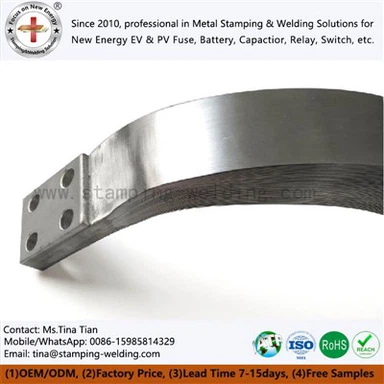
Applications And Technical Advantages Of Tinned Copper Braided Wire in Industrial Electrical Connections: Flexible Conductivity And Corrosion Resistance Drive Upgrades in Connection Systems
Nov 02, 2026
With the continuous development of sectors such as new energy vehicles, energy storage systems, industrial automation, and data centers, electrical equipment now demands higher standards for the electrical conductivity, flexibility, and environmental adaptability of connecting components. In operational settings, rigid conductors often struggle to accommodate complex installation spaces, mechanical vibrations, or temperature fluctuations; consequently, flexible conductive connectors have become essential components in power transmission and grounding systems.
Tinned copper braided wires-which combine the excellent electrical conductivity of copper, the protective benefits of a tin coating, and the inherent flexibility of a multi-strand braided structure-enable reliable electrical connections within confined spaces while effectively buffering mechanical stress generated during equipment operation. Currently, these products are widely utilized in fields including new energy vehicles, energy storage cabinets, industrial power distribution equipment, telecommunications cabinets, rail transit, and precision electronic devices, serving as standard flexible components within industrial electrical connection systems.

Material Structure and Performance Characteristics of Tinned Copper Braided Wires
A tinned copper braided wire is more than just a copper wire with a surface treatment; it is a flexible conductive assembly composed of a copper substrate, a metallic coating, and a braided structure. Its ultimate performance depends not only on the purity of the copper but also on factors such as the diameter of the individual strands, the braiding density, the quality of the coating, and the specific manufacturing processes employed.
In terms of material selection, such products typically utilize T2 pure copper-or other copper grades that meet specific electrical performance requirements-as the base material. Copper offers high electrical conductivity and excellent ductility, ensuring it can meet the continuous current-carrying demands of electrical equipment. By interweaving multiple fine copper strands into a flat or circular configuration, the material gains enhanced overall flexibility while maintaining its conductive capacity, allowing it to adapt to various bending requirements and installation orientations.
Surface tin-plating is a critical process for improving the environmental adaptability of copper braided wires. When exposed to air, moisture, or certain corrosive media over time, copper is prone to oxidation, which can compromise the stability of connection interfaces. A tin coating creates a protective barrier on the surface of the copper strands, slowing down oxidation and corrosion while also improving compatibility with subsequent soldering or connection processes.
Compared to conventional rigid copper conductors, tinned copper braided structures offer superior adaptability to bending. When equipment is subjected to vibration or temperature fluctuations, the multiple fine strands within these connectors can undergo a degree of relative displacement, thereby dispersing localized stress and reducing the risk of fatigue-a common issue when a single, solid conductor is subjected to repeated bending. Consequently, flexible braided connectors are frequently employed in electrical applications that require both high electrical conductivity and mechanical flexibility.
In terms of product structure, flat braided strips offer a wider contact surface, making them well-suited for connections in relatively uniform or regular spaces. Round braided cables, by contrast, provide multi-directional bending flexibility, making them ideal for complex routing environments. Engineers can select the appropriate structure based on factors such as available installation space, connection orientation, rated current, and the required range of mechanical movement.

Continuous Optimization of Flexible Connection Structures and Manufacturing Processes
As the integration level of electrical equipment continues to rise, traditional rigid copper busbars often struggle to meet the installation and operational requirements of complex connection points. Flexible copper braided connectors can accommodate assembly tolerances and mechanical displacements through structural deformation, thereby minimizing the additional stress exerted on the connection points.
In new energy vehicles and energy storage systems, components such as battery modules, inverters, power distribution units, and other electrical hardware often feature varying installation heights or relative displacements. Utilizing flexible copper braided busbars allows for the creation of a pliable current path between conductive components, enhancing the mechanical adaptability of the connection.
The manufacturing process for these products typically involves several stages: copper wire drawing, annealing, surface tin-plating, braiding, terminal processing, and quality inspection. The diameter of the individual copper wires directly influences the flexibility of the braided structure and its total conductive cross-sectional area, while the braiding density determines the product's structural stability, physical dimensions, and mechanical strength.
The annealing process enhances the ductility and flexibility of the copper wires and reduces internal stresses introduced during fabrication, allowing the product to better withstand repeated bending and deformation during assembly. For applications with unique installation requirements, products can be customized by adjusting parameters such as braid width, thickness, length, and terminal configuration.
For high-current applications, flexible copper busbars (Cu Flex Busbars) serve as an effective structural solution that balances the need for high electrical conductivity with the requirement for mechanical flexibility. Compared to entirely rigid copper busbars, flexible copper braided connectors can accommodate a certain degree of thermal expansion and mechanical displacement, thereby reducing the transmission of equipment vibrations directly to the connection interface.
For various electrical connection points, copper braids can be combined with copper terminals-joined via crimping, welding, or other suitable processes-to form a complete assembly. The quality of the terminal connection directly influences the product's contact resistance and temperature rise; therefore, strict control over the welding area, crimping dimensions, and the quality of the contact surfaces is essential.
Applications of Flexible Copper Connectors in New Energy and Industrial Sectors
As new energy vehicles and energy storage systems evolve toward higher voltages, larger currents, and greater integration, the scope for using flexible conductive components continues to expand. Different application scenarios impose distinct requirements regarding electrical performance, mechanical structure, and environmental adaptability.
In the traction battery systems of new energy vehicles, reliable current transmission paths must be established between battery modules, within battery packs, and between high-voltage power distribution units. Given the constant vibrations, acceleration-induced shocks, and temperature fluctuations experienced during vehicle operation, these connecting components must not only meet current-carrying requirements but also possess sufficient fatigue resistance. Flat braided shunts can be utilized for flexible shunting and connection within specific electrical circuits, helping to improve mechanical adaptability at connection points.
In energy storage systems, significant current transmission is typically required between battery clusters, busbar units, inverters, and power distribution components. Flexible copper braided connectors are well-suited for the compact installation spaces found within cabinets, as they can buffer minor displacements that occur during equipment operation. When selecting flexible electrical copper braided connectors for energy storage systems, factors such as rated current, operating temperature, connection length, and the long-term operating environment must be carefully considered to prevent abnormal temperature rises caused by insufficient cross-sectional area or poor contact.
In industrial power distribution equipment, conductive components located in different positions-such as those within transformers, circuit breakers, switchgear, and high-power electrical equipment-frequently require interconnection. Because such equipment generates thermal expansion and mechanical vibrations during operation, the use of flexible connection structures helps to mitigate the mechanical load that rigid connections would otherwise impose on equipment interfaces. For applications requiring high current-carrying capacity, braided flexible power shunts can be selected based on the specific structural configuration to meet flexible conductive requirements at designated locations.
In the fields of telecommunications and data centers, the grounding system within a cabinet must ensure reliable connections between equipment enclosures, metal structures, and grounding busbars. Given the high density of telecommunications equipment and the limited internal space, grounding connectors must offer both routing flexibility and connection stability. Flexible grounding connectors designed for telecommunications can be used for equipotential bonding and protective grounding within cabinets, helping to establish a continuous grounding path.
In rail transit and industrial automation, electrical components are frequently exposed to vibrations, temperature fluctuations, and complex mechanical environments. Flexible copper-braided structures can accommodate a certain degree of mechanical movement, reducing the risk of fatigue failure that rigid conductors might otherwise experience under repetitive stress. For equipment requiring grounding protection or current transmission, flexible tinned copper-braided connectors are a common solution.
Furthermore, in welding equipment, industrial robots, transformers, and precision electronic devices, flexible copper connectors are utilized at moving parts, equipment interfaces, and within localized current-carrying circuits to satisfy the specific structural and electrical requirements of each system.

Impact of End-Connection Methods and Specifications on Performance
The real-world performance of tinned copper-braided conductors depends not only on the braided body itself but also, significantly, on the method used for end connections. Because installation interfaces vary across different types of equipment, the end configuration of a flexible connector must be chosen to suit its specific mounting location.
Common configurations include bare-braided ends, tinned ends, copper tube terminals, copper lug terminals, and stamped terminals. Depending on the product design, these ends can be attached using crimping, brazing, diffusion welding, or other appropriate joining processes-ensuring that the connection between the copper-braided body and the terminal provides both sufficient mechanical strength and excellent electrical conductivity.
For applications requiring direct attachment to bolted interfaces, flexible copper-braided connectors can be assembled into complete units by crimping or welding copper terminals onto their ends. The terminal aperture, thickness, hole spacing, and mounting orientation must align with the equipment interface to prevent issues such as hole misalignment or mismatched connection surfaces during on-site assembly.
For products requiring specialized end treatments, braided copper flex connectors can be customized in terms of length, width, and terminal configuration to meet specific installation requirements. When utilizing tinned ends, factors such as coating adhesion, weldability, and the stability of the connection interface must be carefully considered.
In certain applications, flexible copper conductors must accommodate both electrical current transmission and mechanical movement. Therefore, product selection should not be based solely on physical dimensions; it must also account for the effective conductive cross-sectional area, braiding structure, connection length, and actual operating temperature.
Key Considerations for Product Selection: Electrical Conductivity, Corrosion Resistance, and Fatigue Resistance
Requirements for flexible connectors vary significantly across different industrial environments; thus, proper selection requires a comprehensive assessment based on actual operating conditions.
First, consider electrical conductivity. The effective copper cross-sectional area, the resistivity of the copper material, and the quality of the terminal contact all influence total electrical resistance and temperature rise. For high-current applications, selection must be based on continuous operating current, short-term overload conditions, and the thermal dissipation environment-rather than relying solely on the product's width or external dimensions to gauge current-carrying capacity.
Second, evaluate coating quality. The tin plating must exhibit good uniformity and strong adhesion to prevent issues such as exposed copper, coating delamination, or surface contamination. In coastal regions, chemical processing environments, or high-humidity settings, the coating thickness and protective requirements should be assessed against specific corrosive conditions; if necessary, the product's corrosion resistance should be verified through testing, such as salt spray tests.
Third, assess flexibility and mechanical service life. For connections subject to continuous vibration or repeated bending, key factors to evaluate include copper wire diameter, braid density, annealing state, and the actual bending radius. The product's bending structure should be optimized for the available installation space to avoid prolonged exposure to excessive tension or sharp, acute-angle bending.
Furthermore, temperature adaptability is also a critical factor in the selection process. The permissible operating temperature of flexible connectors depends not only on the copper material itself but also on the plating, the terminal connection process, and the surrounding insulating materials. During engineering procurement, it is essential to specify the continuous operating temperature, requirements for short-term temperature rise, and the ambient temperature range, while also requesting that suppliers provide relevant material specifications and test documentation.
For grounding applications, copper braided ground straps require careful attention to the cross-sectional area of the connection, the reliability of the terminal attachment, and the continuity of the grounding circuit. Product specifications should be determined based on the equipment's grounding design requirements, and the quality of the connection must be verified through appropriate electrical and mechanical testing.
The Trend Toward Customization and High Reliability in Flexible Copper Braided Connectors
As new energy systems, power electronics, and industrial automation equipment continue to evolve, the demand for flexible copper connectors is shifting from standardized products toward customized components. Since different pieces of equipment have varying requirements regarding connection length, installation space, terminal configuration, conductive cross-sectional area, and protective features, a single, one-size-fits-all product is no longer sufficient for all engineering applications.
Moving forward, the manufacturing of flexible connectors will place greater emphasis on material control, braiding precision, terminal processing, and automated inspection. By optimizing copper wire specifications and braiding structures, a proper balance can be achieved between electrical conductivity, flexibility, and mechanical strength. Furthermore, improvements in terminal welding and crimping processes can reduce interface resistance and enhance the consistency of the components.
For electrical systems requiring high connection reliability, flexible tinned copper braided connectors-which combine the protective benefits of tin plating with a flexible braided structure-are well-suited for applications that demand both corrosion resistance and flexible conductivity. As product designs become more refined, there will be an increasing focus on how these flexible components integrate with the overall equipment structure, installation procedures, and long-term maintenance requirements.
In summary, by combining the inherent conductivity of copper with surface protection technologies and multi-strand braided structures, tinned copper braided connectors provide versatile electrical connection solutions for sectors such as new energy, industrial power distribution, telecommunications, and rail transit. Their value extends beyond simple electrical transmission; they also serve to buffer mechanical stress, adapt to complex installation environments, and improve the long-term reliability of electrical connections.
For engineering teams with custom procurement requirements, it is recommended to provide product drawings, rated current, copper material specifications, braiding dimensions, tin-plating processes, terminal specifications, and details regarding the actual operating environment during the inquiry stage. This enables a targeted assessment of the product's structure and manufacturing process.
Furthermore, for specific equipment interfaces, requirements concerning terminal crimping or welding, plating types, and dimensional tolerances should be clarified. Conducting sample testing to verify electrical conductivity, connection resistance, and mechanical reliability will establish a clear technical foundation for subsequent volume procurement and consistent, reliable delivery.
contact us