

Epoxy Powder Coated Insulated Busbar: Technological Innovation And New Market Opportunities in The Field Of Power Transmission
Apr 11, 2025
Technological Breakthrough: Epoxy Powder Coating Redefines Busbar Insulation Standards
Epoxy Powder Coated Insulated Busbar, as a core component of the power transmission system, is becoming a key technological breakthrough in the fields of new energy and smart grids with its excellent insulation performance and full life cycle advantages.

Technical Core Advantages
1. Ultra-high insulation reliability
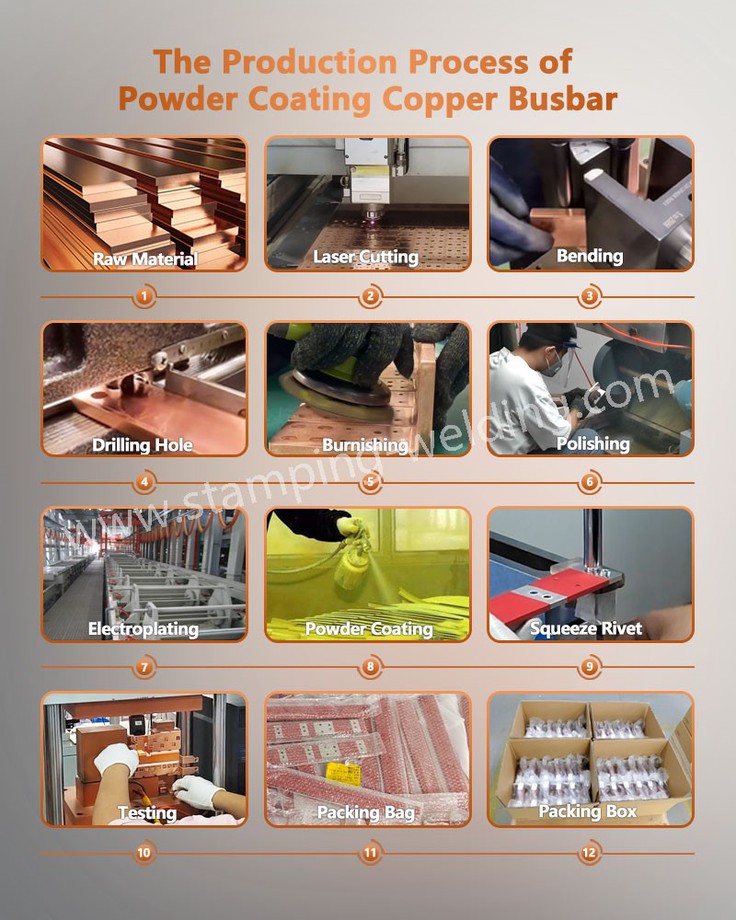
Insulation Coating Busbar forms a dense insulation layer through an electrostatic spraying process, and its dielectric strength can reach 20-30 kV/mm, and its withstand voltage can meet the requirements of 38 kV medium voltage systems. This insulation layer can not only effectively isolate the conductor from the external environment, but also resist arc discharge and corona effects, significantly reducing the risk of system short circuits.
2. Adaptability to extreme environments
The coating material has a wide temperature range stability of -45℃ to 150℃, and can still maintain mechanical strength in high temperature environments. At the same time, it shows excellent anti-aging performance in corrosive environments such as humidity and salt spray. For example, in industrial plants in coastal areas, Electroplating and Powder Coating Busbars can pass a 240-hour salt spray test, and the service life is more than 3 times longer than that of traditional insulation materials.
3. Environmental protection and sustainability
Compared with traditional liquid coatings, Epoxy Powder Coat Busbars use 100% solid materials, have no volatile organic compound (VOC) emissions, and meet global environmental regulations. For example, the VOC emission standards recently updated by the US EPA include electrical coatings in the control, and epoxy powder coatings have become the first choice for compliance due to their low pollution characteristics.
market explosion: new energy and smart grid drive demand surge
As the global energy structure transforms to low-carbon, the market demand for epoxy powder-coated insulated busbars has shown exponential growth.
Application scenario expansion
1. New energy infrastructure
In the fields of photovoltaic inverters, energy storage batteries, etc., powder-coated busbars can optimize power transmission efficiency due to their low inductance design and high heat dissipation efficiency. For example, in distributed photovoltaic power stations, the junction box using epoxy powder-coated busbars can reduce energy loss by more than 15%.
2. Data center and industrial automation
The high-density power demand of data centers drives the Busbar Coating with Epoxy Coating Powder to miniaturization and integration. Epoxy powder-coated busbars can achieve 30% space savings and support rapid installation through modular design to meet the "plug and play" deployment requirements of data centers.
3. Smart grid upgrade
The intelligent transformation of the power grid requires the Busbar Insulating Coating Powder to have fault warning and self-repair capabilities. The combination of epoxy powder coating and sensor technology can monitor the insulation layer status in real time, warn of potential faults in advance, and improve the stability of the power grid.
Market size and growth
According to industry analysis reports, the global laminated busbar market is expected to grow at a compound annual growth rate of 6%, reaching US$1.296 billion by 2030, of which the epoxy powder coating segment accounts for the largest share. In China, the rapid development of new energy vehicles and energy storage industries has further driven demand, and the relevant market size is expected to exceed 5 billion yuan in 2025.
Technology trends: material innovation and manufacturing process upgrades
The industry is improving the performance boundaries of Epoxy Power Coating Insulated Busbars through material science breakthroughs and intelligent manufacturing technology.
Directions of material innovation
1. Nano-enhanced coating
The introduction of nanomaterials such as graphene can enhance the barrier properties and thermal conductivity of the coating. For example, the graphene composite Busbar Coating developed by South China University of Technology has a 50% increase in wear resistance in a corrosive and wear environment, while the thermal conductivity is increased by 30%.
2. Low VOC and low temperature curing technology
The new generation of Busbar Epoxi Powder Coatings can be cured below 120℃, reducing energy consumption, and at the same time reducing VOC emissions to 10 g/L or less by optimizing the formula, meeting the stringent requirements of EU REACH regulations.
contact us


