Flex Connector: Innovative Breakthroughs And Industry Applications Of Flexible Connection Technology
Dec 10, 2025
As a key connecting component in electronic devices and industrial systems, Flex Connector has become a core solution for solving connection challenges in complex scenarios, relying on its core characteristics of flexibility, vibration resistance, and high reliability. It breaks through the application limitations of traditional rigid connectors, enabling stable transmission of signals and power in confined spaces, dynamic environments, and harsh working conditions. Braided Copper Flexible Wire Connectors is widely used in new energy, industrial automation, consumer electronics, medical equipment, and other fields. Compared with traditional connectors, the flexible structural design of Braided Wire Flexible Copper provides stronger environmental adaptability, effectively reducing the impact of installation errors and improving the overall operational stability of equipment.

Structural Design: Precise Balance Between Flexibility and Stability
The structural design of Copper Stranded Flexible Connection directly determines its adaptability and service life, consisting of three core modules:
- Conductive Path Layer: Minimizing Transmission Loss
Braided Tin Coated Copper Flexible Wire Connectors adopts precision circuit layout, with single-core or multi-core structures designed according to transmission requirements to ensure minimal signal/power transmission loss.
- Flexible Substrate Layer: Balancing Flexibility and Strength
As the core bearing structure, it needs to balance flexibility and mechanical strength. Common Braided Tin Coated Copper Flexible Connectors structures include single-layer flexible, multi-layer composite, and foldable designs.
- Protective Sealing Layer: Adapting to Harsh Environments
Waterproof, dustproof, and corrosion-resistant structures are designed for different application scenarios. Some high-end products add electromagnetic shielding layers to adapt to harsh industrial environments.
The core principle of Copper power braid structural design is to ensure the mechanical strength and electrical performance of the connection points while maintaining flexible deformation capacity, avoiding wire breakage or poor contact caused by frequent bending.
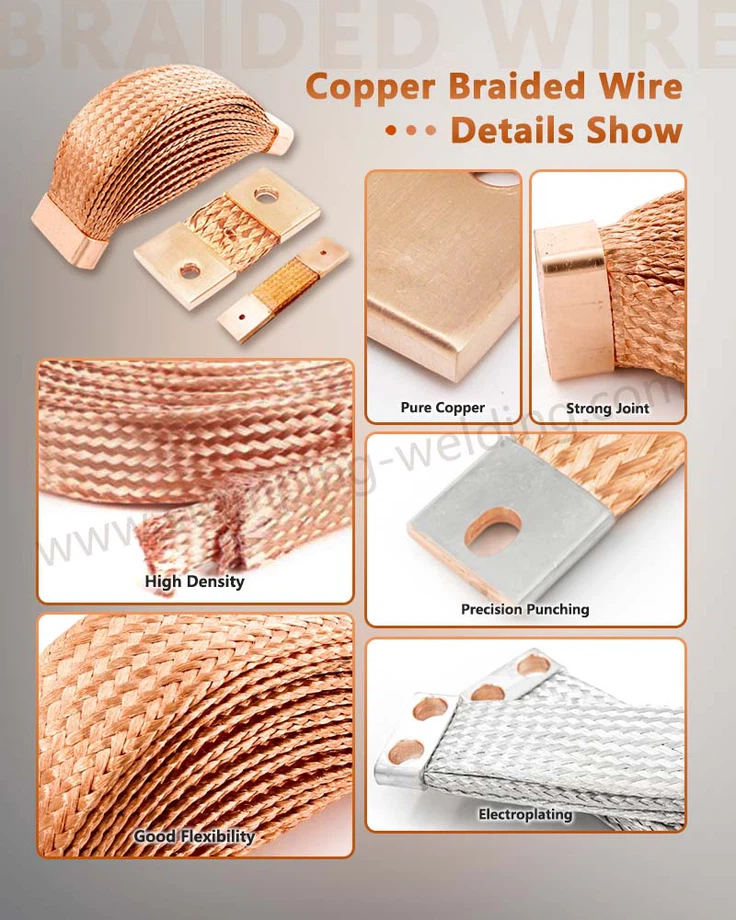
Material Selection: Precise Matching of Performance and Scenarios
Materials are the foundation for Round Braided Stranded Flexible Cords to achieve core functions, and the material selection of different components must meet specific technical requirements:
- Conductive Materials: Ensuring Stable Conductivity
Mainstream uses high-conductivity copper alloys (such as phosphor bronze and brass), while gold-plated or silver-plated materials are selected for high-end scenarios to enhance oxidation resistance and conductive stability.
- Flexible Substrates: Withstanding Extreme Conditions
Braided Copper Flexible Wire Connectors' ommon materials include high-temperature resistant and bend-resistant polyimide (PI) and polyester (PET), ensuring stable operation in environments ranging from -40℃ to 125℃.
- Packaging Materials: Balancing Protection and Sealing
Silicone, epoxy resin, or polytetrafluoroethylene (PTFE) are selected according to application scenarios, balancing sealing performance and mechanical protection.
The core Braided Wire Flexible Copper logic of material selection is "scenario adaptation". For example, the new energy vehicle field focuses on high-temperature resistance and vibration resistance, while medical equipment needs to meet biocompatibility and high-precision transmission requirements.

Production Process: Precision Manufacturing and Quality Control
The production process of Copper Stranded Flexible Connection integrates precision processing and strict quality inspection, with core processes including:
- Substrate Pretreatment: Enhancing Surface Adhesion
Improves substrate surface adhesion through cleaning, coating, and other processes, laying the foundation for subsequent processing.
- Circuit Forming: Achieving Micron-Level Precision
Braided Tin Coated Copper Flexible Wire Connectors uses photolithography, etching, or laser cutting technology to achieve micron-level circuit precision and ensure transmission performance.
- Assembly and Packaging: Ensuring Precision and Quality
Automated equipment completes the precise bonding of conductive terminals and substrates, Copper power braid with strict control of bubbles and impurities during the packaging process.
- Quality Inspection: Guaranteeing Reliability
Covers continuity testing, bending life testing, environmental reliability testing (high and low temperature, humidity, salt spray, etc.) to ensure Braided Tin Coated Copper Flexible Connectors qualification rate.
Advanced production processes are the guarantee of product performance. For example, the bending life test needs to reach more than 100,000 times to ensure stable operation during the equipment's service life.

Industry Application Trends
As electronic devices develop towards miniaturization, integration, and high reliability, the application scenarios of Round Braided Stranded Flexible Cords continue to expand: in the new energy field, it is used for flexible connection between battery packs and electronic control systems; in industrial automation, it adapts to the dynamic transmission needs of robot joints; in the consumer electronics field, it helps the lightweight design of foldable mobile phones and wearable devices. In the future, Flex Connector will move towards the direction of "higher transmission rate, better environmental adaptability, and lower cost", becoming a core breakthrough in connection technology innovation.
Contact us