Industry Knowledge Of Stainless Steel Stamping Parts: Focus On Tapping
Feb 23, 2025
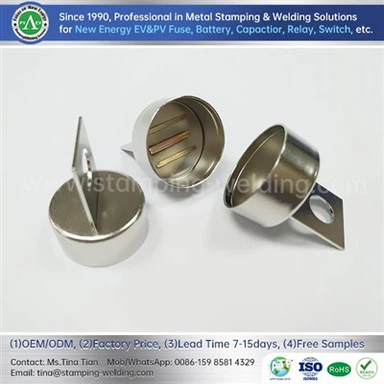
Stainless steel stamping parts are widely used in various fields, such as automobile manufacturing, electronic equipment, mechanical engineering, etc., due to their excellent corrosion resistance, high strength, and good processing performance. The following is a detailed introduction to the production process of stainless steel stamping parts, especially focusing on the tapping process.

1. Overview of the production process of stainless steel stamping parts
Material preparation: According to the product design requirements, select Carbon Steel Sheet Metal Stamping or coils with suitable specifications, models,s, and materials. For example,304 or 316 stainless steel may be used 304 or 316 stainless steel may be used for stamping parts that require higher strength and corrosion resistance. The cut and level the material to meet the dimensional requirements of the stamping process.

Mold design and manufacturing: Design and manufacture special stamping molds based on the shape, size, and precision requirements of the product. The quality of the mold directly affects the precision and production efficiency of the custom metal stamp parts. Therefore, it is necessary to use high-quality mold steel materials and advanced processing technologies such as CNC machining and EDM to ensure the precision and surface quality of the mold.
Stamping: Put the prepared Stamping Carbon Steel material into the stamping machine, and through the die punching, bending, stretching, and other processes, the material is plastically deformed to obtain the stamping parts of the required shape. During the stamping process, the pressure, speed,d, and stroke of the stamping machine need to be accurately controlled to ensure the dimensional accuracy and surface quality of the stamping parts.

Tapping: This is a key process for processing internal or external threads on carbon steel stamping parts, which is used to achieve threaded connections between parts. The tapping process will be introduced in detail next.
Subsequent processing: including deburring, cleaning, surface treatment (such as electroplating, painting, passivation, etc.,) and quality inspection processes to improve the appearance quality, corrosion resistance,ce and service life of progressive stamping Steel Metals, and ensure that the products meet quality standards.
2. Detailed explanation of the tapping process
(I) Preparation before tapping
| Determination of bottom hole size | Reasonable bottom hole size is the key to successful tapping. Generally speaking, for threads with a pitch of less than 1mm, the bottom hole diameter is equal to the nominal diameter minus the pitch; when the pitch is greater than 1mm, the bottom hole diameter is equal to the nominal diameter minus 1.1 times the pitch. For example, for an M6×1 thread, the bottom hole diameter should be 6 - 1 = 5mm; for an M8×1.25 thread, the bottom hole diameter should be 8 - 1.25×1.1≈6.6mm. Accurate bottom hole size can reduce the difficulty of tapping and prevent problems such as tap breakage or thread rot. |
| Bottom-hole processing methods | Common bottom-hole processing methods include mechanical drilling and laser drilling. Mechanical drilling is suitable for standard hole diameters in mass production. Using cobalt or aluminum super-hard high-speed steel drill bits can improve drilling efficiency and quality. During the drilling process, keep the drill stable, control the feed speed, avoid overheating or damage to the drill, and use cooling lubricants to reduce friction and heat. Laser drilling is suitable for processing complex patterns and non-standard apertures. It has the advantages of high precision, high speed, and contactless processing. It has a small heat-affected zone and can maintain the original performance of the material. |
| Tap material | Cobalt or aluminum super-hard high-speed steel taps should be selected. Such materials have better wear resistance and hardness, and can effectively cope with the high hardness and viscosity of stainless steel. |
| Tap parameters | The main deflection angle is related to the pitch and the number of taps. The head cone κr is generally 5° - 7°, and the second and third cones are κr = 10° - 20°. The calibration part generally takes 3 - 4 thread lengths and has a reverse taper of 0.05 - 0.1mm/100mm. The chip groove direction is generally β = 8° - 15° to control the chip flow direction. The front angle of the tap is generally γp = 15° - 20°, and the back angle is 8° - 12°. |
(II) Key points of tapping operation
| Manual tapping | Suitable for small-batch production or maintenance operations. During operation, first place the tap vertically into the bottom hole, then slowly turn the wrench, apply appropriate pressure, and gradually cut the tap into the material. During the cutting process, carefully check and correct the position of the tap to ensure that the tap axis is perpendicular to the plane of the workpiece. When the tap is cut into a certain depth, only turn the wrench and no longer apply pressure to avoid damaging the thread profile. |
| Mechanical tapping | In large-scale production, mechanical tapping is often used, such as using a tapping machine. The tapping machine can realize automated operation, and improve production efficiency and processing accuracy. When using a tapping machine, ensure that the workpiece is clamped in the correct position, and try to place the center line of the threaded hole in a horizontal or vertical position to facilitate the judgment of whether the tap axis is vertical. At the same time, set the appropriate cutting speed and feed rate according to the material and tap specifications. |
| Cooling and lubrication | Cooling and lubricating fluid must be used during tapping. Cooling lubricant can not only reduce cutting temperature and tap wear, but also play a lubricating role, inhibit the adhesion of stainless steel to taps, and improve the surface quality of threads. Commonly used cooling lubricants include sulfurized oil + 15% - 20% ccl4, white lead oil + engine oil, other mineral oils, kerosene diluted chlorinated paraffin, etc. Rapeseed oil can also be used for stainless steel tapping when a small number of machine repair parts are used. |
| Retracting and chip removal | During the tapping process, the tool should be retracted and reversed frequently to remove chips in time to prevent chips from clogging the chip groove, causing the tap to break or the thread quality to deteriorate. For non-through-hole threads, the tap should be retracted frequently to remove chips from the hole. |
(III) Quality inspection after tapping
Thread size inspection: Use a thread gauge to inspect the processed threads to check whether the major diameter, minor diameter, middle diameter, pitch, and tooth angle of the threads meet the design requirements. Thread gauges are divided into through gauges and stop gauges. Through gauges, they should be able to be screwed into the thread smoothly, and stop gauges should not be screwed into or can only be screwed into 1-2 turns, otherwise,e the thread size is unqualified.
Thread surface quality inspection: Check whether there are scratches, burrs, rotten teeth, and other defects on the thread surface by visual inspection or with the help of tools such as magnifying glasses. Threads with good surface quality should be smooth and free of obvious defects to ensure the reliability and sealing of threaded connections.

In short, the tapping link is crucial in the production of stainless steel stampings. From careful preparation before tapping, to strict operation during tapping, to quality inspection after tapping, each step directly affects the quality and performance of stampings. Only by mastering the tapping technology can high-quality stainless steel stampings be produced to meet the needs of different industries.
contact us