How to Select a Reliable Laminated Busbar Manufacturer: Design Guide for Low-Inductance Busbars for New Energy Vehicle Inverters and Energy Storage Systems
Jul 31, 2026
SiC MOSFET and IGBT modules used in new energy vehicle (NEV) inverters, energy storage PCS units, and photovoltaic inverters are evolving toward higher frequencies and higher power densities. Traditional single-layer busbars, due to their large current loop areas, generate significant parasitic inductance, which can lead to voltage overshoot and EMI issues during high-speed switching.
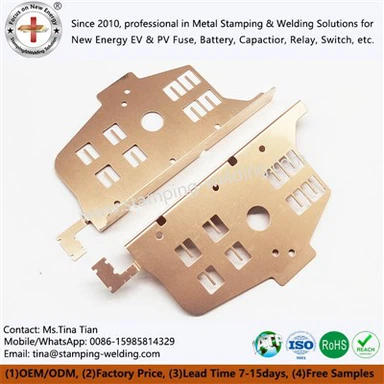
Specially designed Laminated Busbar utilize tightly stacked positive and negative copper layers to create a magnetic field cancellation effect between opposing currents. This design keeps stray inductance below 10 nH, effectively reducing switching stress on power devices and enhancing system reliability.
For NEV Tier 1 and Tier 2 suppliers, battery pack manufacturers, and power electronics equipment makers, selecting a laminated busbar supplier requires looking beyond price; it is essential to evaluate the supplier's capabilities in copper processing, insulation lamination, welding and assembly, dimensional control, and automotive quality management systems.

Design Requirements for Low-Inductance Laminated Busbars in SiC/IGBT Inverters
1. Control of stray inductance determines power module reliability
SiC MOSFET and IGBT modules feature high-speed switching capabilities. As the rate of change of current (di/dt) increases, the parasitic inductance within the interconnection structure generates a voltage defined by:
V = L × di/dt
Consequently, even if the power module itself meets rated voltage requirements, a poorly designed busbar can lead to transient voltage spikes that result in:
- Overvoltage of power devices;
- Increased switching losses;
- Increased EMI;
- Reduced semiconductor lifespan.
Low-inductance laminated busbar designs typically need to meet the following requirements:
| Item | Engineering Requirements |
| Copper Material | C1100 pure copper, conductivity ≥99.5% IACS |
| Stray Inductance | <10 nH (high-speed IGBT/SiC applications) |
| Dimensional Tolerance | ±0.01 mm |
| Dielectric Strength | >15 kV/mm (depending on material system) |
2. Magnetic field cancellation structure enables low-inductance performance
The core principle behind inductance reduction in laminated busbars is shortening the current loop distance between the positive and negative terminals.
Traditional copper busbars:
- Large distance between positive and negative terminals;
- Magnetic fields cannot effectively cancel each other out;
- High parasitic inductance.
Laminated busbars:
- DC+ and DC- terminals are closely spaced;
- Current flows in opposite directions;
- Magnetic fields cancel each other out;
- Loop area is reduced.
Key design parameters affecting inductor performance:
| Parameter | Impact on Performance |
| Copper layer spacing | Smaller spacing results in stronger magnetic coupling |
| Copper layer thickness | Determines current-carrying capacity |
| Terminal structure | Affects local current concentration |
| Inter-layer alignment accuracy | Affects current distribution uniformity |
Therefore, a qualified laminated busbar manufacturer requires not only manufacturing capabilities but also expertise in electromagnetic analysis and structural optimization.

Share your busbar drawing, voltage/current requirements, or application details for engineering feedback.
Insulation System Design: How to Choose Between PET, Kapton, and Nomex Materials
The long-term operational reliability of laminated busbars depends largely on the insulation materials.
The insulation layer must simultaneously meet the following requirements:
- High dielectric strength;
- Low moisture absorption;
- High-temperature stability;
- Thermal cycling reliability;
- Good interlaminar adhesion.
Properties of common materials:
| Material | Temperature Range | Characteristics | Applications |
| PET | -40°C to 125°C | Low cost, stable performance | Standard EVs, power systems |
| Kapton PI | -269°C to 400°C | High temperature resistance, high insulation | High-power inverters |
| Nomex | ≤220°C | Excellent heat resistance | Rail transit, high-reliability equipment |
In new energy vehicle applications, the insulation thickness requires a balance among:
- safety clearance;
- stray inductance;
- heat dissipation capability.
Excessive insulation thickness:
→ increases the distance between positive and negative terminals
→ increases parasitic inductance
Insufficient insulation thickness:
→ reduces voltage withstand capability
→ increases the risk of partial discharge
Therefore, custom laminated busbar projects require material selection tailored to the specific voltage rating, current, and operating environment.

Laminated busbar manufacturing processes determine long-term reliability
Many busbar projects pass initial testing but exhibit the following issues after prolonged thermal cycling:
- Interlayer delamination;
- Insulation failure;
- Solder cracks;
- Increased contact resistance.
The causes typically stem from inadequate manufacturing process control.
1. Precision Copper Processing Capabilities
Laminated busbar manufacturing involves:
- Precision stamping;
- Laser cutting;
- CNC machining;
- Stamping die development.
Commonly used materials:
| Material | Characteristics |
| C1100 Pure Copper | High electrical conductivity; suitable for high-current connections |
| C1020 Copper | High-purity copper material |
| C2680 Brass | Relatively high mechanical strength |
Key controls:
- Flatness;
- Hole position accuracy;
- Edge burrs;
- Dimensional tolerances.
2. High-Reliability Welding Technology
Different applications require different joining methods:
- Laser Welding: Characterized by a small heat-affected zone and high precision; suitable for joining copper and aluminum as well as high-precision electrical connections; minimizes welding deformation and enhances connection reliability.
- Resistance Welding: Offers high levels of automation and production efficiency; ideal for high-volume, standardized manufacturing; widely used in new energy vehicles and electrical connection components.
- Silver Brazing: Features low contact resistance and excellent electrical conductivity; suitable for high-reliability electrical connections; helps reduce temperature rise in the connection area.
- Molecular Diffusion Welding: Achieves joint strength approaching that of the base material; characterized by low resistance and high reliability; suitable for high-current, high-power-density applications.
3. Vacuum Hot-Press Lamination Process
A Laminated Busbar is not merely an assembly; it is an integrated structure formed through vacuum hot-press lamination.
Key control parameters:
| Parameter Control | Objective |
| Vacuum level | Eliminate internal air bubbles |
| Pressure | Ensure interlaminar bonding |
| Temperature profile | Control resin curing |
| Cooling rate | Reduce thermal stress |
Must be avoided:
- Voids;
- Interlayer misalignment;
- Insufficient resin;
- Insulation cracking.
Request OEM Laminated Busbar Manufacturing Support
Why Choose Us as Your Laminated Busbar OEM Supplier?
For customers in the new energy vehicle, energy storage, and power electronics sectors, supplier capability is defined not merely by the manufacturing of individual products, but by end-to-end process control-spanning everything from design support to mass production delivery.
Xiamen Apollo Stamping Welding Technology Co., Ltd. possesses comprehensive manufacturing capabilities for metal stamped and welded components for new energy applications, offering support for:
1. Comprehensive Manufacturing Capabilities
The company possesses:
- Precision stamping workshops;
- Laser welding production lines;
- Vacuum welding and diffusion bonding capabilities;
- CNC machining capabilities;
- Electroplating and surface treatment capabilities;
- Automated assembly capabilities.
Product coverage includes:
- Copper busbars;
- Battery interconnects;
- Fuse contact blades and caps;
- Metal stamped parts;
- High-voltage electrical connection assemblies.
2. Automotive Industry Quality System Support
For new energy vehicle projects, the company manages production in accordance with:
- ISO 9001 quality management systems;
- IATF 16949 automotive quality management systems.
We provide support for:
- PPAP Level 3 documentation;
- Product dimensional reports;
- Material certifications;
- Control plans;
- Process traceability.
3. From sample development to mass production delivery
For different project stages:
| Stage | Support Provided |
| Product Development | DFM analysis, structural optimization |
| Prototyping | Rapid prototyping, performance verification |
| Small-batch Production | Process optimization |
| Mass Production | Stable delivery |
Through in-house mold development and multi-process manufacturing capabilities, we can shorten customer development cycles and enhance supply chain stability.

Typical application areas
Laminated Busbar are primarily used in:
| Application Areas | Product Requirements |
| New Energy Vehicles | EV inverters, battery packs |
| Energy Storage Systems | PCS, battery cluster connections |
| Photovoltaic Systems | High-voltage inverters |
| Industrial Equipment | Variable frequency drives, motor drives |

Key Questions for Procurement to Confirm When Selecting a Laminated Busbar Supplier
When evaluating suppliers, procurement and engineering teams should focus on verifying the following:
- Do they possess capabilities for copper processing and mold development?
- Do they have key process capabilities such as laser welding and diffusion welding?
- Can they provide PPAP documentation?
- Do they have experience with IATF 16949 automotive projects?
- Can they support the transition from prototyping to mass production?
Low-inductance laminated busbars are not merely copper-processed products; they are complex engineering components involving materials science, electromagnetics, thermal management, and precision manufacturing.
FAQ
Q: Can suppliers of laminated busbars for new energy vehicles provide PPAP Level 3 documentation?
A: Yes. Xiamen Apollo Stamping Welding Technology Co., Ltd. can provide PPAP Level 3 documentation in accordance with automotive project requirements, including dimensional reports, material certifications, process flow charts, control plans, and process capability analyses.
Q: How long does it take to develop laminated busbar samples?
A: Depending on the structural complexity and whether new tooling development is required, the sample lead time is typically 7 to 30 working days.
Q: How is long-term low-resistance operation of the laminated busbars ensured?
A: Long-term current-carrying stability is ensured through the selection of C1100 copper, surface treatment, welding quality control, dimensional inspection, and thermal cycling testing.
Contact Us
If you are developing inverters for new energy vehicles, traction battery packs, energy storage PCS, or industrial power electronics, and are seeking a supplier of laminated busbars with capabilities in precision stamping, welding, and automotive quality systems, please contact us. Xiamen Apollo Stamping Welding Technology Co., Ltd. offers DFM analysis, sample validation, and mass production support tailored to your drawings, current specifications, and application environments.