A study on common surface treatment processes for 304 stainless steel punching
Apr 16, 2026
Overview of 304 stainless steel punching surface treatment
After rolling, bending, welding, and high-temperature processing, the surface of Stamping 304 stainless steel is prone to the formation of a hard gray black oxide layer, mainly composed of nickel chromium oxide. This type of oxide layer not only lowers the appearance and texture of the product, but also weakens the anti-corrosion performance of the substrate itself. In order to comprehensively improve the appearance quality, dimensional accuracy, and service life of workpieces, the industry generally implements standardized surface processing for Stainless steel sheet metal stamping.
At present, the mainstream processing techniques are mainly divided into three categories: natural whitening treatment, mirror gloss treatment, and protective coloring treatment, which can be flexibly selected based on differences in workpiece structure, accuracy standards, and appearance requirements.

Natural whitening treatment process
The core function of natural whitening is to remove the oxide skin, oil stains, and various impurities on the surface of 304 stainless steel punching, restore the original silver white matte texture of stainless steel, and strengthen the basic rust prevention ability. The traditional strong acid corrosion process has been gradually phased out due to its high cost, strong pollution, and harm to personnel health.
The current mainstream solutions in the industry are divided into two modes: physical and chemical. Shot blasting and sandblasting rely on physical impact to remove surface oxide impurities, which are more suitable for large and structurally complex workpieces; Environmentally friendly chemical treatment uses passivation paste and neutral non-toxic cleaning solution to soak and clean at room temperature. The operation is gentle and suitable for Custom stainless steel stamping with complex shapes. After treatment, the color is uniform and the environmental friendliness is outstanding. It has become the preferred process for large-scale production.
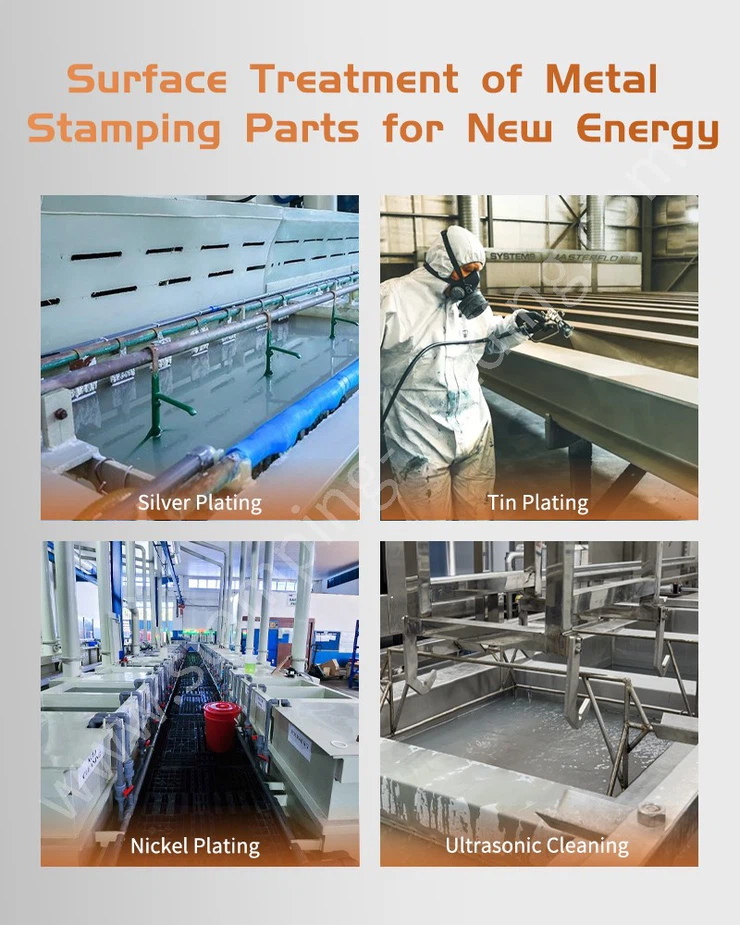
Mirror Bright Polishing Process
Mirror treatment is mainly used to improve the surface smoothness and reflective texture of Stainless metal stamping. According to the processing method, it can be divided into three types: mechanical polishing, chemical polishing, and electrochemical polishing. Mechanical polishing has good leveling effect and high brightness of finished products, but it has high operating intensity and obvious pollution, and is only suitable for small and medium-sized workpieces with simple structures. Complex components are difficult to achieve overall gloss uniformity.
Chemical polishing has low investment cost and high processing efficiency, and can be adapted to the processing of irregular Stainless steel stamped parts. However, the surface brightness is limited and ventilation facilities are required. It is mostly used for low demand, small batch products. Electrochemical polishing process is stable, has low pollution, and has high comprehensive cost-effectiveness. The finished mirror effect is long-lasting and wear-resistant, making it a universal polishing solution for high-end precision stainless steel stamping parts.

Protective coloring treatment process
The stainless steel coloring process can endow workpieces with diversified colors, enhance product decoration and market added value, and further strengthen the surface wear resistance and corrosion resistance. OEM stainless steel stamping parts are widely used in high-end hardware, automotive parts, decorative components and other fields. Common coloring techniques include ion deposition oxidation, high-temperature oxidation, chemical oxidation, electrochemical oxidation, and gas-phase cracking.
Among them, ion deposition method is suitable for large-scale production, with stable and durable colors, but the equipment investment cost is relatively high; High temperature oxidation, chemical oxidation, and electrochemical oxidation processes are mature, with easily controllable parameters, and can produce batches of uniformly colored products Stainless steel zinc plating drawing stamping parts; The operation process of gas-phase cracking method is complex, and its practical industrial application is limited.
contact us
The reasonable selection of surface treatment processes directly affects the quality, performance, and service life of 304 stainless steel punching products. Matching and adapting processes based on product operating conditions, appearance requirements, and production costs is the core of controlling production quality. If you have customized processing, surface technology selection, material matching and other related needs for Stainless steel clip, please feel free to consult at any time. We can provide professional process solutions and full process supporting processing services.