Braided copper wire and flexible copper braided busbar industry knowledge popularization
May 22, 2026
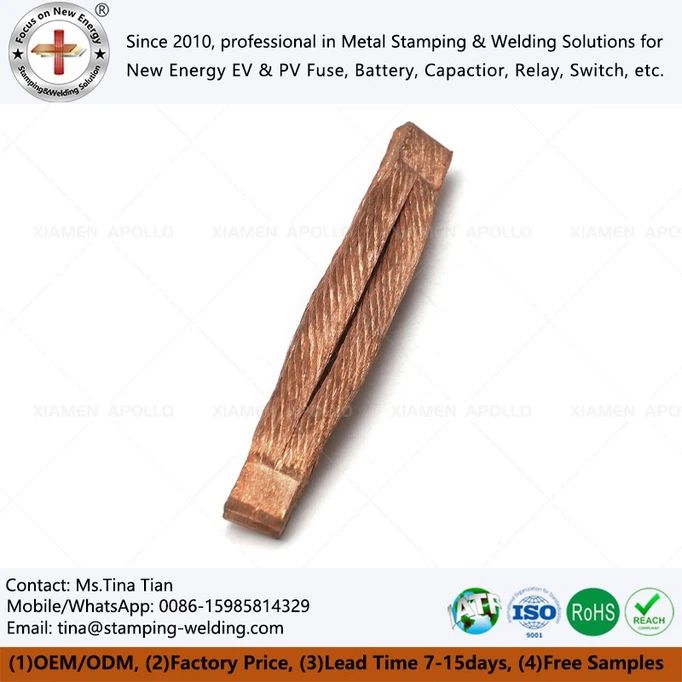
Braided copper wire is a very practical flexible conductive material in the field of power electronics. It relies on multiple strands of fine copper wires to be precisely woven and interwoven, completely breaking the structural limitations of traditional hard copper conductors. It has excellent conductive properties and flexible deformation capabilities, and is widely suitable for various industrial scenarios such as power transmission, equipment connection, and lightning protection grounding. The core application advantage of this material is to optimize the current conduction efficiency through a proprietary braided structure, while greatly improving the flexibility, fatigue resistance and heat dissipation capacity of the wire. It can perfectly adapt to equipment vibration, frequent bending, narrow space wiring and other working conditions that rigid wires cannot adapt to. It is an indispensable flexible conductive accessory in modern electrical systems and is often used as Copper Braided Wire in various electrical connection projects.
Material structural properties
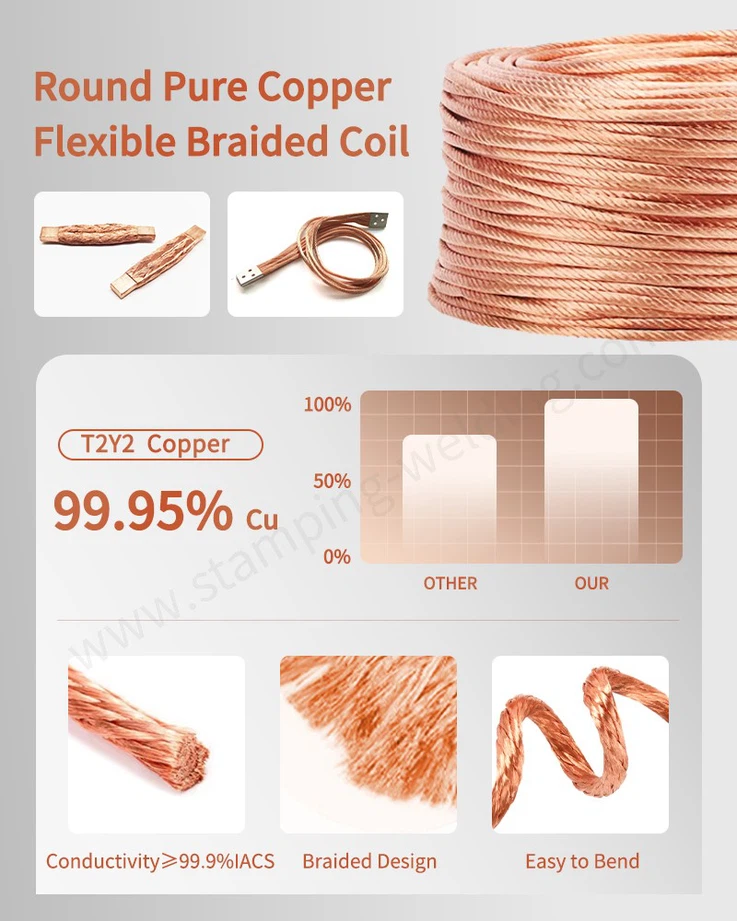
The structural characteristics of braided copper wire result from its unique manufacturing process. During the production process, dozens of strands composed of copper wires with a diameter of 0.1 to 0.5 mm are fed into the braiding machine at the same time, and are cross-wound according to the set interweaving rules to form a tubular or strip conductor similar to a textile mesh structure. Braiding density - that is, the ratio of copper wire coverage area to total surface area - is usually adjustable between 70% and 90%: higher braiding density makes the structure more compact and the conductive cross-sectional area more effective, but the flexibility is slightly reduced; lower braiding density provides greater bending freedom and heat dissipation channels, which is suitable for high-frequency bending scenarios.
From the perspective of cross-sectional shape, circular braided wires have omnidirectional bending capabilities and are suitable for complex path wiring; flat braided wires adhere more closely to the busbar or terminal surface and have lower contact resistance. On the material end, the braided copper wire base material is made of high-purity electrolytic copper, and the conductivity reaches a value close to 100% IACS (International Annealed Copper Standard), ensuring the lowest DC resistance under the same cross-sectional area. Copper Braided Flexible Busbar is based on this braided structure. While maintaining a current-carrying capacity similar to that of solid copper busbars, it reduces the bending radius to an extent that is beyond the reach of hard copper busbars.
Typical application scenarios
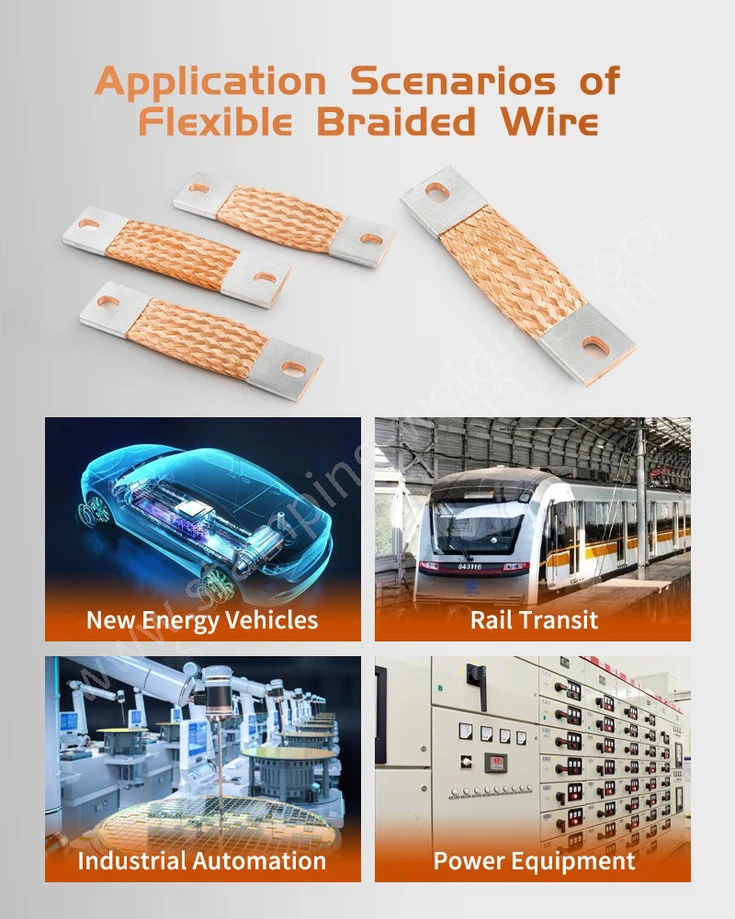
Power system equipment connection: In high and low-voltage switch cabinets, the soft connection between the upper and lower outlet terminals of the circuit breaker and the busbar requires the conductor to have both high current-carrying capacity and a certain degree of displacement compensation capability. Braided copper wire has formed mature application specifications in such scenarios. In the transition connection from the low-voltage side lead of the transformer to the busbar, the braided wire can absorb the vibration and thermal expansion and contraction displacement of the transformer during operation, avoiding pull-off or seal damage caused by rigid connections. Braided copper wires are also widely used for parallel connections of reactors and capacitor banks to achieve balanced shunting.
New energy field: In electric vehicle power battery packs, the series and parallel connections between multiple battery modules require flexible conductive connectors to cope with the thickness expansion during battery charging and discharging and vehicle driving vibration. In the battery cluster bus cabinet of an energy storage power station, braided copper wires are used to connect the battery poles and bus bars. Its low resistance characteristics help reduce energy loss during charge and discharge cycles. Industrial machinery and welding equipment: The secondary circuit of a large resistance welding machine needs to transport thousands of amps of welding current from the transformer to the electrode of the welding gun, and the circuit needs to bend frequently with the movement of the welding gun. The flexible structure and fatigue resistance of braided copper wire make it a standard configuration in this scenario. In the electrolytic cell conductive busbar and electric furnace short network system in the metallurgical industry, braided copper wires are also used to compensate for thermal expansion displacement.
Rail transit and special vehicles: The connection between the current receiver and the on-board electrical cabinet of subway and light rail vehicles must maintain conductive continuity when the vehicle vibrates and passes through curves. The laminated connection between the internal power module and the DC bus of the locomotive traction converter also often uses a flat braided copper wire solution. Copper Braided Busbars for Electrical play the role of "flexible electrical arteries" in the above scenario. Its irreplaceability stems from the natural limitations of hard connection solutions under dynamic working conditions.
Technology development trends
The evolution direction of braided copper wire technology is mainly focused on the two dimensions of material compounding and manufacturing automation. In terms of materials, copper alloy braided wires are developed to improve creep resistance in high-temperature environments, while aluminum core copper braided wires try to find a balance between cost and weight. In terms of manufacturing processes, the combination of continuous extrusion braiding technology and online quality inspection systems is improving product consistency levels. In surface treatment technology, the environmentally friendly cyanide-free silver plating process is gradually replacing the traditional cyanide-containing process to meet the environmental compliance requirements of export products. On the application side, with the popularization of 800V high-voltage platforms for electric vehicles, braided copper wires are facing higher requirements in terms of insulation withstand voltage levels and partial discharge control, which is driving the upgrading of insulation materials and the optimized design of braided structures. As a basic component in the electrical connection field, Flexible Braided BusBar's technological progress has always evolved in step with the trend of miniaturization and high power density of power electronic equipment.
contact us
Whether it is conventional or highly customized various types of Braided Wire Flexible Copper, we can provide high-quality products that meet international standards to help your engineering projects achieve safer, more efficient, and longer-lasting power connections.