Detailed explanation of copper foil soft connection technology
May 22, 2026
Product Overview
Copper foil soft connection is a high-current flexible conductive connection made of multiple layers of high-purity copper foil that are superimposed and welded. Its original design is to solve the technical contradiction in electrical systems where rigid conductors cannot balance current-carrying capacity and displacement compensation requirements. Between the transformer outlet and the busbar, between the switch cabinet drawer unit and the fixed busbar, and in the series-parallel circuit of the new energy vehicle battery pack, the thermal expansion displacement, mechanical vibration and installation tolerance accumulation caused by the operation of the equipment require the connector to have a certain degree of flexibility.
Copper foil soft connections achieve the unification of longitudinal high conductivity and transverse bending flexibility by decomposing a single cross-section conductor into a laminated structure of dozens to hundreds of independent copper foils. Each layer of copper foil can independently withstand bending deformation, and interlayer slip absorbs repeated movements with large displacements. This technical route distinguishes it from copper braided wires - the latter focuses on omnidirectional flexibility of multi-strand strands, while copper foil soft connections provide directional flexibility within a flat cross-section, which is particularly suitable for connection scenarios that require low inductance and large contact areas. For engineering designers, the Laminated Flexible BusBar represents a proven solution for achieving the dual goals of high current density and mechanical decoupling in a limited space.
Material selection and structural design
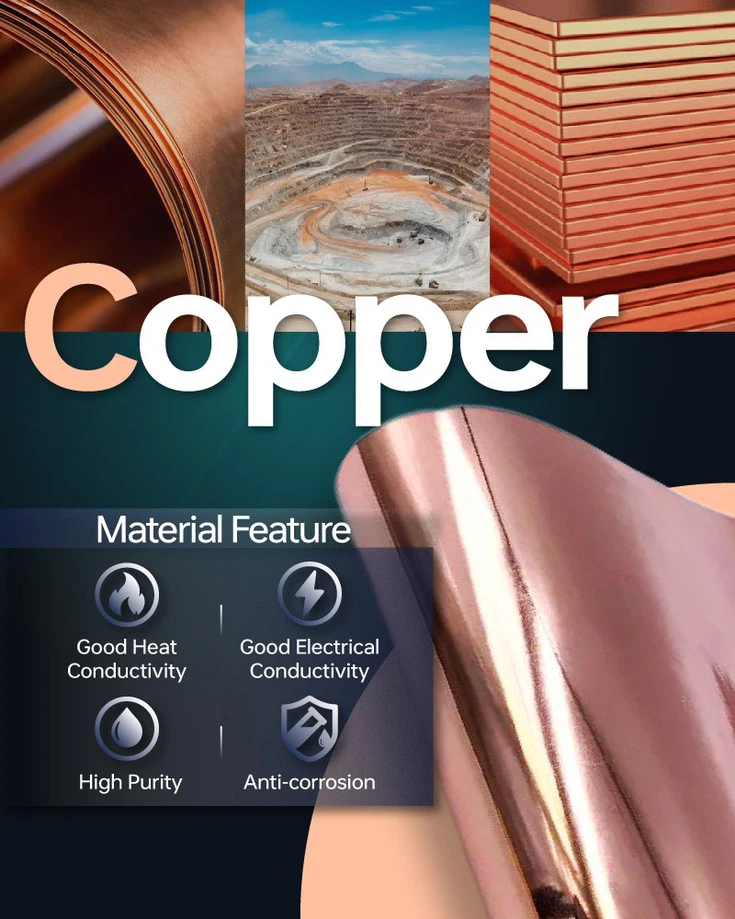
The base material of the copper foil soft connection is T2 or higher grade copper tape, with a copper content of not less than 99.95%, ensuring that the conductivity is close to the theoretical upper limit of 100% IACS (International Annealed Copper Standard). The thickness of a single copper foil ranges from 0.03 mm to 1 mm. The thin foil solution improves flexibility and reduces bending stress, and is suitable for scenarios that require frequent bending or a very small bending radius. The thick foil solution simplifies the number of stacks and reduces the difficulty of the welding process, and is suitable for fixed installations and connections that do not require high flexibility. The number of stacks is determined based on the total cross-sectional area and the thickness of the single piece. A typical soft connection of 25 square millimeters may be composed of dozens of layers of 0.1 mm copper foil, while specifications above 300 square millimeters may involve the precise alignment and simultaneous welding of hundreds of layers of copper foil.
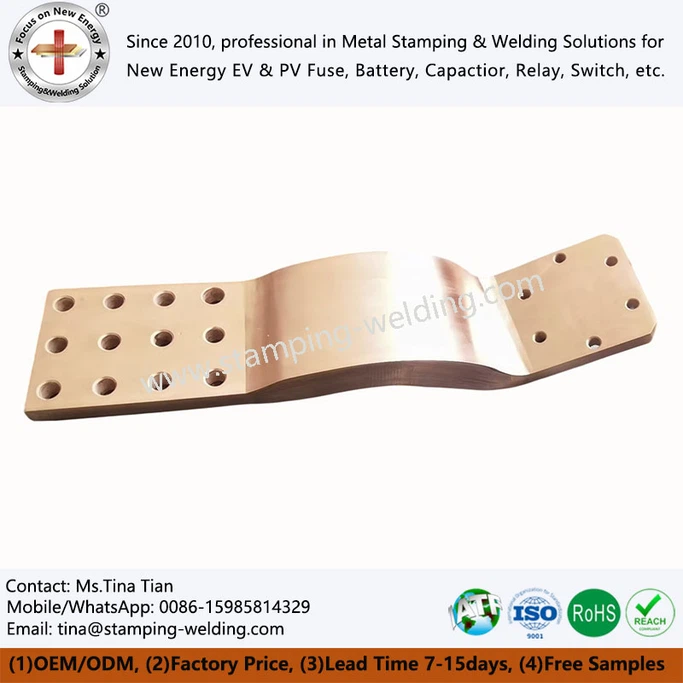
From the perspective of cross-sectional geometry, the main body of the copper foil soft connection is in the shape of a flat strip after forming. The two ends can be processed into various special-shaped structures such as co-directional flat ends, reverse flat ends, U-shaped elbows, Z-shaped offset ends or L-shaped right-angle ends according to installation requirements. This degree of design freedom allows the copper foil soft connection to fit into the complex spatial layout of the switch cabinet and complete the electrical overlap between the busbar and components within a limited gap. Tip dimensions-including width, thickness and overlap length-are customized to the specifications of the terminal being connected, ensuring complete coverage of the contact surface and precise alignment of the bolt holes. In terms of structural integrity, the density of the welding area and the bonding strength between layers directly determine the current-carrying capacity and long-term reliability of the product. Flexible Insulated Copper BusBar adds an insulating wrapping layer to the copper foil flexible connection to meet the requirements of high-voltage systems for creepage distance and electric shock protection.
Core manufacturing process
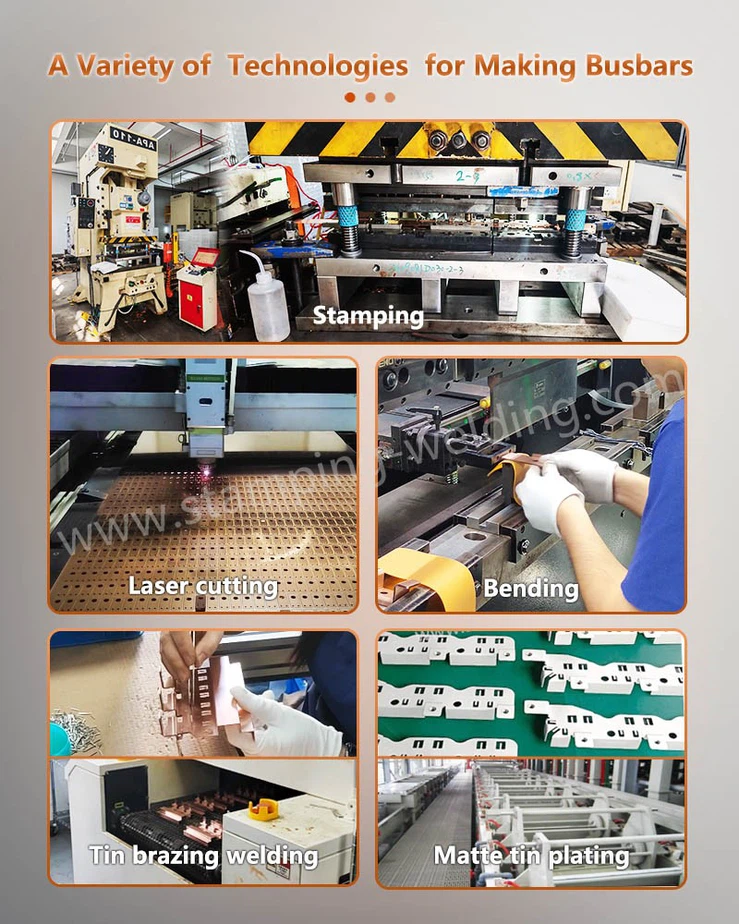
Polymer diffusion welding is a key technology in the manufacturing of copper foil soft connections, and its essence is a solid-state welding process. This process uses low voltage (typically 5 to 10 volts), high current (up to thousands of amps) to generate Joule heat in the copper foil stack while applying axial pressure of tens to hundreds of kilograms per square centimeter. Under the synergistic effect of high temperature (about 700 to 900°C) and high pressure, the atoms on the copper foil contact surface gain enough energy to break through the interface barrier, diffuse each other and form metallic bonds, ultimately realizing the integrated connection of multiple layers of copper foil. Unlike the fusion welding process, the copper foil does not melt during the polymer diffusion welding process, thus avoiding the formation of as-cast structures and the resulting increase in brittleness. The grain size of the weld area is similar to that of the base material, and the attenuation of mechanical properties and electrical conductivity is minimal. This process requires high cleanliness on the surface of the copper foil. Any oil or oxides will hinder the diffusion of atoms, resulting in weak soldering or insufficient bonding strength.
Therefore, deglazing, cleaning and reducing atmosphere protection before welding are prerequisites for ensuring welding quality. In terms of process adaptability, polymer diffusion welding has certain limitations on product size. When the width of the soft connection exceeds 90 mm or the thickness exceeds 60 mm, in order to ensure the flatness of the terminal contact surface and the uniformity of welding, it is usually necessary to attach a 1 mm thick copper plate to the end of the copper foil stack as a pressure transmission medium. When the width exceeds 140 mm or the thickness exceeds 130 mm, it is difficult to maintain the pressure uniformity of the diffusion welding mold. At this time, engineering often turns to the brazing process. The manufacturing quality of Flexible Copper Busbar Laminated Foils Connector is highly dependent on the precise control of diffusion welding process parameters - including heating current curve, pressure application timing, holding time and cooling rate - which need to be optimized on a case-by-case basis based on copper foil thickness, number of layers and product specifications.
Typical application scenarios
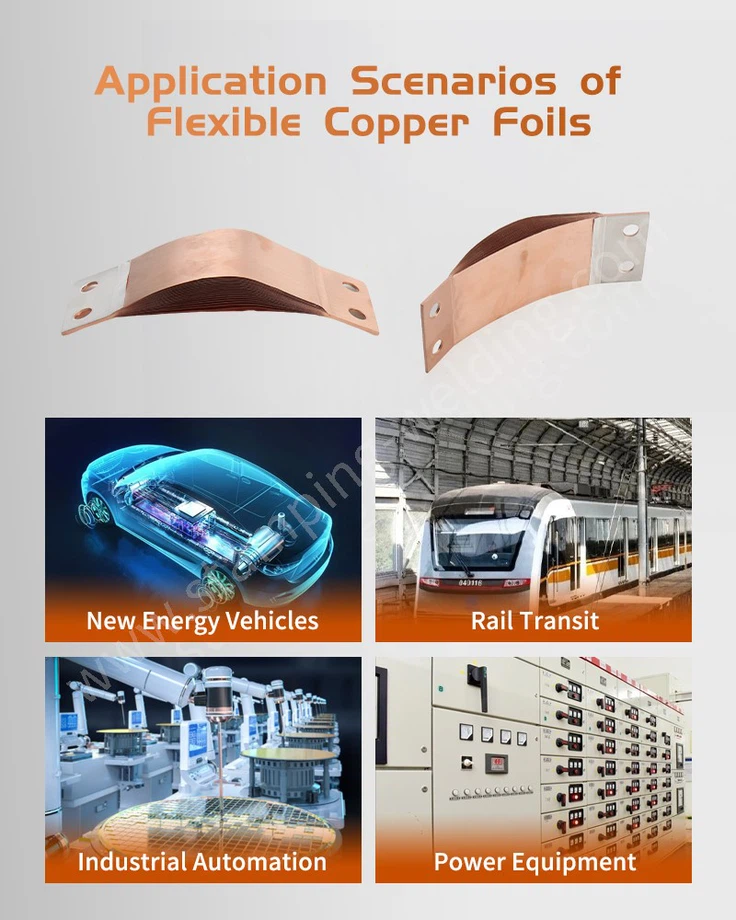
Power system equipment: The flexible connection between the generator outlet and the step-up transformer needs to compensate for vibration and thermal displacement during operation. Copper foil flexible connections have become mature applications in such high-current scenarios. In high and low-voltage switch cabinets, the connection between the upper and lower contact arms of the circuit breaker and the busbar requires the conductor to have both current-carrying capacity and a certain degree of displacement compensation capability. Copper foil soft connections are also widely used in the transformer neutral point ground loop, the DC side output busbar of the rectifier equipment, and the power supply busbar of the electrolytic smelting equipment.
New energy vehicle field: Within the power battery pack, the series and parallel connections between multiple battery modules require flexible conductive components to cope with the thickness expansion during battery charge and discharge cycles and the continuous vibration during vehicle driving. The three-phase AC bus connection between the electronic control system (motor controller) and the drive motor also benefits from the flat structure and low inductance characteristics of the copper foil soft connection. Flexible Battery Pack Copper Connectors play a key role in battery pack technology. Their low resistance and high fatigue resistance directly affect the energy efficiency and safe life of the battery system.
Energy storage system and communication equipment: The connection between the battery cluster and the busbar in the energy storage cabinet requires on-site adjustment capabilities that take into account high current carrying and installation tolerances. In communication equipment such as 5G base stations, the flat structure of copper foil soft connections helps control the radiation path of electromagnetic interference. Rail transit and special equipment: The internal power module connection of the traction converter of subway and light rail vehicles needs to maintain low contact resistance in a continuous vibration environment. In nuclear magnetic resonance equipment, special-shaped copper foil soft connections with a flatness requirement of 0.02 mm are used for precise thermal and electrical conductive connections of cold heads. Rectified power output circuits in chemical, carbon, marine and other industries also rely on copper foil soft connections to compensate for the thermal expansion and contraction displacement of long-distance busbars. The common value of Laminated Copper Flexible Connectors in the above scenarios is to provide predictable, low-loss, high-reliability flexible conductive channels in limited spaces.
contact us
We focus on the R&D and precision manufacturing of Copper foil flexible bus bar, and are committed to providing high-performance flexible conductive solutions to customers around the world. We can provide customized design and production services to ensure that your power system connection is reliable, safe and worry-free.