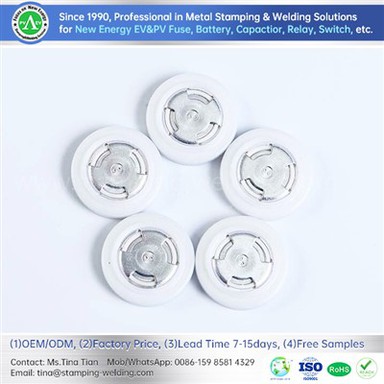
Why are Brass Precision Stamping Parts preferred for conductive terminals? A material and procurement guide for brass stamped terminals
Aug 15, 2026
In switches, sockets, relays, connectors, and low-voltage electrical appliances, conductive terminals need to simultaneously meet requirements for conductivity, connection, assembly, and long-term use. Therefore, material selection cannot be based solely on a single performance characteristic; it also requires comprehensive consideration of processing efficiency, dimensional stability, and bulk purchasing costs. Brass Precision Stamping Parts are widely used in conductive terminals primarily because brass offers a good balance between conductivity, mechanical properties, corrosion resistance, and stamping processability, making it suitable for most conventional electrical connection applications.

Why is brass suitable for use as conductive terminals?
For engineers and purchasing personnel, the material of conductive terminals must first meet the requirements of stable current transmission, while also being able to withstand mechanical forces such as assembly, insertion, bending, or crimping. Brass-stamped parts offer excellent conductivity and mechanical strength, and are easy to process by punching, bending, and forming, allowing for customization to different terminal structures.
Furthermore, terminals are typically installed inside equipment for extended periods, requiring stable dimensions and connection performance. Brass offers good corrosion resistance and processing adaptability, meeting the usage requirements of many terminals in typical electrical environments. For switch and socket products, Electrical Brass Stamping Parts for Switch Sockets achieve stable connection and assembly performance through appropriate material thickness, structural design, and stamping processes.
Why is stamping a suitable process for brass?
After determining the material, the manufacturing process also needs to be considered. For terminals with fixed structures and large demand, stamping is generally more suitable for mass production than single-piece machining. Custom brass sheet metal stamping parts can complete punching, trimming, bending, forming, and cutting processes using dies, improving production efficiency while maintaining good dimensional consistency.
The advantage of stamping lies not only in Brass Precision Stamping Parts production speed but also in its suitability for repetitive manufacturing. For terminals of the same specification, as long as the die and production parameters are stable, a large number of consistent parts can be continuously produced. Therefore, Brass Sheet Metal Components are particularly suitable for electrical component projects requiring long-term, stable supply, and also help purchasing personnel control overall costs in mass production.

How should you choose conductive terminals made of brass, copper, or stainless steel?
Material selection cannot be simply understood as "the higher the conductivity, the better." Copper generally has higher conductivity, but material cost and specific mechanical properties need to be evaluated in conjunction with product requirements; stainless steel has good mechanical strength and corrosion resistance, but its conductivity is generally not as good as copper and brass. Therefore, for general conductive terminals, brass often achieves a good balance between performance, processability, and cost.
| Material | Electrical conductivity | Stamping processability | Comprehensive cost | Common Applications |
|---|---|---|---|---|
| brass | high | excellent | Moderate | Electrical terminals, connecting pieces |
| copper | Very high | excellent | higher | High conductivity components |
| Stainless steel | lower | excellent | medium | Mechanical connection terminals |
Therefore, when selecting materials, one should consider current requirements, mechanical strength, working environment, structural design, and target cost, rather than comparing only one performance aspect.
Which conductive terminals are suitable for brass stamping?
Brass stamping can be applied to a variety of electrical connection structures. For small, complex parts, Brass Stamping Small Parts can achieve punching, bending, and partial forming using precision dies, suitable for applications such as relay terminals, switch contact links, and small connector parts.
If the product has high requirements for dimensional accuracy, tolerances, and assembly consistency, then die precision and process control need to be carefully considered. Brass Precision Stamping Parts are suitable for connector terminals, relay parts, precision conductive sheets, and other similar products. For these types of projects, engineers should confirm material thickness, critical dimensions, tolerances, and forming direction during the design phase to minimize subsequent assembly problems.

What parameters need to be confirmed when purchasing brass stamped terminals?
Once the procurement phase begins, product drawings are only the foundation; material and manufacturing requirements are equally important. When procuring Brass Custom Stamping Parts, it is recommended to confirm the material grade, sheet thickness, dimensional tolerances, surface treatment, annual purchase volume, and key functional requirements in advance. If the terminals involve bending, crimping, or insertion/removal, the corresponding mechanical properties and assembly requirements should also be specified.
For batch projects, it is also necessary to pay attention to mold design and lifespan, trial molding process, production cycle, quality inspection, and packaging methods. The supplier's ability to develop stable stamping equipment and molds directly impacts product consistency and long-term supply capacity. Clarifying these parameters in advance can reduce communication back-and-forth during the quotation and prototyping stages, improving project implementation efficiency.
Contact Us
If you are developing or sourcing brass conductive terminals, please provide product drawings, material specifications, dimensional requirements, and estimated purchase quantity. Advance evaluation of materials and stamping processes helps determine the appropriate manufacturing solution and improves project development efficiency.