Pure Copper (C1100) vs. Brass (C2680) Fuse Contact Caps: Thermal Stress & Conductivity
Sep 06, 2026
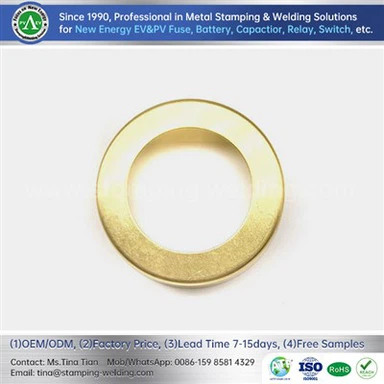
Pure Copper C1100 fuse contact caps provide electrical conductivity up to 100% IACS, while C2680 brass fuse caps offer higher mechanical strength with approximately 28% IACS conductivity. For high-voltage EV fuse applications operating under continuous current loads, material selection directly determines temperature rise, contact resistance stability, and long-term connection reliability.
The engineering decision between Pure Copper Fuse Contact Cap and Brass Fuse Cap Manufacturer solutions depends on current density, thermal cycling frequency, plating requirements, and mechanical assembly conditions.

Electrical Conductivity Comparison: 100% IACS C1100 Copper vs. 28% IACS C2680 Brass
Material selection parameters based on IEC 60269 and EV high-current fuse requirements
High-voltage EV fuse caps must maintain low electrical resistance during repeated charging cycles, fast discharge events, and thermal shock conditions. The base material affects Joule heating:
P = I^2R
where resistance increase directly results in additional heat generation.
C1100 pure copper has significantly lower electrical resistivity compared with C2680 brass, making it suitable for applications requiring minimum voltage drop and reduced thermal loss.
| Parameter | C1100 Pure Copper | C2680 Brass |
| Copper Content | ≥99.90% | 60-65% |
| Electrical Conductivity | 100% IACS | 26-28% IACS |
| Electrical Resistivity | 0.01724 Ω·mm²/m | 0.063 Ω·mm²/m |
| Thermal Conductivity | 390-400 W/m·K | 110-130 W/m·K |
| Tensile Strength | 220-260 MPa | 300-450 MPa |
| Hardness | 50-90 HV | 80-150 HV |
| Formability | Excellent | Good |
| Typical Application | EV fuse contact cap, power terminal | Mechanical fuse housing parts |
For a 400A high-voltage fuse system, replacing brass with C1100 copper can significantly reduce I²R heating at the contact interface.
Lower temperature rise improves:
Contact resistance stability under IEC 60269 testing
Thermal cycling lifetime
Plastic housing protection
Battery pack safety margin

Thermal Stress Control Under High Current: Preventing Contact Resistance Growth After 10,000+ Cycles
Heat management requirements based on EV fuse operating conditions and ISO 16750 thermal cycling
High voltage EV fuse caps experience repeated temperature fluctuations:
Battery charging and fast charging cycles
Regenerative braking current changes
Ambient temperature variation from -40°C to +125°C
Continuous current loading
Thermal expansion mismatch between fuse elements, copper caps, plating layers, and polymer housings can create mechanical stress.
The coefficient of thermal expansion:
| Material | Thermal Expansion Coefficient |
| C1100 Copper | 16.8 ×10⁻⁶ /K |
| C2680 Brass | 19-20 ×10⁻⁶ /K |
| Nickel Plating | 13 ×10⁻⁶ /K |
| Silver Plating | 19 ×10⁻⁶ /K |
C2680 brass provides higher mechanical rigidity, but its lower conductivity creates additional heat accumulation during continuous current operation.
For EV fuse caps, the engineering balance normally follows:
| Application Condition | Recommended Material |
| Continuous current >200A | C1100 Pure Copper |
| High thermal cycling | C1100 Copper with silver plating |
| Mechanical locking requirement | C2680 Brass |
| Cost-sensitive low-current fuse | C2680 Brass |
Precision Stamping Control: ±0.01mm Tolerance for Fuse Cap Assembly
High voltage fuse caps require controlled dimensional accuracy because excessive clearance causes:
Increased contact resistance
Localized heating
Mechanical loosening
Arc generation risk
Apollo manufacturing processes include:
Progressive die stamping
Deep drawing
In-die riveting
CNC secondary machining
Resistance welding
Silver brazing
Typical dimensional capability:
Stamping tolerance: ±0.01mm
Flatness control: ≤0.05mm
Burr height: ≤0.03mm
CMM inspection accuracy: 0.005mm
Request Free DFM Evaluation & Quote
Manufacturing Process Selection: Stamping, Welding, and Surface Treatment Based on IATF 16949 Requirements
OEM fuse cap production with PPAP Level 3 documentation and CMM inspection
Automotive fuse components require controlled manufacturing processes rather than simple metal forming.
A typical production workflow includes:
Raw material incoming inspection
Progressive stamping process verification
Cleaning and surface activation
Welding or brazing assembly
Electroplating process control
Dimensional inspection
Electrical resistance testing
PPAP Level 3 submission
Apollo applies:
IATF 16949 quality management system
ISO 9001 manufacturing control
RoHS and REACH compliance
SPC process monitoring
Copper Fuse Cap Manufacturing Process Comparison
| Process | Advantage | Limitation | Typical Application |
| Progressive Stamping | High-volume production, ±0.01mm accuracy | Requires precision tooling | EV fuse caps |
| Deep Drawing | Produces seamless cup structure | Material thickness limitation | Cylindrical fuse caps |
| Laser Welding Cu-Cu | Low heat-affected zone | Requires parameter optimization | Battery electrical parts |
| Resistance Silver Brazing | Strong electrical joint | Requires temperature control | Fuse contact assembly |
| Molecular Diffusion Welding | High conductivity connection | Higher equipment investment | High-current busbar |

Surface Plating Performance: Silver, Nickel and Tin Coating Selection for High Voltage EV Fuse Caps
Plating thickness control from 1μm to 10μm for contact resistance stability
Copper and brass materials require surface treatment to prevent oxidation and maintain stable electrical contact.
Common plating solutions:
| Plating Type | Thickness Range | Electrical Performance | Application |
| Silver Plating | 3-10μm | Excellent conductivity | EV high voltage fuse caps |
| Nickel Plating | 1-5μm | High corrosion resistance | Mechanical protection |
| Tin Plating | 3-10μm | Good solderability | Low-voltage applications |
Silver plating is commonly selected for high-current EV fuse contact caps because silver oxide maintains better conductivity compared with copper oxide.
Typical quality controls:
XRF coating thickness measurement
Salt spray corrosion test
Contact resistance test
Adhesion test
Epoxy Powder Coating vs Heat Shrink Insulation for Fuse Protection
| Feature | Epoxy Powder Coating | Heat Shrink Tube |
| Dielectric Strength | >15kV/mm | 10-20kV/mm |
| Temperature Resistance | -40°C to 150°C | -40°C to 125°C |
| Thickness Control | 200-500μm | Variable |
| Mechanical Protection | Excellent | Medium |
| Automotive Application | Battery systems | Wire harness protection |
Engineering Selection Guide: Choosing Pure Copper Fuse Contact Cap or Brass Fuse Cap
Material decision matrix based on IEC 60269, ISO 16750, and EV system requirements
| Design Requirement | Recommended Solution |
| Maximum conductivity | C1100 pure copper |
| High mechanical strength | C2680 brass |
| Continuous current above 300A | Silver-plated C1100 copper |
| High vibration environment | C2680 brass reinforced structure |
| Battery pack integration | C1100 copper stamped cap |
| Long-term corrosion resistance | Nickel + silver composite plating |
For global EV manufacturers and energy storage integrators, fuse cap material selection should be determined by electrical load analysis, thermal simulation results, and lifecycle testing data.
A correctly specified Pure Copper Fuse Contact Cap reduces:
Electrical energy loss
Local temperature rise
Contact degradation
Maintenance risk
FAQ: Engineering Questions About EV Fuse Contact Cap Manufacturing
What is the recommended material for high current EV fuse contact caps?
C1100 pure copper is recommended for high-current EV fuse caps because it provides 100% IACS conductivity and lower electrical resistance compared with brass.
Can a fuse cap manufacturer provide PPAP Level 3 documents for automotive projects?
Yes. Automotive fuse cap suppliers can provide PPAP Level 3 documentation including dimensional reports, material certificates, process flow charts, PFMEA, and control plans.
What plating thickness is commonly used for copper fuse contact caps?
Silver plating thickness of 3-10μm is commonly used for EV high voltage fuse caps to maintain low contact resistance and corrosion resistance.
contact us