Classification of Floor-standing charger for new energy vehicles
Mar 18, 2026
Overview and definition of the Floor-standing charger industry for new energy vehicles
With the rapid development of the new energy vehicle industry, charging infrastructure, as a key link to ensure vehicle operation, is facing enormous growth potential. Fireproof battery charging cabinet for new energy vehicles, also known as electric vehicle power supply equipment, is a device specifically designed to provide electrical energy supply for plug-in new energy vehicles. Its power input end is connected to the AC power grid, and its output end is connected to the car through a charging plug, thereby achieving energy storage.
From the perspective of installation scenarios, Lithium battery charging cabinets are widely distributed in public places such as public buildings, parking lots, shopping malls, operational vehicle charging stations, as well as private areas such as residential communities. At present, the charging pile industry has formed a relatively mature operating model, with four main participants including government and power grid enterprises, automobile manufacturers, operators, and end users, jointly building a diversified industrial ecosystem.

Core category: Analysis of AC and DC charging station technology
Floor-standing chargers are mainly divided into AC charging piles and DC charging piles according to charging types, and there are significant differences between the two in terms of technical principles and application scenarios. AC charging station, commonly known as "slow charging", is a specialized power supply device that provides AC power for electric vehicles equipped with on-board charging devices. It cannot directly charge the battery and relies on the car charger for AC-DC conversion.
The Lithium ion battery charging cabinet has a small charging current and a long charging time (usually 7 to 10 hours), but it has a simple structure, low cost, easy installation, and minimal impact on the power grid, which is beneficial for extending battery life. Therefore, it is widely used in private or semi private parking spaces such as residential areas and office buildings. In contrast, DC charging stations, commonly known as "fast charging", integrate AC/DC conversion modules internally, which can directly convert AC power into DC power to charge the power battery. Its charging current is high and the time is short (usually 1 to 2 hours), making it suitable for public places that require high energy replenishment efficiency. Although DC piles have solved the pain point of charging time, they have put forward higher requirements for power supply capacity, equipment safety, and heat dissipation technology.
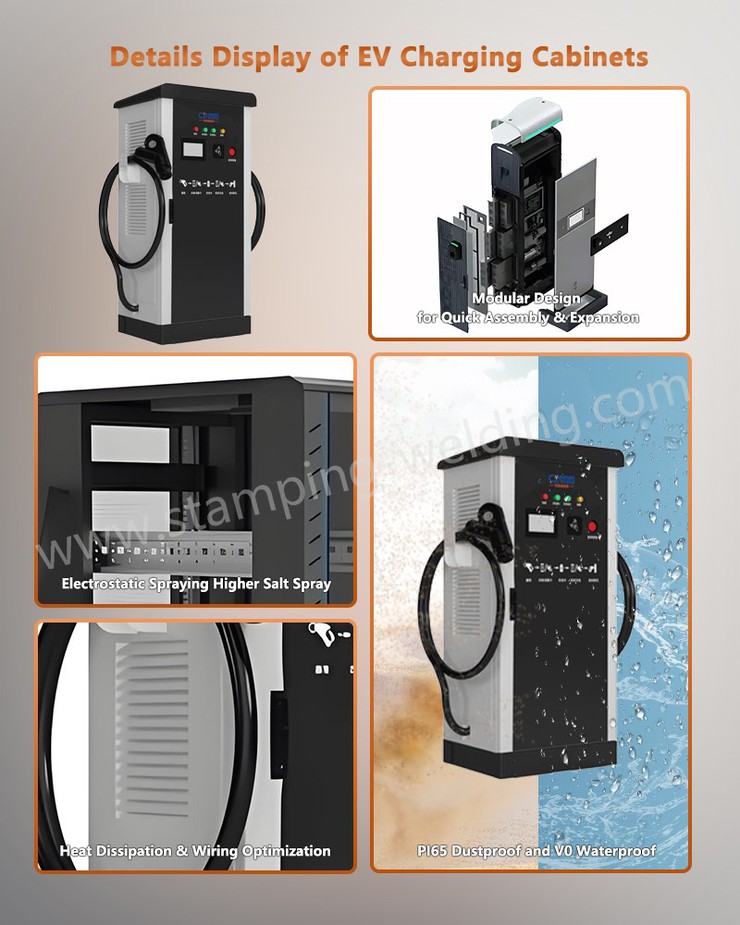
DC fast charging subdivision structure and supercharging technology evolution
In the field of High-power DC charging, it can be divided into integrated, split, and portable according to its structural form. The integrated pile integrates the charging module, controller, billing module, etc. into the pile body, with a large volume; The split type system concentrates the power modules in the main cabinet and charges them through terminals, which is beneficial for saving space and power scheduling.
With technological iteration, DC rapid charging has gradually become a hot topic in the industry. Supercharging stations mainly replace traditional air cooling with liquid cooling technology, which not only greatly improves integration and reduces equipment volume, but also reduces the weight of charging gun cables and improves operational convenience. At present, the mainstream supercharging pile power is generally higher than 200kW. Thanks to the application of the 800V high-voltage platform, the peak power of some leading technologies has exceeded 600kW or even higher, achieving an efficient energy replenishment experience of "charging for five minutes and driving for hundreds of kilometers".
Application scenarios and selection suggestions
In summary, the classification and selection of Electric vehicle charging cabinets require comprehensive consideration of technical characteristics, application scenarios, and economic costs. Slow communication piles, with their advantages of low cost and battery friendliness, are suitable for long-term parking scenarios such as home and office use; Fast DC piles are the preferred choice for public service areas such as commercial parking lots and highway service areas, which can meet the emergency energy replenishment needs of car owners; Ultra high power supercharging stations are more suitable for long-distance travel nodes or specific scenarios that require extremely high charging efficiency.
In the future, with the continuous increase in the number of new energy vehicles, the Custom battery charging cabinet industry will develop towards intelligence, high power, and stronger compatibility, and build a more complete charging service network. It is worth noting that the installation of charging stations involves power access and safety regulations, and requires construction and maintenance by qualified technical personnel to ensure electrical safety.
Contact us
If you have specific needs in project planning or equipment procurement for new energy vehicle Floor-standing chargers, please feel free to contact our professional technical team at any time. We will provide you with one-stop consulting services from solution design to product selection, helping your business develop efficiently.