Copper Busbars for EV Capacitor: Production, Technology & Application
Oct 22, 2025
Factory Production Workflow
In the manufacturing facility of a Copper Busbar for Electric Vehicle Capacitors, the production typically proceeds through several critical steps:
Raw Material Preparation
The base material is high-purity copper or a finely tuned copper alloy with excellent electrical conductivity and mechanical strength. This conductor will serve as the backbone of the system that links the vehicle's energy storage, inverter, or other highcurrent modules. Prior to processing, the material undergoes quality inspection: checking composition, dimensions, surface condition, presence of cracks or oxide film, etc.
Cutting & Stamping/Forming
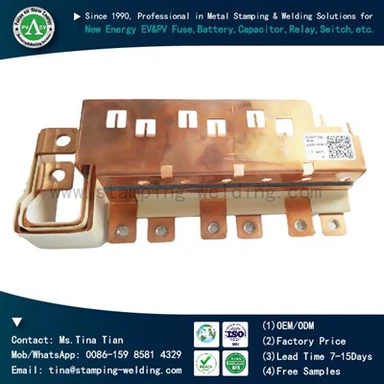
Metal is cut, stamped or CNC-machined into the designed shape of the busbar-rectangular plates, L- or U-shaped bars, laminated busbars (which may be used in hybrid vehicle or film capacitor applications). During this phase holes for mounting screws or bolts, insulation slots, connection ends are formed.
Bending, Welding & Assembly
The parts are bent or formed to suit the installation geometry. For a Film Capacitor Copper Busbar for Electric Vehicles, special structural alignment is required so as to minimise inductance and resistance. Welding or bolt-connection is used to join segments. Given vehicle vibration and thermal cycling, mechanical fixing, thermal expansion compensation and stress relief are incorporated into the design.
Surface Treatment & Insulation / Protective Layering
To ensure durability and performance, the busbar surfaces may be plated (e.g., tin, nickel) to reduce contact resistance and prevent corrosion. Insulation requirements are critical when the busbar is used in a high-voltage environment: an "automotive battery terminal bus bar" or "Insulated BusBars" might be used where insulation tubes, coatings or moulded insulating covers are applied. Cleaning, degreasing and drying precede the final finish.
Inspection & Testing
Before packaging, the automotive battery terminal bus bar undergo a variety of tests: electrical measurement of the conduction path (resistance, contact resistance), current-carrying and temperature-rise tests under load, mechanical vibration and shock testing to simulate vehicle usage. Insulation tests (creepage, clearance, dielectric withstand) are necessary especially when the busbar interacts with a capacitor module or battery pack. Once passed, the product is ready for packaging and shipping.

Key Technologies & Material Characteristics
Focusing on a Copper Busbar for Electric Vehicle Capacitors, several technical and material aspects are crucial:
High Conductivity & Current Carrying Capacity: Copper's excellent electrical conductivity means that the busbar can transmit large currents with minimal losses, which is vital in EV capacitor circuits and modules.
Thermal Management / Heat Dissipation: In high-power systems (such as capacitor banks in EVs or modules used in hybrid systems), the busbar must handle significant heat generation. A wide flat geometry or laminated structure helps dissipate heat, and when used in a "Film Capacitor Copper Busbar for Electric Vehicles" context, thermal path optimisation is even more important.
Mechanical & Vibration Resistance: Within the vehicle environment, the busbar must withstand vibration, thermal expansion/contraction, shock loads. The "automotive battery terminal bus bar" structure and fixings must account for mechanical stability over many cycles.
Electrical Safety & Insulation: In high-voltage systems, the busbar must meet insulation, creepage/clearance and partial discharge requirements. When the busbar is part of a capacitor assembly, any unintended inductance or parasitic capacitance must also be minimised. Laminated or insulated busbar systems (i.e., "Insulated BusBars") are increasingly used for such control.
Customisation & Modularisation: Because modern EV and hybrid EV architectures vary (battery pack layout, module design, capacitor placement), the busbar must be adaptable. A "Film Capacitor Copper Busbar for Electric Vehicles" may be tailor-shaped, multi-layered or flexible to integrate into constrained spaces.
Packaging & Shipment
Once the manufacturing and testing are complete for the specified Copper Busbar for Electric Vehicle Capacitors, proper packaging and logistics play a key role:
Pre-packaging Clean & Protection: Busbars must be free of oils, machining burrs, oxidation. They may receive a protective film or anti-oxidation treatment on exposed metal surfaces (particularly contact zones) to preserve quality during transport and before installation.
Packaging Design: Depending on the physical size and weight of the busbar (which might be used as a "Film Capacitor Copper Busbar for Electric Vehicles" or "automotive battery terminal bus bar"), packaging must prevent deformation, vibration damage, corrosion and moisture ingress.
- Smaller busbars may be placed in custom foam-lined boxes;
- Larger assemblies might go on wooden pallets, strapped, covered with moisture-barrier material.
If the busbar is part of an insulating system ("Insulated BusBars"), the insulation covers and mounting hardware must also be secured.
Labeling & Documentation: The outer carton or pallet should show the part number, manufacturing batch, dimensions, material specification (copper purity, plating), electrical rating (current, voltage), compatibility (capacitor module or EV pack model), and instructions or warnings relating to handling, installation torque, orientation.
Transportation & Storage Conditions: During transit, the Film Capacitor Copper Busbar for Electric Vehicles must be shielded from extremes of temperature, salts, humidity, and mechanical shock. In storage at the destination prior to assembly, the environment must be dry, free of corrosive atmosphere, pallets must avoid stacking heavy loads on top of busbars.
On-site Installation Support: The packaging may include installation instructions: ensuring clean contact surfaces, correct bolt torques, use of conductive paste, fixings for vibration isolation. For a "Film Capacitor Copper Busbar for Electric Vehicles" application, alignment with the capacitor module and clearance/insulation checks may be included.

Application Scenarios & Selection Considerations
The role of a Copper Busbar for Electric Vehicle Capacitors extends across multiple segments, and correct selection is vital:
Application Scenarios
- In complete EVs (battery-electric, hybrid, plug-in hybrid), the busbar connects capacitor modules to battery packs, inverters and power distribution networks.
- In charging infrastructure or high-power capacitor based systems, the busbar may serve as a high-current link-here the term "Film Capacitor Copper Busbar for Electric Vehicles" becomes relevant when capacitor modules are used for fast-charge/discharge.
- In the battery pack itself, a "automotive battery terminal bus bar" is used for series/parallel connections of cells and modules, often in conjunction with high-voltage capacitor banks or filters.
Selection Considerations
- Current and Voltage Rating: The maximum continuous and transient current flowing through the busbar must align with system specs. Cross-sectional area and copper purity must be sized accordingly.
- Geometry & Layout: The physical shape (flat, L-shaped, laminated, flexible) impacts inductance, thermal performance and fitment. For "Film Capacitor Copper Busbar for Electric Vehicles", a low-inductance laminated structure may be preferred.
- Thermal Performance: High power flows generate heat. Busbar design must accommodate thermal management: surface area, mounting onto heat sinks, airflow, adjacent components.
- Mechanical Robustness: In an automotive environment, vibration, shock, thermal expansion, electromagnetic forces (especially during short circuits) must be considered. Support clamps, fixings and tolerance for expansion are part of "Insulated BusBars" design.
- Electrical Safety & Insulation: When the busbar is part of high-voltage capacitor assemblies, ensuring insulation, creepage/clearance, contact resistance, corrosion resistance is essential.
- Integration & Maintenance: The busbar should enable modular installation, easy replacement, and avoid complex wiring. A "Film Capacitor Copper Busbar for Electric Vehicles" often uses standardised modules to ease installation.
Reliability Over Lifecycle
- Vehicle usage involves thousands of charge/discharge cycles, environmental changes. Therefore the busbar material and connections must resist oxidation, corrosion, fatigue, mechanical creep and remain low resistance. Use of high-quality copper, protective coatings, and proper design is crucial.

Summary
In summary, the Copper Busbar for Electric Vehicle Capacitors plays a pivotal role in modern EV and hybrid vehicle power systems. From the factory production workflow - which includes raw material preparation, forming, welding, surface treatment and rigorous testing - to the packaging and logistics ensuring safe delivery and installation, each step demands precision. The technical essentials centre around high conductivity, effective thermal management, mechanical robustness and electrical safety, especially when integrated with capacitor modules or high-voltage battery systems. Applications span electric vehicles, hybrid systems, battery modules and charging infrastructure, where careful selection (geometry, current rating, insulation, mechanical design) ensures optimal system performance and reliability. Ultimately, this component, though often unseen, supports the efficient, safe and durable operation of advanced vehicle electrification architectures.

contact us