Core composition and industry technology analysis of electrical cabinets
May 16, 2026
Basic framework and structural design
The mechanical integrity of an electrical cabinet relies on the synergy of the cabinet, mounting rails and grounding system. Cabinets are mostly made of cold-rolled steel plates (thickness 1.5–2.5mm) or stainless steel, with standard dimensions such as 800×600×2000mm (width×depth×height), complying with IEC 61439 specifications. For outdoor applications, outdoor electrical cabinets require additional enhanced sealing and weather-resistant design: for example, the use of a stepped groove connection structure and a dual shock absorption system (spring shock absorbers combined with magnets of the same polarity) can reduce mechanical impact transmission by 80%. The installation rails are mainly 35mm standard DIN rails, which are used to fix modular components such as circuit breakers and contactors; the cross-sectional area of the copper bars in the grounding system is not less than 50mm² (according to GB 7251.1). The cabinet protection level usually needs to reach IP54 or above to meet the dustproof and waterproof requirements of about 80% of industrial scenes.

Core electrical components and function allocation
The power distribution unit and control module are integrated inside the electrical cabinet to realize power distribution and logic control. The core of the power distribution unit includes circuit breakers and contactors: the rated current of the circuit breaker covers 6A to 630A, and the breaking capacity can reach 50kA; the contactor coil voltage is usually 24VDC or 220VAC. The control module is represented by the programmable logic controller (PLC), which realizes equipment control through the I/O module, with a response time of less than 10ms; the frequency converter is used to adjust the motor speed, with a control accuracy of ±0.5%. In certain areas such as traffic control, electrical cabinets and enclosures need to pass EN 50121-4 electromagnetic compatibility certification and can be equipped with redundant power supplies to maintain uninterrupted operation of critical equipment. In addition, electronic cabinets put forward higher requirements for electromagnetic shielding and heat dissipation layout, and often integrate signal acquisition modules and multi-layer isolation structures.

structure optimization and production technology
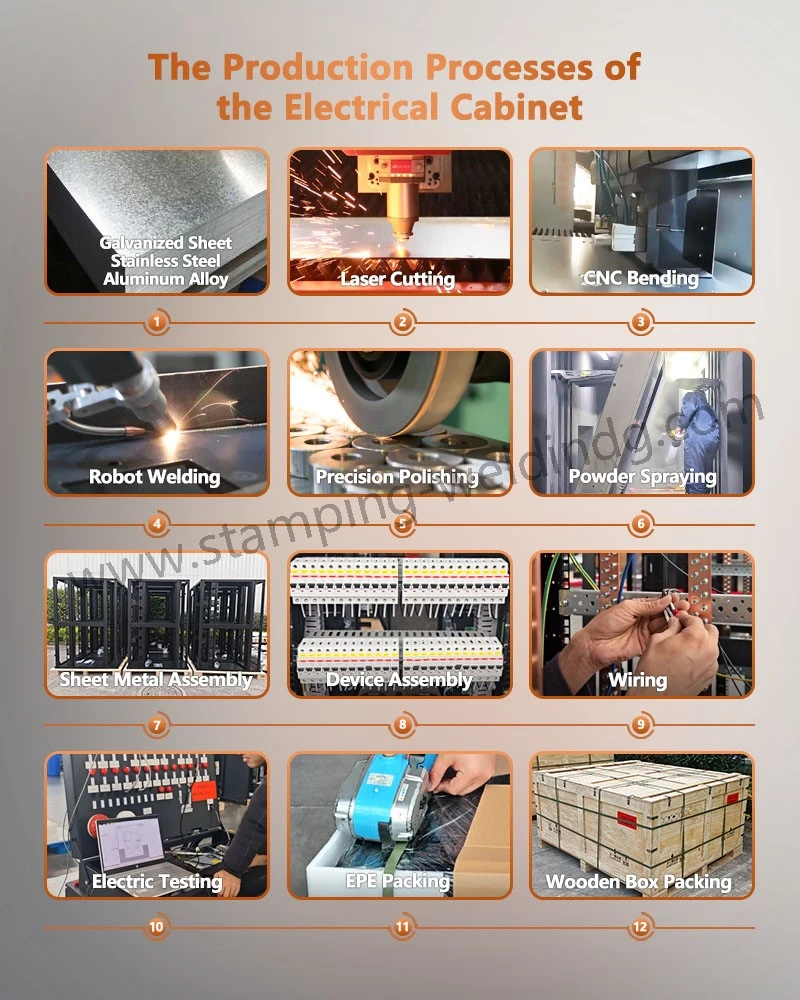
With the development of industrial technology, the structural design and production process of electrical cabinets have been continuously upgraded, further improving the stability and environmental adaptability of the equipment. In terms of structural design, the relevant utility model patent in 2024 introduces a stepped groove connection structure and a dual shock-absorbing system (spring shock-absorbing parts + magnets of the same polarity), which can reduce the transmission of mechanical impact by 80%; the anti-rust design adopts an umbrella-shaped rain shield and a thickened anti-rust coating, and the thickness of the connection is increased by 30%. Combined with the humidity sensor in the cabinet, it is linked to the electric heating wire heating chamber to form a closed-loop moisture-proof system.
As key components to ensure the sealing and safety of cabinet doors, locks and hinges are made of high-specification zinc alloy and aluminum alloy materials and optimized surface treatment technology for harsh working conditions such as high salt spray, humidity and dust along the coast. They must undergo salt spray, wear resistance, and high and low temperature adaptability testing before leaving the factory. In terms of production technology, the core process includes phosphating treatment and powder spraying. The thickness of the nanoceramic phosphating layer is controlled at 12-18μm, and the welding accuracy can reach ±0.1mm. The electrophoretic spraying process improves the anti-rust ability of the cabinet and is suitable for various complex industrial environments. Some special grp electrical enclosures will also use special materials to further improve corrosion resistance and anti-aging performance.
Functional features and application fields
The core function of the electrical cabinet is to ensure the stable operation of internal components through physical protection and environmental control systems. The protection system includes a three-layer isolation structure. The outer explosion-proof isolation board can shield 85% of electromagnetic radiation. The middle layer sealing strip makes the cabinet door airtight to IP65 standards. The inner layer grounding system ensures the rapid release of static electricity. In terms of environmental adaptability, the operating temperature range of conventional electrical cabinets covers 0°C to 55°C, and the humidity tolerance is less than 85% RH. The PLC control cabinet supports multi-cabinet joint control through modular design, and can build a distributed control system that can accommodate 2,000 I/O points. It has a wide range of applications.
Special electrical cabinets for the metallurgical industry can carry more than 2000A current and have built-in short-circuit protection devices; PLC control cabinets for environmentally friendly sewage treatment systems integrate signal acquisition modules, which can monitor water quality parameters in real time; special models for the nuclear power field are made of cold-rolled steel plates with a protection level of IP41 or IP20; electrical cabinets in traffic control systems need to pass EN 50121-4 electromagnetic compatibility certification, equipped with redundant power supply to maintain 48-hour uninterrupted operation of key equipment, and special models in the chemical industry have a dedicated dust removal mechanism to achieve effective dust prevention and adapt to corrosive working conditions.

contact us
Our company focuses on providing high-performance cnc electrical cabinet solutions that meet international standards. All cabinets adopt precision manufacturing processes and can be equipped with cooling systems, electromagnetic shielding and IoT monitoring modules according to customer needs. For selection suggestions or technical specifications, please contact our engineering team.