The Role of Film Capacitor Busbars in New Energy Vehicle Power Systems
Sep 17, 2026
With the rapid global expansion of the new energy vehicle industry, electric vehicles (EVs) and hybrid electric vehicles (HEVs) are placing increasingly stringent demands on the efficiency, power density, and reliability of their powertrain systems. As the core component linking the traction battery to the drive motor, the inverter is responsible for power conversion and precise control, requiring stable operation under harsh conditions characterized by high voltages, high currents, and high-frequency switching. In this context, DC-Link film capacitors and their associated busbar assemblies play a pivotal role, serving as essential components that ensure the electrical performance and electromagnetic compatibility of high-voltage electric drive systems.
The film capacitor busbar is far more than a simple conductive connector; it is a high-precision electrical component that integrates current transmission, heat dissipation, and structural support. It directly influences the system's transmission efficiency, thermal management capabilities, and long-term operational lifespan. Particularly with the widespread adoption of third-generation semiconductors, traditional wiring harnesses struggle to meet the requirements for high-frequency operation and low inductance. Consequently, composite capacitor busbars-offering low parasitic inductance, high insulation reliability, and high integration-are becoming an indispensable development trend in the new energy vehicle electronics industry, as they effectively suppress high-frequency voltage spikes during switching and reduce system losses.
The development of new energy vehicle electric drive systems promotes busbar technology upgrades
The powertrain system of a new energy vehicle comprises the power battery, motor controller, inverter, and high-voltage interconnects. As the core component for electrical energy conversion, the inverter must convert direct current (DC) into alternating current (AC) to drive the motor; within this process, the DC-Link capacitor plays a critical role in stabilizing the DC bus voltage. Under complex operating conditions-such as startup, acceleration, and energy recovery-current fluctuations are intense. Without efficient filtering components, power modules are highly susceptible to reduced efficiency and shortened service life caused by voltage jitter and ripple.
DC-Link film capacitors effectively smooth voltage fluctuations, absorb high-frequency ripple currents, and mitigate voltage surges, thereby significantly enhancing the stability of power modules. Among these, biaxially oriented polypropylene (BOPP) film capacitors have emerged as the preferred solution for traction inverters in new energy vehicles, thanks to their low loss, high voltage withstand capability, and superior high-frequency response. However, fully realizing a capacitor's performance potential depends not only on its internal structure but also on the method of external electrical connection.
If traditional wiring is used to connect the capacitor to the power module, the resulting long physical paths introduce significant parasitic inductance. During high-speed switching of power devices, this parasitic inductance causes severe turn-off voltage spikes; these not only substantially increase system thermal losses but also risk causing dielectric breakdown in sensitive semiconductor chips. Consequently, overcoming the electromagnetic limitations inherent in traditional wiring has become a key breakthrough for improving the overall efficiency and safety of high-voltage electric drive systems.
Specialized busbars for new energy vehicle capacitors have emerged as a critical architectural solution for optimizing DC-Link performance. By employing a tightly overlapped, low-inductance laminated topology, the busbar utilizes the mutual cancellation of magnetic fields generated by opposing currents to reduce loop parasitic inductance to the nanohenry (nH) range. This fundamentally suppresses high-frequency switching voltage spikes and reduces system losses, while simultaneously enhancing system integration and ensuring the stable operation of the high-voltage electric drive system.
What is a film capacitor busbar for new energy vehicles?
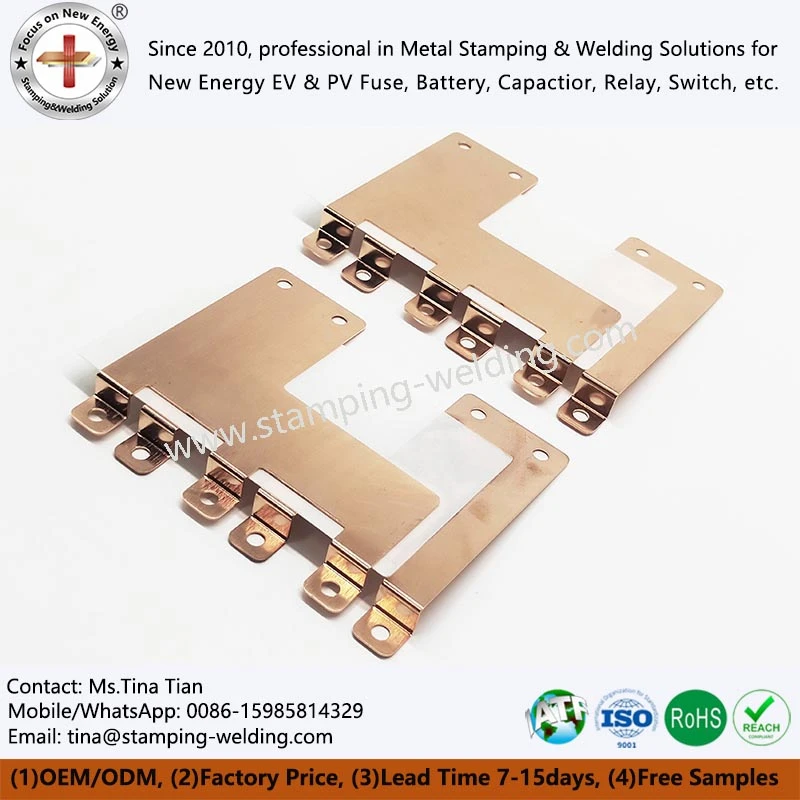
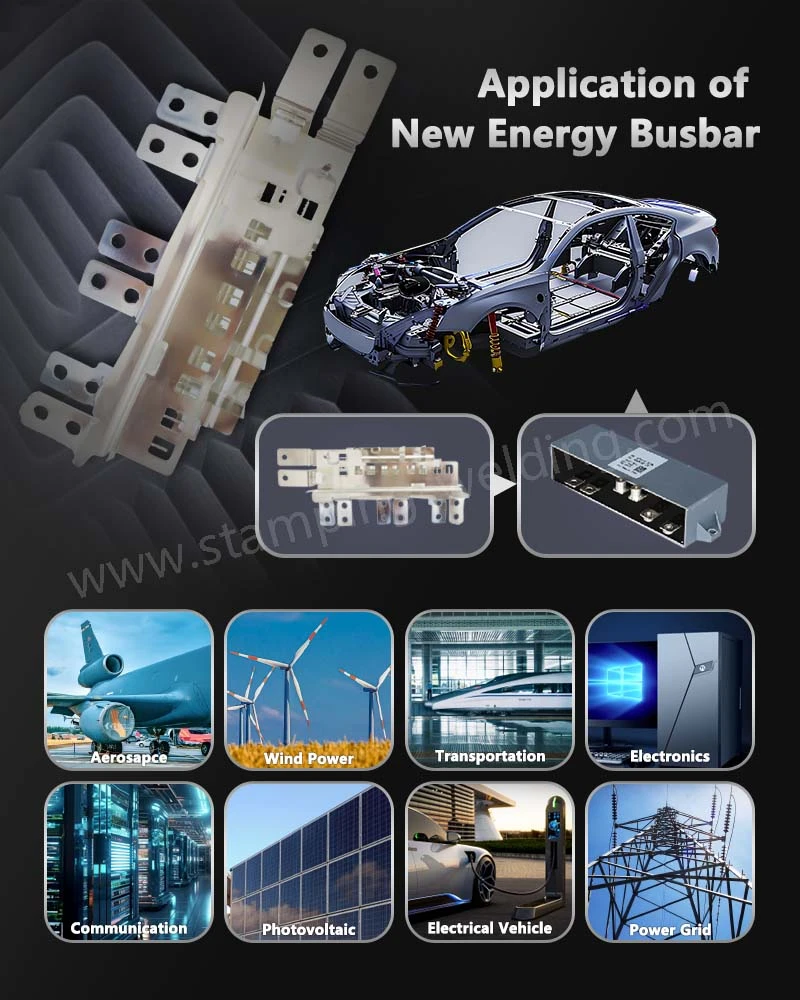
The EV film capacitor busbar is a composite conductive connection structure specifically designed for the high-voltage electric drive systems of new energy vehicles. It primarily serves to interconnect DC-Link film capacitors, IGBT power modules, SiC MOSFET power modules, and motor control inverters.
Unlike standard copper busbars, EV capacitor busbars typically feature a laminated design composed of multiple functional layers. The first is the conductive layer. This layer generally utilizes high-conductivity copper materials-such as T2 copper, C1100 pure copper, or OFC (oxygen-free copper)-which offer excellent electrical and thermal conductivity to meet the high-current operational demands of new energy vehicles. The second layer is the insulation layer. Common materials include PET polyester film, PI polyimide film, and PEN insulation material. This layer serves to prevent short circuits between positive and negative poles, enhance voltage withstand capability, and improve environmental reliability. The third layer consists of protective and connection structures.
Depending on the specific requirements of the vehicle project, the busbar may incorporate surface treatments (such as tin, nickel, or silver plating), terminal structures, and precision-stamped connection zones. Through this multi-layer composite design, the laminated busbar enables high-current transmission within a compact space while minimizing circuit loop area, thereby reducing parasitic inductance.
Why do new energy vehicles (NEVs) require high-performance capacitor busbars?
Reducing parasitic inductance to improve inverter efficiency. New energy vehicle (NEV) inverters are transitioning from traditional IGBT technology to SiC power semiconductor technology. SiC devices offer higher switching frequencies, lower switching losses, higher operating temperatures, and greater power density. For next-generation NEV inverters utilizing SiC power modules, a low-inductance busbar design has become a critical technical requirement.
Enhancing the integration of NEV powertrain systems. NEVs demand increasingly efficient use of space. Traditional connection methods typically require multiple copper cables, numerous terminals, and complex mounting structures; such approaches not only consume space but are also prone to connection errors. In contrast, busbars for NEV film capacitors feature a modular design that can be customized to fit the specific inverter architecture. For 800V NEV platforms, high-voltage systems require connection solutions that are more compact, safe, and reliable, making integrated busbar assemblies a key trend in NEV electronic systems.
Improving thermal management in high-current environments. NEV powertrains often must withstand significant fluctuations in current. In high-current operating environments, busbars generate Joule heat (P = I²R), where P represents power loss, I is the operating current, and R is the resistance. Consequently, the choice of busbar material, cross-sectional area, and structural design all influence the system's temperature rise. High-quality copper busbars offer low resistance, high thermal conductivity, and stable mechanical strength. Optimizing the copper layer thickness and heat dissipation paths helps reduce operating temperature rise, thereby enhancing the long-term reliability of the NEV powertrain system.
Why Are Busbars Critical for EV Film Capacitors?
In the powertrain systems of new energy vehicles (NEVs), DC-link film capacitors play a crucial role in stabilizing DC voltage, while the busbars connecting these capacitors to power modules determine power transmission efficiency and system reliability. When evaluating NEV powertrains, attention is often focused on battery capacity, motor efficiency, inverter performance, and power semiconductor technology.
However, interconnect components play an equally vital role in high-performance electric drive systems.
Shorter current transmission paths minimize system losses, while a more compact electrical structure reduces parasitic parameters. Consequently, high-performance busbars for DC-link film capacitors have become a key focus in the optimization of NEV power electronics systems.
By effectively reducing parasitic inductance, this integration enhances overall system stability while boosting high-current transmission capacity. At the same time, it optimizes thermal management capabilities and significantly improves electromagnetic compatibility (EMC) performance across demanding high-voltage operations.
Application Scenarios and Future Development Trends of Film Capacitor Busbars in New Energy Vehicles
Film capacitor busbars are widely used in core components of new energy vehicles, such as main drive inverters, on-board chargers (OBCs), DC/DC converters, and high-voltage power distribution units (PDUs). In inverters and "all-in-one" electric drive systems, the busbar is tightly coupled with the DC-Link film capacitor; it not only smooths DC voltage and absorbs the intense ripple currents and voltage spikes generated by high-frequency switching in power semiconductors but also efficiently distributes high currents and balances multiple capacitor branches in dual-motor and PDU architectures. Thanks to their compact geometric topology, composite busbars meet the requirements for low-inductance transmission, reliable insulation, efficient heat dissipation, and electromagnetic compatibility (EMC) shielding-all within a minimal footprint and at high power densities.
Driven by the rapid adoption of 800V high-voltage platforms and silicon carbide (SiC) semiconductors, future film capacitor busbars are evolving toward sub-nanohenry (sub-nH) ultra-low inductance topologies. Through the use of precision parallel-plate topologies, micron-scale lamination spacing, and 3D magnetic field cancellation designs, composite busbars can drastically reduce parasitic inductance, thereby eliminating high-frequency turn-off voltage spikes at the source. Simultaneously, busbars are transcending their traditional role as mere "electrical connectors" to integrate seamlessly with capacitor cores, liquid-cooling baseplates, and power modules. This creates highly integrated "electromagnetic-thermal-structural" multi-physics modules that combine current transmission, heat conduction, and sensor mounting, effectively meeting the demands for lightweight design and optimized space utilization in electric drive systems.
To address the challenges of localized heat accumulation and high-voltage alternating electric fields associated with high power density, future new energy vehicle (NEV) film capacitor busbars will widely adopt novel insulation materials characterized by high-temperature resistance (exceeding 150°C) and high thermal conductivity-such as modified PI films and thermally conductive epoxy resins. By combining these materials with vacuum hot-pressing and seamless edge-sealing processes, manufacturers can ensure partial discharge-free operation (< 10 pC) under long-term high-voltage conditions and extend the component's service life and environmental durability. Furthermore, driven by the need for vehicle lightweighting and cost optimization, the adoption of high-conductivity aluminum busbars and copper-aluminum composite busbars will continue to rise; when combined with selective micron-level salt-spray-resistant coatings and precision ultrasonic or laser welding technologies, these solutions significantly reduce system weight while ensuring high-frequency conductivity and welding reliability.
Contact Us