Detailed explanation of the core knowledge of the PLC control cabinet
May 20, 2026
PLC control cabinet (programmable logic controller cabinet) is the core control unit in the modern industrial automation system. Its essence is an automation control device specially designed for harsh industrial environments. As a typical representative of a programmable logic controller cabinet, it receives input signals from on-site sensors, limit switches and various detection components, relies on internal preset control programs to perform high-speed logic operations and data processing, and then accurately drives the actuator to complete predetermined actions. From power distribution to intelligent manufacturing, from water treatment facilities to building automation, PLC control cabinets have deeply penetrated into all dimensions of industrial production and have become a key infrastructure for promoting process automation and equipment intelligence. Its core value is not only reflected in the start-stop control of a single piece of equipment but also in the flexible program reconstruction capability to achieve coordinated scheduling and optimized operation of the entire production line and even the entire factory, thereby significantly improving production efficiency and process consistency.
Component details
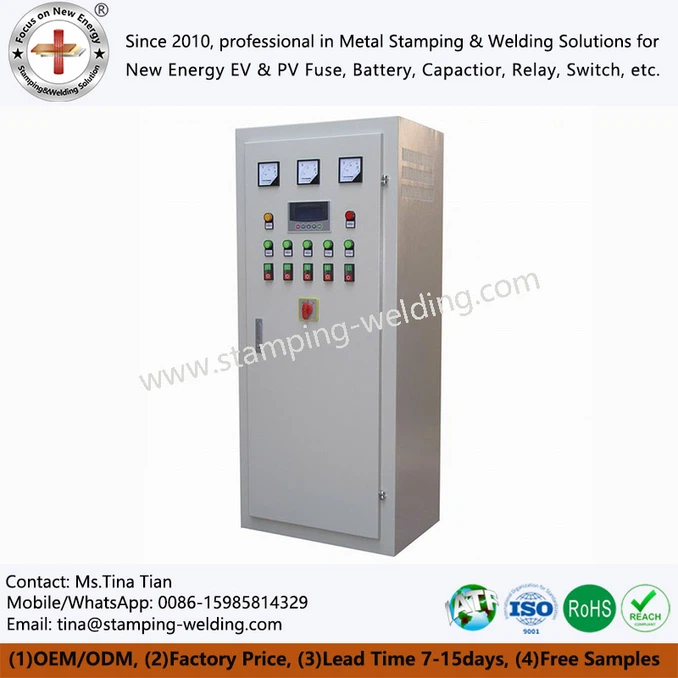
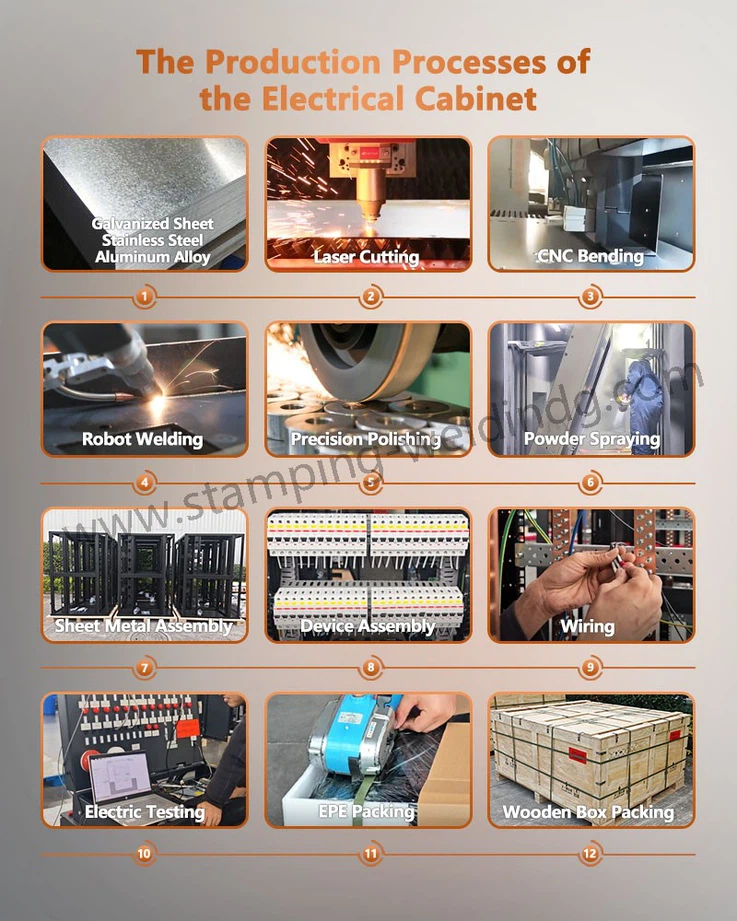
A complete set of automated control cabinets consists of a number of precisely coordinated PLC cabinet components, which together determine the functional boundaries and reliability levels of the system. From the perspective of hardware architecture, electrical control cabinets usually use high-strength metal cabinets as carriers and integrate four major functional blocks: power distribution, logic processing, signal conversion and human-computer interaction. Among them, the main power air switch serves as the energy inlet and assumes the key functions of overload protection, short-circuit isolation and emergency braking; the 24VDC switching power supply provides a stable and pure DC power supply for the PLC body, field sensors and low-voltage actuators. This modular hardware stacking method not only facilitates early system integration but also reserves sufficient space for later function expansion and fault maintenance, allowing the control cabinet to evolve smoothly with process upgrades.
Air switch (circuit breaker): As the main power on-off control component of the control cabinet, the main power air switch is not only used for normal power-on and power-off operations but also provides overload and short-circuit protection functions to ensure the safe operation of the entire PLC cabinet components under abnormal electrical conditions. Power module: This module is responsible for providing a stable and clean power supply to all electronic components in the cabinet. Common configurations include a 24VDC switching power supply, which is used to continuously power the PLC body, sensors and actuators to ensure that they can still work reliably in voltage fluctuation environments. PLC controller: As the logical center of the control cabinet, the selection of the PLC controller needs to be determined based on the actual control scale. It can adopt an integrated structure or a modular structure and supports functions such as I/O point expansion, analog processing, and communication interface integration. In high-reliability application scenarios, redundant CPU systems can also be equipped.
Terminal block: The terminal block is used to electrically connect the signal lines of external field devices (such as sensors, buttons, actuators) and the input/output modules of the PLC to facilitate line layout, troubleshooting and later maintenance. A high-quality PLC System Cabinet for Sewage will pay special attention to the marking and protection of terminals. Relay: When a weak current is required to control strong current, the relay serves as a key conversion component to convert the weak current control signal output by the PLC into a strong current drive signal, thereby achieving reliable on-off control of high-current loads such as motors and heaters. Expansion modules: In order to adapt to complex control requirements, I/O expansion modules, analog input and output modules, high-speed counting modules or positioning control modules can be flexibly added to enhance the adaptability of the Application Cabinet. Communication module: This module supports data exchange between the PLC and the host computer, human-machine interface, other controllers, or remote I/O stations to achieve centralized monitoring, remote diagnosis and industrial network integration. Cabinets and Accessories: Cabinets provide physical protection and mounting support for all internal components. Accessories include terminal blocks, power distributors, cooling fans, lights, cabinet door locks, etc. In addition, human-computer interaction components such as the cooling system, dustproof and waterproof sealing strips, indicator lights, operating buttons and touch screens form a complete operating interface.
Technical advantages
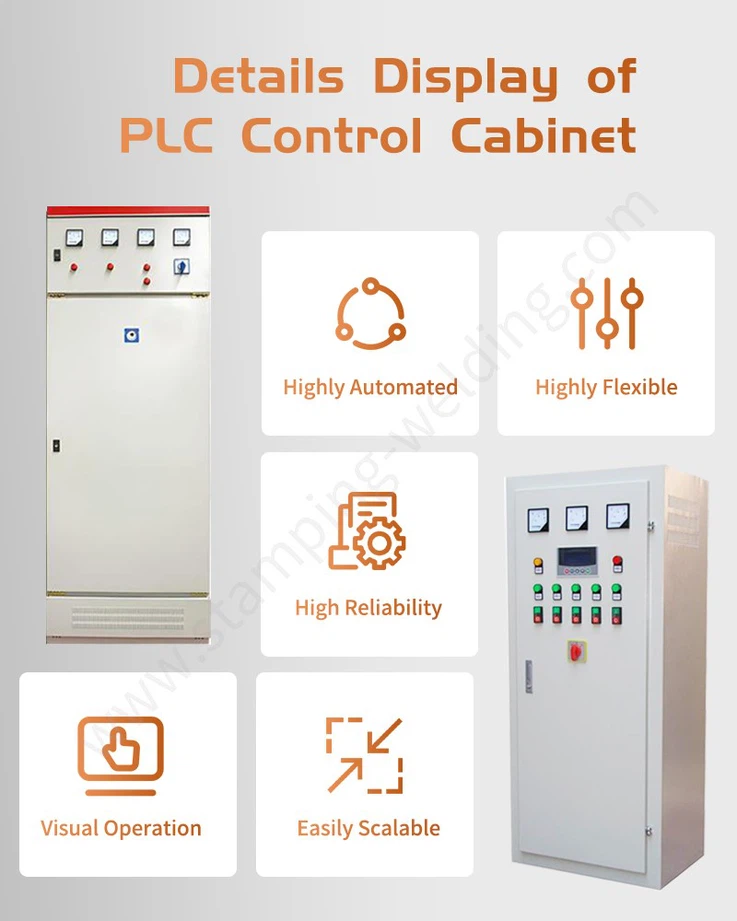
The PLC control cabinet has the characteristics of a flexible system structure and easy expansion. It is good at switching quantity control and can realize PID adjustment of the continuous process. Its programming method is mainly ladder diagram, logic diagram or statement list, which does not require in-depth computer expertise and is convenient for on-site debugging and later maintenance. More importantly, the PLC control cabinet can operate reliably for a long time in harsh industrial environments such as high temperature, dust, and electromagnetic interference, and its mean time between failures is much higher than that of traditional relay control systems. Whether it is automatic control of a single cabinet or a distributed control system (DCS) formed through industrial Ethernet or fieldbus, Industrial PLC cabinet can effectively adapt to application needs of different scales.
practical applications
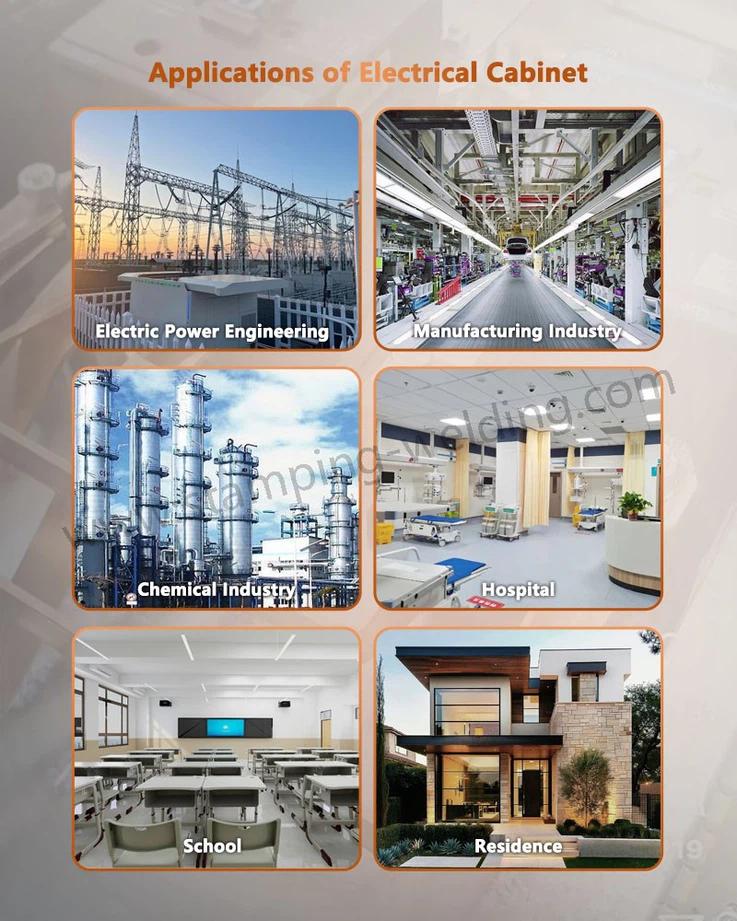
In practical applications, typical scenarios of PLC control cabinets include constant pressure water supply, air compressors, fans and water pumps, central air conditioners, port machinery, machine tools, boilers, paper machinery, food machinery, etc. In different scenarios, the configuration of PLC control cabinets can be flexibly adjusted according to actual needs. For example, in sewage treatment scenarios, a PLC System Cabinet for Sewage can achieve targeted automated control of sewage treatment processes, improving treatment efficiency and compliance rates. In addition, there are clear specification requirements for the use of PLC control cabinets.
The power supply can be DC 24V or two-phase AC 220V. The voltage fluctuation must be controlled within the range of (-10%, +15%), and the frequency is 50Hz; the protection level is usually IP41 or IP20, can be adjusted according to the use environment; the ambient temperature needs to be controlled between 0℃-55℃, avoid direct sunlight, the relative air humidity should be less than 85% (no condensation), and stay away from strong vibration sources to avoid corrosion and flammable gases to ensure long-term stable operation of the equipment.
contact us
If you are looking for a Modular PLC Cabinet partner with high scalability, strong environmental adaptability and long-term technical support, please feel free to contact our engineering team to discuss your next automation upgrade project.