Explanation of core knowledge of Industrial electrical cabinet
Apr 29, 2026
Definition and core role
The electrical cabinet commonly referred to as a Key control cabinet is a cabinet that integrates electrical components related to energy distribution, and is rarely referred to as an "electrical cabinet" in daily life.
Its core functions mainly have two aspects. Firstly, it distributes and controls electrical equipment, and distributes electrical energy reasonably to various load parts;
The second is circuit protection, which can promptly cut off the power supply when abnormal situations such as short circuit, overload, and leakage occur in the circuit, avoiding equipment damage and safety accidents.
Electric cabinet key has a wide range of application scenarios, including power distribution control for residential buildings, schools, hospitals and other daily electricity use scenarios, as well as widely used in enterprise factories and workshops. Common lighting distribution boxes and power distribution boxes belong to the category of distribution cabinets.
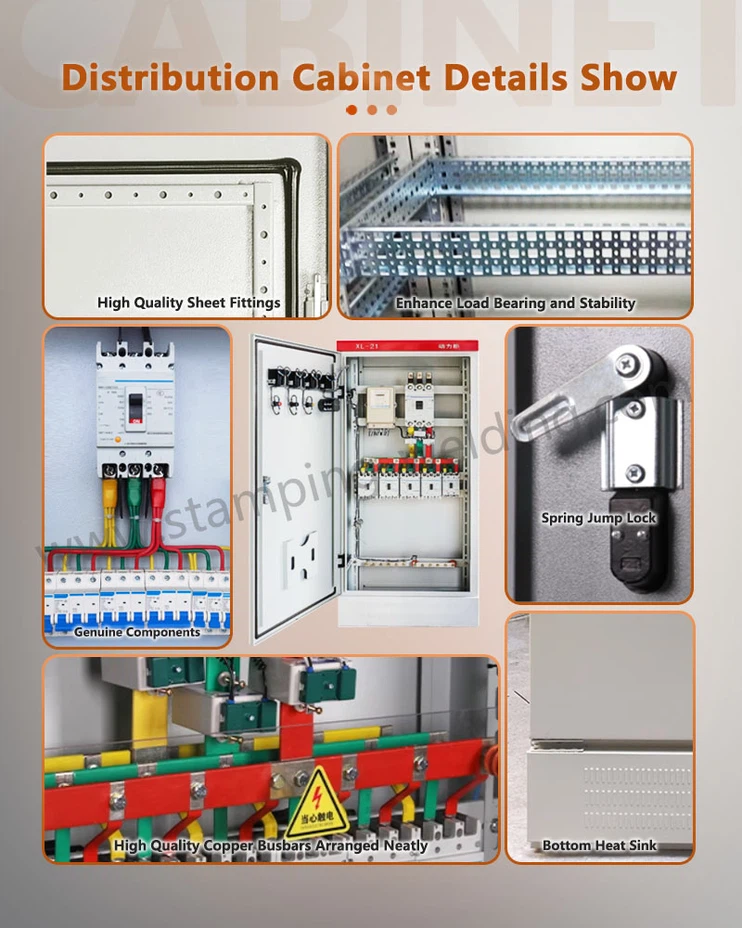
The internal components of Access control cabinets mainly include busbars (busbars), circuit breakers, conventional relays, comprehensive relay protection devices, measuring instruments, isolation knives, indicator lights, grounding knives, etc., to ensure the normal operation of the equipment.

Classification and grading of Industrial electrical cabinets
Climate controlled cabinets can be classified into various types based on their structure, including fixed panel, protective, drawer, and power lighting distribution cabinets; According to their functions, they can be divided into power distribution cabinets and motor control centers. The power distribution cabinet is suitable for areas with few circuits and scattered loads, while the motor control center is suitable for areas with multiple circuits and concentrated loads, receiving the electrical energy distributed by the primary distribution cabinet and supplying it to nearby loads.
From the perspective of power distribution levels, Electrical control cabinets are mainly divided into three levels: first level, second level, and lower level. The first level distribution box has a complex structure and a large output circuit capacity. As the power distribution center of the power supply system, it is usually installed in substations and is responsible for distributing electrical energy to the second level distribution cabinets; Secondary and lower level distribution cabinets (such as lighting distribution cabinets and power distribution cabinets) have small capacity and scattered layout, mainly responsible for controlling the lowest level load distribution.
Internal structure and common types
The structure of the switchgear is generally similar, mainly divided into busbar room, circuit breaker room, secondary control room (instrument room), and feeder room. Steel plates are usually used to isolate each room to ensure safe operation. Common types of distribution cabinets have their own characteristics: fixed panel Universal cabinet key (also known as distribution panel) with a covered open close panel on the front, open on the back and sides, low protection level, only suitable for situations with low safety requirements and continuous power supply, such as centralized power supply in industrial and mining enterprise substations; The drawer type distribution cabinet adopts a steel plate cabinet body, and the electrical components are installed in independent drawers. It has high reliability, interchangeability, and safety, and is suitable for centralized control distribution centers with high requirements for power supply reliability;
The power lighting distribution cabinet adopts a closed installation, and the safety level is adjusted according to the usage situation. It is mostly used as a low-level distribution equipment and is used in production sites of industrial and mining enterprises. In addition, the internal structure of the Climate controlled network cabinet also includes busbar structure, door handle, and small distribution structure. At the same time, it is necessary to properly ground equipment such as PLC, power supply, cabinet main grounding, and frequency converter to ensure stable operation of the equipment.

Wiring specifications
The wiring specifications of Industrial control cabinets directly affect their operational safety and stability, and daily wiring must follow clear standards. In the distribution of new house electrical boxes, the lines are usually connected below the main circuit breaker for easy operation; When wiring, it is necessary to adjust according to the type of circuit breaker. For a 1P circuit breaker, the L pole should be connected to the line, the N pole should be connected to the N pole line, and for a 2P circuit breaker, it can be directly connected to the LN pole.
The wiring of the circuit breaker in the Motor control cabinet follows the principle of "top in, bottom out". The 1P circuit breaker inlet and outlet can accommodate 16MM wire diameter, and the 2P circuit breaker outlet can accommodate 10MM wire diameter, with a minimum outlet wire diameter of not less than 6MM, ensuring that the line carrying capacity matches the circuit breaker and avoiding faults caused by improper wiring.
contact us
If you have any questions or inquiries regarding Industrial electrical cabinet selection, classification adaptation, wiring specifications, etc., please feel free to contact us at any time. We will combine professional industry experience to provide you with customized solutions, helping you achieve safe and stable operation of distribution cabinets.