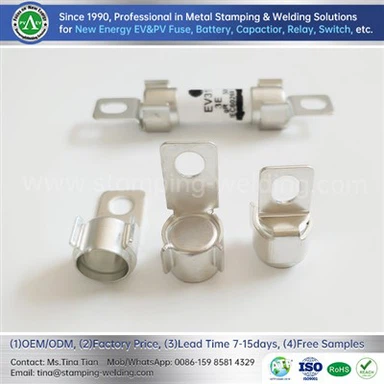
How Does EV Fuse Ceramic Body Solve Fast-Charge Overheating
Sep 04, 2025
According to Sina Auto, China had over 120,000 480kW+ ultra-fast charging piles in H1 2025. 800V EVs made up 38% of new car sales. Fast charging brings overheating risks to fuses. An EV fuse ceramic body is a key part to fix this problem. This article talks about its heat-solving rules, material performance, structural design, application scenarios and Xiamen APOLLO's solutions.
Core Principles of Solving Fast-Charge Overheating
1. Efficient Heat Conduction Mechanism
The ceramic body for EV fuses has a thermal conductivity of 1.8-2.2 W/(m·K). It's 3 times higher than plastic casings. It quickly moves heat from the fuse link to the outside. This stops local overheating during 480kW fast charging.
2. Arc Quenching and Heat Absorption
A ceramic body for ev fuse can stand 1200℃ high temperatures. When fast charging causes current surges, it absorbs arc heat right away. It quenches arcs in 0.02 seconds. This stops heat from piling up and damaging components.
3. Insulation and Heat Isolation
The ceramic body has a volume resistivity over 10¹⁴ Ω·cm. It separates high-temperature fuse links from nearby parts. This stops heat from moving to battery packs or charging modules during fast charging.
Material Performance Requirements for Fast-Charge Scenarios
1. High-temperature stability: A ceramic tube for high voltage fuse uses 95% purity steatite ceramic. Even when fast-charge current hits 1500A and surface temperature reaches 600℃, it won't soften or deform.
2. Low thermal expansion: The ceramic body's thermal expansion coefficient is ≤5×10⁻⁶/℃. This avoids cracks from quick temperature changes (from 25℃ to 500℃ in 10 seconds) during fast charging.
3. Corrosion resistance: The ceramic surface has an anti-oxidation coating. It resists damage from battery electrolytes and charging station humidity. This keeps its heat dissipation performance good for a long time.
Structural Design Optimization for Heat Dissipation
1. Multi-Channel Heat Dissipation Grooves
Add 4-6 axial grooves on the outer wall of a ceramic casing for fuse link. The grooves increase heat dissipation area by 40%. This speeds up heat release during 30-minute fast charging (0-80% SOC).
2. Hollow Cavity Heat Buffer
Design a 2mm-thick hollow cavity inside the ceramic body. The cavity acts as a heat buffer. It slows down heat transfer to the casing surface by 25%. This protects nearby temperature-sensitive components.
3. Sealed Heat-Resistant Gasket
Use silicone gaskets at the ceramic body's ports. These gaskets can stand 300℃ high temperatures. They stop dust and moisture from blocking heat dissipation channels. They also bear high temperatures from fast charging.
Application Scenarios of EV Fuse Ceramic Body
An EV fuse ceramic body is widely used in fast-charge-related systems. In 800V EV battery packs, it solves overheating during 10-minute ultra-fast charging (5C rate). In 480kW DC charging piles, a ceramic tube for EV DC fuse handles 1200A peak current without overheating. In commercial EV charging stations (with 10+ piles), it keeps heat dissipation stable even during 8-hour continuous fast charging. These scenarios fully prove its ability to solve fast-charge overheating.

Xiamen APOLLO's Fuse Ceramic Body Solutions
Xiamen APOLLO's ceramic body for EV fuses uses 96% high-purity steatite ceramic. It's higher than the 95% purity commonly used in the industry. This improves heat conductivity by 8%. It keeps heat dissipation stable during fast charging. Our ceramic body for ev fuse goes through 4-step quality checks (density, thermal conductivity, high-temperature resistance, insulation). It's stricter than the industry's 3-step checks. It meets IATF 16949 and UL standards.
We offer flexible custom services. We adjust the length (10-30mm) and inner diameter (5-15mm) of ceramic tube for high voltage fuse. We do this according to customers' fast-charge fuse models. It fits 400V/800V platforms. Our global sea-land-air logistics works well. It delivers to European ports in 18-25 days, North American ports in 15-22 days, and Southeast Asian countries in 5-10 days. Our after-sales team gives technical guidance within 24 hours. It helps customers solve fast-charge heat dissipation matching issues quickly.

conatct us