Nickel Plated Copper Busbars: a key process to improve conductivity and prevent corrosion
Apr 10, 2026
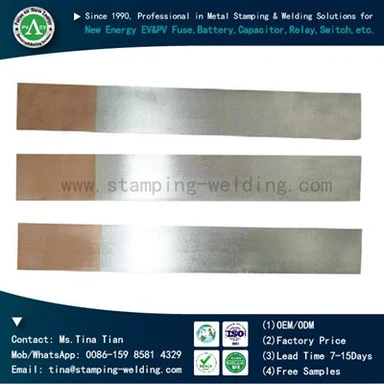
Nickel-plated copper busbar is a conductive component with high conductivity copper as the base and the surface covered with a nickel layer through an electrochemical deposition process. It is widely used in scenarios such as power distribution, power module interconnection and grounding protection. The copper substrate provides excellent electrical conductivity, while the nickel plating on the surface gives the product good corrosion resistance, wear resistance and weldability. It is especially suitable for electrical systems that need to operate in humid, salt spray or limited temperature fluctuation environments for a long time. In the field of industrial power distribution, Nickel Plated Copper Flat Bus Bar is widely used as the main distribution bus bar in low-voltage switch cabinets, compensation cabinets and control cabinets.
Its flat cross-section design is conducive to large current transmission and heat dissipation. The nickel plating layer effectively inhibits the oxidation and sulfurization of the copper matrix in the atmospheric environment, ensuring long-term stability of the contact resistance. Within the power electronic equipment, Flat Bar Red Pure Copper Nickel Plating not only undertakes the task of current transmission between power modules, but also enables rapid identification of phase sequence through the red insulation layer or marking coating, which facilitates on-site installation and subsequent maintenance operations. In response to standardized power distribution needs, the Standard Nickel Plating Flat Busbar is a universal product. Its overall dimensions, plating thickness and end treatment methods are all produced in accordance with industry-wide specifications, and can seamlessly replace or adapt to most standard power distribution components.
Detailed display
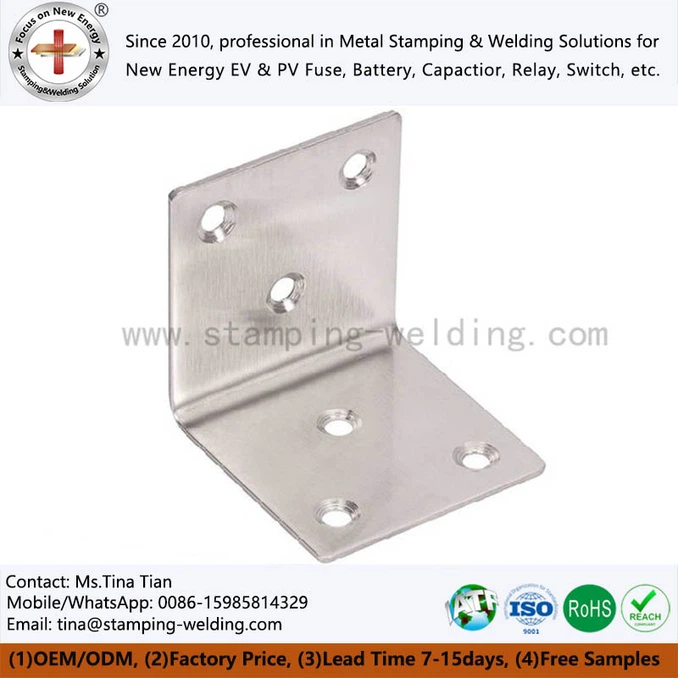
The quality of nickel-plated copper busbars is often reflected in some details that are easily overlooked, and these details determine the reliability and safety of the product in long-term operation. In terms of copper matrix processing details, high-quality products should have the following characteristics: the cutting section should be flat and vertical, without obvious bevels or waves, and the copper color at the section should be uniform and free of oxidation and discoloration; the inner walls of all connection holes should be smooth and free of burrs, the hole chamfers should be uniform and continuous, and the chamfer width is generally controlled at 0.2-0.5mm; the outer copper surface of the bend should not have any visible micro-cracks or orange peel-like morphology, and the compression wrinkles on the inside of the bend should be smooth and free of layering.
For Nickel Plated Copper Flat Bus Bar, the control of flatness is an important detail. When long-size products are freely placed on a horizontal platform, the amount of warpage within the entire length should not exceed 1mm per meter, otherwise additional stress will be generated during installation, affecting the contact pressure distribution of the connection surface. In terms of plating details, a high-quality nickel plating layer should be uniformly light yellow to silvery white (depending on the thickness of the plating and additives), and the color differences in different parts of the same workpiece should be within the acceptable range of the naked eye; the surface of the plating should be smooth and delicate, with no pitting, no pinholes, no dendrites, and no peeling or peeling areas. For Standard Nickel Plating Flat Busbar, the integrity of the plating coverage on the inner wall of the connection hole is an easily overlooked detail. You can cut a sample hole or observe the inner wall of the hole under fiber optic light. For high-quality products, you should be able to see a uniform nickel layer luster and no exposed copper areas. The consistency of coating thickness distribution is also a reflection of the quality of details. For Nickel plated Copper Bus Bar, the coating thickness deviation in different parts of the same workpiece (center area, edges, inside and outside of bends, hole walls) should generally not exceed ±30% of the average thickness.

Application industry
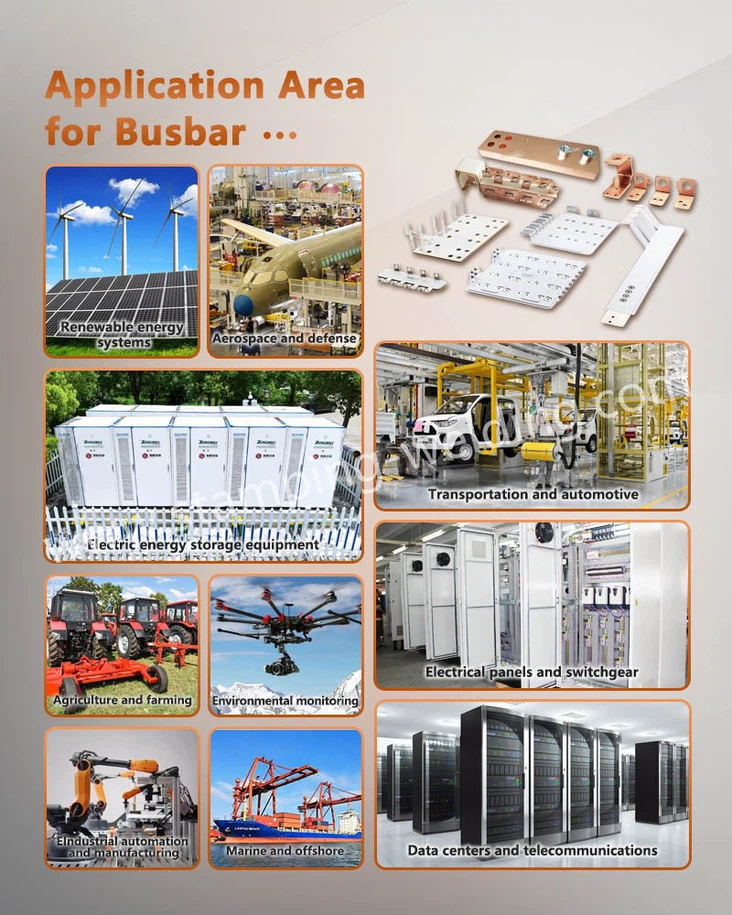
The application industries of nickel-plated copper busbars are very wide, covering many fields from traditional power distribution to high-end power electronic equipment. In the field of power systems and industrial power distribution, Nickel Plated Copper Flat Bus Bar serves as the main busbar or branch busbar in switch cabinets, distribution cabinets and busway systems, carrying current transmission tasks of tens to thousands of amps. The nickel plating layer effectively prevents corrosion of the copper bar surface in humid environments and reduces the risk of joint overheating caused by thickening of the oxide film. In the power electronic equipment manufacturing industry, Flat Bar Red Pure Copper Nickel Plating is widely used in the internal power connections of inverters, servo drives, UPS power supplies, active power filters and other equipment. The red mark helps assembly personnel quickly distinguish the positive and negative polarity of the DC bus or the AC phase sequence, reducing the probability of misconnection. In the new energy and energy storage industry, Standard Nickel Plating Flat Busbar is used as a connector between battery modules and between battery clusters and converters. Its nickel plating layer can withstand chemical corrosion caused by electrolyte volatiles and local temperature rise. At the same time, the hardness of the nickel layer also improves the wear resistance of the bolt connection surface, ensuring contact stability in long-term vibration environments. In the field of rail transit and industrial vehicles, Nickel Plated Bus Bars are used for the laminated connection between the DC support capacitors of the traction converter and the IGBT module, as well as the power distribution of the auxiliary power system. The nickel plating process enables the copper bars to adapt to the salt spray, condensation and drastic temperature changes faced when installing under the vehicle.
FAQ
Q: What are the advantages of nickel-plated copper busbars compared to bare copper busbars?
A: The main advantages are corrosion resistance and contact stability. Bare copper is easily oxidized in humid or sulfur-containing environments, causing contact resistance to increase significantly and even heat. The nickel plating layer forms a dense passivation film in the atmosphere, effectively blocking corrosive media and maintaining low and stable contact resistance for a long time. In addition, the nickel layer has higher hardness and better resistance to crushing than bare copper, making it more suitable for bolted connections.
Q: What is the general thickness of nickel plating?
A: 3-5μm is recommended for indoor environments, 5-10μm for outdoor or high-humidity environments, and 10-15μm for highly corrosive environments such as coastal salt spray or chemical plants. If it is too thin (<2μm), it will easily produce pores and lead to corrosion penetration. If it is too thick (>20μm), it may cause stress cracking in the coating and increase the resistance. Reasonable selection must be based on the actual working conditions.
Q: Does nickel-plated copper busbar support welding?
A: Supports tin soldering and silver soldering. It is recommended that the thickness of the nickel plating layer be controlled at 3-5μm. Use rosin-based flux and a 300-350°C soldering iron to obtain good wetting effects. When the coating is too thick, welding will take longer and at higher temperatures. It should be noted that the weldability of electroless nickel plating (nickel-phosphorus alloy) is lower than that of electrolytic nickel. It is recommended to conduct welding test verification in advance.
Q: What should you pay attention to when bending?
A: Pay attention to three points: first, the minimum bending radius, take 1 times the thickness of soft copper, and 2-3 times the thickness of semi-hard copper; second, bend as much as possible along the direction of the vertical copper rolling texture to reduce the risk of cracking; third, use the process sequence of bending first and then electroplating to avoid cracking of the coating caused by bending. Bending springback needs to be compensated through trial bending, generally 1°-3°.
contact us
We focus on the manufacturing of Nickel Plated Copper Busbars for high-reliability power connections. Our products cover the above-mentioned nickel-clad copper bar, pure copper nickel-plated flat bar, and standard nickel-plated flat conductor. They are suitable for busbar systems with comprehensive requirements for conductivity and anti-corrosion. Welcome to consult for detailed technical parameters and application support.