Technological Development of Aluminum Casing Materials for Power Batteries: 3003 Aluminum Alloy, Precision Forming, and Application in Battery Structural Components
Sep 25, 2026
As new energy vehicles and energy storage systems continue to evolve toward higher energy density, lightweighting, and enhanced safety, the structural components of power batteries demand superior material properties and precision manufacturing capabilities. Prismatic lithium batteries typically utilize metal casings to encapsulate the battery cells; among these materials, aluminum alloys have emerged as a key choice for casings and cover plates due to their low density, good thermal conductivity, excellent formability, and strong corrosion resistance.
In terms of manufacturing requirements, 3003 aluminum alloy is widely used for prismatic power battery casings thanks to its excellent overall formability. However, other aluminum alloy grades-such as 1060, 5052, and 6061-are also employed depending on the specific requirements for strength, corrosion resistance, machining precision, and weldability. The choice of material is not a simple matter of substitution; rather, it requires a comprehensive evaluation based on factors such as battery dimensions, forming depth, wall thickness, welding methods, operating environment, and structural strength.

Key Characteristics of Aluminum Materials for Power Battery Casings
Aluminum materials used for power battery casings primarily serve to encapsulate the battery cell, provide mechanical protection, and facilitate thermal management. In prismatic battery designs, the casing undergoes processes such as deep drawing, stamping, trimming, sizing, and welding to achieve its final form. Consequently, the material must not only meet basic strength requirements but also exhibit consistent plasticity and dimensional stability.
Compared to steel, aluminum alloys have a lower density, allowing for a reduction in the structural weight of individual cells and the overall battery system while still meeting structural strength requirements. For new energy vehicles, reducing the weight of structural components contributes to vehicle lightweighting and optimizes energy efficiency; for energy storage systems, lower structural weight facilitates equipment transport, installation, and modular design.
Aluminum alloys also possess good thermal conductivity, helping battery structural components dissipate heat generated during operation. Although core thermal management relies on cell design, cooling systems, and control strategies, the thermal conductivity of the casing material influences heat transfer pathways within the battery structure; therefore, the material's thermal properties must be factored into the comprehensive assessment during the structural design phase.
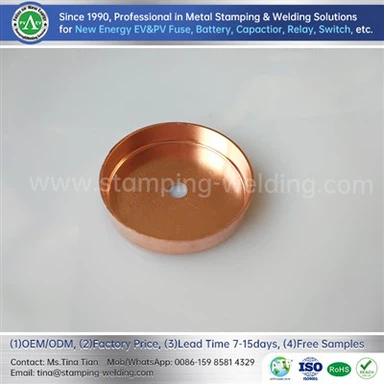
In prismatic battery packaging, the cover plate is a critical structural component that connects the casing, terminal posts, safety mechanisms, and external electrical systems. Depending on the specific battery design, aluminum cover plates for batteries generally must meet requirements regarding dimensional stability, welding compatibility, insulation, and sealing. Features such as terminal holes, explosion-proof structures, electrolyte filling ports, and other functional zones require high manufacturing consistency.

Application Characteristics of Different Aluminum Alloy Grades
3003 aluminum alloy is an aluminum-manganese alloy characterized by good ductility, corrosion resistance, and formability, making it suitable for battery casing structures that require deep drawing or complex stamping. For deep prismatic battery casings, the material undergoes significant plastic deformation during forming; if elongation properties are insufficient, issues such as cracking, uneven wall thinning, or localized instability can occur.
In actual production, softer tempers (such as 3003-O) are typically better suited for complex deep drawing, whereas work-hardened tempers offer different balances between strength and formability. Consequently, the choice of material temper cannot be determined in isolation from the specific structural design and manufacturing process.
1060 aluminum alloy features high aluminum content, excellent electrical and thermal conductivity, and good ductility, making it suitable for certain ultra-thin, precision-stamped structural components. In scenarios demanding high material purity, forming stability, and thin-wall processing capabilities, high-purity aluminum materials may be considered based on the part's structure.
5052 aluminum alloy is an aluminum-magnesium alloy offering good corrosion resistance and moderate strength, making it suitable for structural components that require high environmental durability. The 5052 series is particularly valuable for applications such as outdoor energy storage equipment, environments with complex heat and humidity conditions, and uses requiring high structural stability.
Heat-treated 6061 aluminum alloy offers high strength and excellent machinability, making it ideal for cover plates and structural components that require high strength, precision hole positioning, or CNC machining. However, compared to materials like 3003, its deep-drawing capability requires evaluation based on the specific temper and structural design.
Forming and Processing Technologies for Power Battery Casings
The manufacturing of power battery casings is not merely a sheet metal stamping process; rather, it is the result of the interplay between materials, tooling, forming parameters, and subsequent processing steps. For deep square housings, it is essential to formulate an appropriate deep-drawing process based on product dimensions and material properties. Key factors such as the drawing ratio, blank holder force, die clearance, and lubrication conditions must be controlled to minimize the risk of cracking and localized thinning.
In complex housing structures, deep drawing and ironing (thinning draw) can be combined; deep drawing establishes the overall shape, while ironing allows for the fine-tuning of local wall thickness and dimensional accuracy. For thin-walled battery housings, variations in material thickness must be kept within reasonable limits to avoid compromising subsequent welding, sealing, and mechanical strength.
Precision stamping is primarily employed for smaller, structurally complex functional areas, such as mounting holes, positioning features, and safety mechanisms. Factors such as the condition of the stamping die's cutting edges, clearance control, and material grain direction significantly influence the final part's burr formation, deformation, and dimensional accuracy.
Battery cover plates may undergo subsequent processes such as CNC drilling, milling, threading, and precision forming. These operations require strict control over the relationships between datum surfaces, hole locations, and flatness to ensure a stable assembly interface with the housing, terminal posts, and other components.
Sealed Connection Between Battery Cover Plate and Housing
Sealing is a critical technical requirement for power battery structural components. Once the housing is formed, it must be reliably joined to the cover plate to create a sealed enclosure for the battery cells. Depending on the product design and manufacturing process, methods such as laser welding are commonly used to join the housing and cover plate.
Laser welding offers advantages such as concentrated heat input, high welding speeds, and a high degree of automation, making it ideal for the mass production of power batteries for new energy vehicles. When welding thin-walled aluminum alloy components, parameters such as laser power, welding speed, focal position, and shielding gas flow must be precisely controlled to prevent defects like burn-through, lack of fusion, porosity, and irregular weld bead formation.
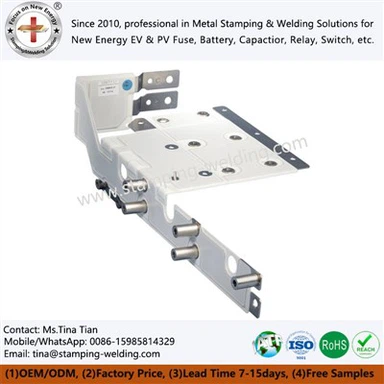
Battery cover plate assemblies often integrate terminal posts, safety pressure-relief mechanisms, and other functional components.
Consequently, the cover plate is not merely a simple sealing sheet but a precision structural component integrating multiple functional zones. Its design must simultaneously address requirements for sealing, insulation, electrical connection, mechanical fastening, and safety pressure relief.
Explosion-proof Structures and Battery Safety Design
Power batteries may experience internal gas generation and pressure buildup under abnormal conditions; consequently, prismatic batteries typically incorporate safety pressure-relief structures. When internal pressure reaches a design threshold, the explosion-proof structure must activate in a predetermined manner to release internal gases, thereby mitigating the risk of catastrophic casing failure.
Explosion-proof structures impose stringent requirements regarding material thickness, score line geometry, residual wall thickness, and manufacturing consistency. For stamped parts made from ultra-thin aluminum sheet, localized scoring or thinning zones require high dimensional consistency; otherwise, parts from different batches may exhibit varying activation pressures.
Fabricating such structures typically involves processes including precision stamping, scoring, deburring, and cleaning. For components critical to battery safety, attention must be paid not only to geometric dimensions but also to material microstructural uniformity, processing-induced deformation, and batch-to-batch consistency.

Multi-material Joining Requirements for Battery Cover Plates
As the electrical architecture of power batteries becomes increasingly integrated, cover plates and their associated connection assemblies may involve a combination of aluminum, copper, and other conductive materials. Joining dissimilar metals requires consideration of factors such as electrical conductivity, thermal expansion coefficients, contact resistance, and electrochemical corrosion.
In certain bipolar configurations and electrochemical devices, composite material approaches-such as copper-aluminum bimetal bipolar plates-may be employed, allowing different metals to fulfill distinct functional roles. However, in the practical application of power battery cover plates, specific material combinations must be validated based on current paths, joining methods, corrosive environments, and structural design.
Regarding conductive structures on the cover plate, contact stability between materials is a critical concern. Mechanical stability and electrical performance at contact interfaces may shift under conditions such as prolonged vibration, thermal cycling, and current loading; therefore, appropriate testing is required during the design validation phase.
Dimensional Control of Prismatic Lithium Battery Structural Components
Prismatic battery casings are typically characterized by thin walls, large dimensions, and strict requirements for dimensional consistency.
Following casing formation, issues such as significant wall thickness unevenness, bottom deformation, or sidewall inclination can directly impact cell assembly and subsequent module integration.
For cover plate components-such as prismatic lithium battery lids-critical dimensions typically include overall external dimensions, mounting hole locations, terminal hole positions, sealing zone dimensions, and the boundary dimensions that interface with the casing. A unified manufacturing datum must be established across different dimensions to minimize the impact of cumulative tolerances on assembly.
During mass production, dimensional inspection typically employs a combination of measuring tools, coordinate measuring machines (CMMs), and dedicated inspection fixtures. Stricter process control requirements can be implemented for critical hole locations and sealing areas, with batch consistency maintained through first-article inspection, in-process sampling, and final inspection.
Material Selection for Different Application Scenarios
Power batteries for new energy vehicles prioritize lightweighting, structural strength, formability, and sealing reliability; consequently, 3003-series alloys are widely used for prismatic battery casings. For structures requiring complex deep drawing, materials should be evaluated primarily based on elongation, work-hardening behavior, and forming limits.
Battery structural components for commercial, industrial, and residential energy storage systems may be exposed to environments with significant temperature and humidity fluctuations; therefore, corrosion resistance, welding stability, and long-term structural reliability are key considerations. For outdoor applications, aluminum alloys with superior corrosion resistance-such as the 5052 series-should be evaluated based on actual environmental conditions.
Consumer electronics prioritize lightweight and slim profiles, dimensional precision, and aesthetic quality. Given the typically small size of these batteries and the potential for reduced wall thickness in structural components, factors such as sheet surface quality, stamping die precision, and thinning-draw processes significantly impact the final product.
For high-strength cover plate structures, heat-treatable aluminum alloys may be considered depending on the specific design. These materials are better suited for structures requiring high mechanical strength and precision machining, though the manufacturing process must balance material strength with formability.
Key Focus Areas for Quality Control of Battery Structural Components
Aluminum casings and cover plates for power batteries are functional structural components; quality control cannot rely solely on final dimensional inspection but must encompass multiple stages, including material sourcing, tooling, forming, welding, cleaning, and assembly.
At the material intake stage, focus should be placed on alloy grade, temper, thickness, surface quality, and material properties. During the forming stage, control efforts should target cracks, wrinkles, thinning, deformation, and dimensional deviations. Stamped parts require inspection for burrs, edge quality, and critical dimensions. For welded structures, key areas of focus include weld continuity, porosity, cracks, lack of fusion, and sealing performance.
For critical structural components such as battery cover plates, reliability verification protocols must be established based on product functionality; these include airtightness testing, dimensional stability testing, thermal cycling, and mechanical strength verification. For components involving safety pressure relief functions, particular emphasis must be placed on verifying opening pressure and the consistency of the opening mechanism.
Cleanliness is another crucial control parameter in the manufacturing of power battery structural components. Processes such as stamping, machining, and welding can generate oil residue, metal particles, and processing debris on aluminum casings and cover plates; therefore, appropriate cleaning procedures are essential to prevent contaminants from entering the battery cell or interfering with subsequent welding and insulation processes.
Evolution Toward Lightweight and Integrated Aluminum Casing Structures
As power battery systems continue to achieve higher energy densities, the structural design of battery casings and cover plates is shifting from a role of simple protection toward lightweight and integrated configurations. An increasing number of structural components are required to simultaneously fulfill functions related to mechanical protection, heat transfer, sealing, electrical interconnection, and safety.
In light of this trend, the design of top structures for prismatic lithium batteries-such as the battery canopy-requires the spatial integration of multiple functional zones while strictly controlling dimensions and weight. Material thickness should not be reduced merely for the sake of weight saving; instead, optimization must account for localized stress, welding zones, and safety-critical structural features.
For larger battery cells, the increased casing dimensions result in more complex stress distribution during material forming. Mold design, lubrication conditions, and forming paths require targeted optimization to ensure the overall consistency of large-format casings.
Simultaneously, the proportion of automated production for battery structural components continues to rise. Technologies such as automatic feeding, automated stamping, in-line visual inspection, dimensional checking, and automated welding help minimize variations caused by manual handling and enhance consistency in high-volume manufacturing.
Technological Trends in Aluminum Battery Casing Manufacturing
Future manufacturing of aluminum casings for power batteries will place greater emphasis on the synergistic design of materials, molds, and processes. Relying solely on increasing material strength cannot resolve all structural challenges; for deep-drawn casings, material ductility, forming limits, and work-hardening behavior are equally critical.
Furthermore, the drive for lightweight structural components is spurring the development of thinner sheet materials and localized reinforcement structures. By optimizing cross-sectional profiles, stiffening ribs, localized thickness, and joining methods-while still meeting safety and service life requirements-manufacturers can reduce unnecessary material usage. For aluminum casings and cover plates, further improvements in dimensional accuracy and welding consistency are required.
As battery cell sizes increase and system integration technologies-such as CTP (Cell-to-Pack) and CTC (Cell-to-Chassis)-evolve, the interfaces between structural components and the cells, cooling systems, and overall pack structures are becoming increasingly tight; consequently, the importance of controlling manufacturing tolerances is rising.
Regarding safety, explosion-proof pressure-relief structures will remain a key area of research in power battery casing design. Future safety structures may be further integrated with cover plates, electrical connections, and pressure management systems to reduce part counts and improve spatial efficiency.

Comprehensive Engineering Assessment: From Materials to Structural Components
Aluminum power battery casings are not merely products of simple sheet metal processing; they are complex structural components resulting from the interplay of material properties, forming processes, precision machining, welding technologies, and quality control.
Materials such as 3003, 5052, 6061, and 1060 offer distinct performance characteristics, and the final material selection requires a comprehensive evaluation based on battery architecture, production processes, and operating environments.
To achieve lightweight battery structures, materials for aluminum covers and casings must strike an optimal balance between weight, strength, formability, weldability, and sealing reliability. For large-format battery structures, dimensional stability under long-term mechanical loads and temperature fluctuations is also a critical consideration.
As the new energy vehicle and energy storage markets increasingly demand products offering high safety, high energy density, and high consistency, the manufacturing of battery structural components is evolving. The industry is shifting from simple stamping processes toward an integrated approach that encompasses material selection, structural design, precision forming, automated welding, and end-to-end quality control.
From an engineering procurement perspective, the evaluation of suppliers for aluminum battery casings and cover plates should focus on material grades and tempers, forming capability, critical dimension control, welding and sealing capability, and batch consistency, rather than relying solely on material prices or per-unit processing costs as the basis for assessment.
contact us