Why Thermal Management Matters in Server Enclosures: From Traditional Racks to High-Density Data Centers
Sep 23, 2026
In the past, the primary role of server cabinets was generally understood as simply "mounting and protecting servers." However, as computing densities in data centers continue to rise, the functionality of server enclosures is evolving. Beyond providing standardized mounting space for equipment, these cabinets must now facilitate airflow management, cable organization, power distribution, and equipment maintenance.
This is particularly critical in high-performance computing and high-density data centers, where internal heat densities are increasing; traditional designs relying solely on basic fans and natural ventilation often struggle to meet modern thermal management requirements. Consequently, server cabinet design has shifted from purely structural engineering to an integrated approach combining mechanical structure, airflow dynamics, and thermal management.
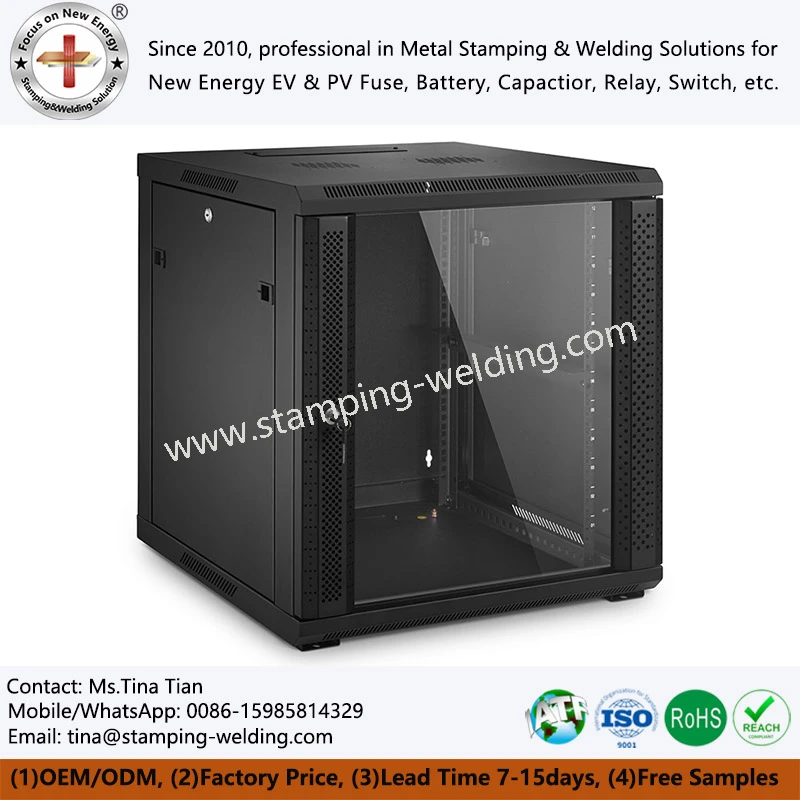
Why do servers generate so much heat?
During operation, components such as CPUs, GPUs, memory modules, power supply units, storage devices, and other electronics generate heat. If this heat is not dissipated promptly, internal temperatures can rise. Standard IT equipment typically relies on front-to-back airflow for cooling.
Server cabinets must facilitate stable airflow and prevent hot air from recirculating within the enclosure. Consequently, the cabinet's doors, side panels, top and bottom sections, and internal mounting space all influence the final airflow path.
Why is the ventilation design of the front and rear doors important?
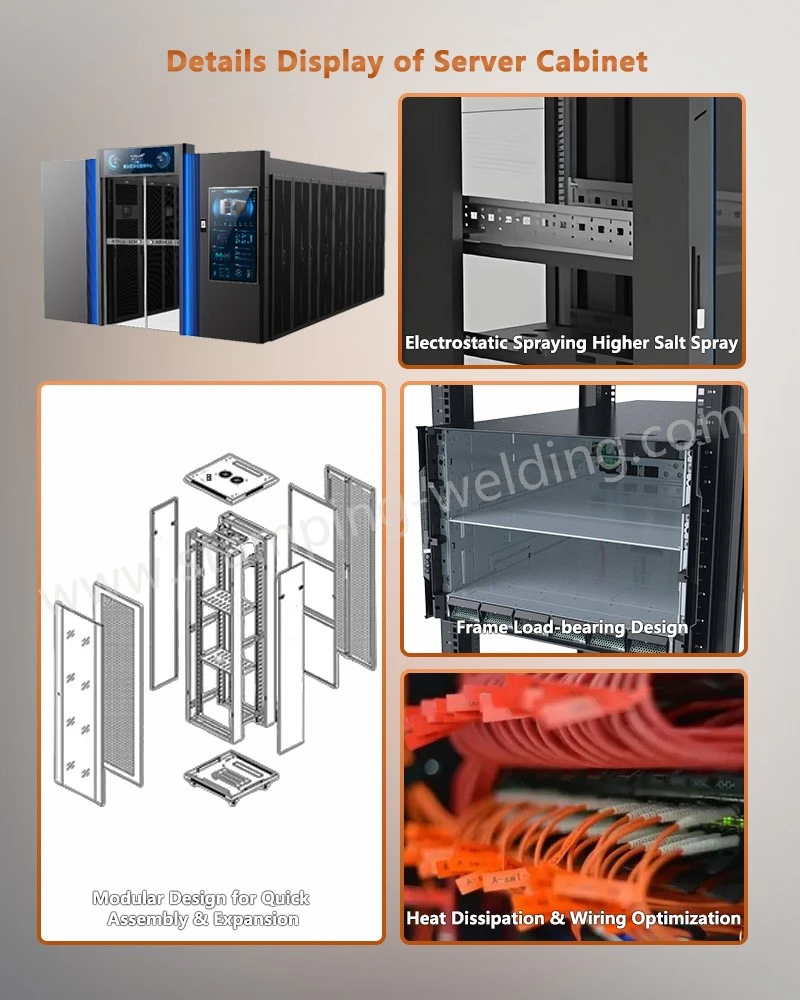
Air-cooled servers typically require cool air to enter from the front and hot air to be exhausted from the rear. Consequently, the front and rear doors of server rack enclosures generally require sufficient open area for ventilation. Perforated metal panels provide a pathway for airflow while maintaining necessary mechanical strength.
Manufacturers of server cabinet components often employ various perforation patterns and opening structures to strike a balance between airflow, structural integrity, and aesthetics. This means the ventilated door panels themselves are an integral part of the thermal management system.
How does cable management affect heat dissipation?
Server rooms typically contain a vast number of cables. If power cords, network cables, and fiber-optic lines are haphazardly arranged inside the cabinet, they can obstruct airflow paths.
Consequently, modern server racks often incorporate features such as vertical cable managers, overhead and under-floor cable routing, and dedicated cable pathways. Effective cable management not only facilitates maintenance but also minimizes the impact of cabling on airflow-a factor that is particularly critical for high-density cabinets.
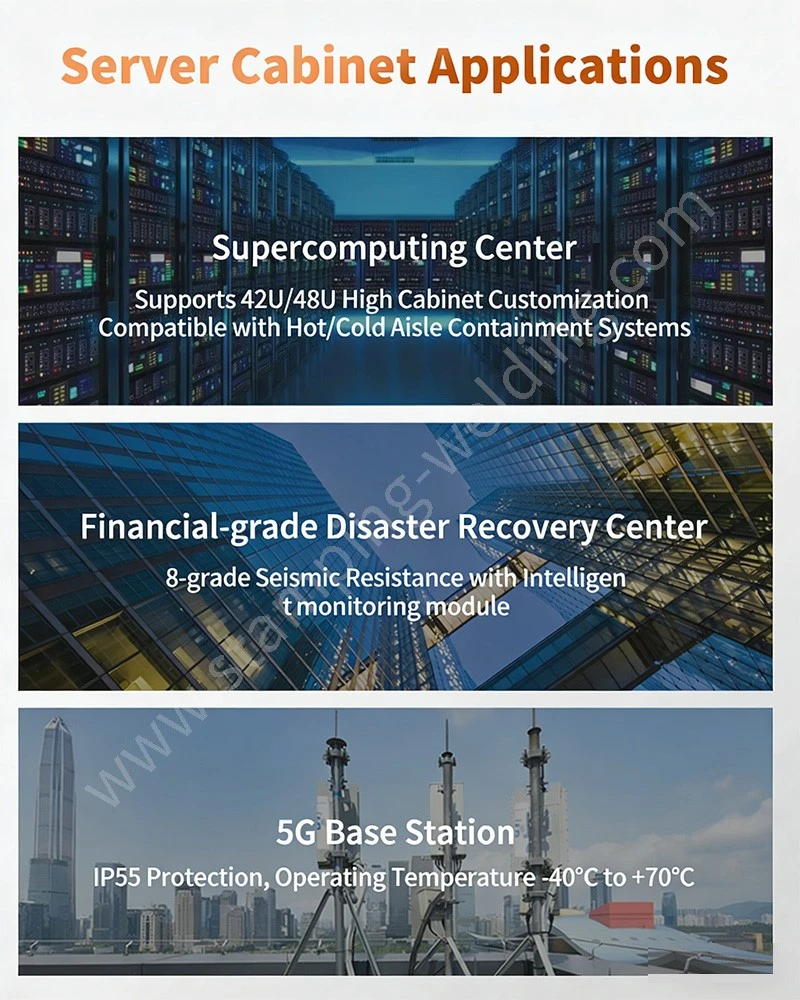
Cold and Hot Aisle Design
In large-scale data centers, server cabinets are typically arranged in a specific configuration. Cold aisles supply relatively cool air to the servers, while hot aisles serve to collect and exhaust the hot air generated by the servers. This layout minimizes the mixing of cold and hot air, thereby enhancing the efficiency of the cooling system.
Consequently, the orientation of the server cabinets' front and rear doors, the cabinet arrangement, and the airflow patterns-whether overhead or side-based-must be coordinated with the data center's overall HVAC system.
What new demands do high-density servers place on outdoor server cabinet?
With the advancement of AI, GPUs, and high-performance computing (HPC) equipment, the power density of computing hardware within a single rack can increase significantly. Recently, the data center industry has seen the adoption of liquid cooling architectures and copper-aluminum composite heat dissipation structures for high-density GPU servers.
This means that future floor-standing data cabinets may no longer be merely "server cabinets" in the traditional sense. For certain high-density applications, the enclosure might need to integrate cold plates, liquid cooling piping, cooling manifolds, or other thermal management interfaces.
What distinguishes liquid-cooled server cabinets?
Traditional air cooling relies on fans and airflow to dissipate heat. In contrast, liquid cooling systems circulate liquid to remove heat generated by the equipment, either directly or indirectly.
For high-power computing equipment, liquid cooling serves as a crucial thermal management alternative to air cooling. This necessitates changes to the outdoor network cabinet's structure; beyond simply providing space for server installation, the cabinet must accommodate liquid cooling interfaces, piping, leak detection systems, and maintenance access.
How do server cabinets support high-density deployments?
High-density deployment means installing more computing equipment within the same amount of space. Consequently, cabinets must maximize effective mounting space while maintaining sufficient load-bearing capacity and adequate room for maintenance.
Standardized "U-space" designs help data centers plan server counts more efficiently. Additionally, mounting rails require high positional accuracy to ensure the smooth installation of standard rack-mount equipment from various manufacturers.
Outdoor data cabinet in Edge Computing
White server cabinets are not limited to large-scale data centers. With the rise of edge computing, an increasing number of servers and network devices are being deployed in factories, telecommunication sites, commercial buildings, transportation facilities, and other non-traditional data center environments.
These scenarios often impose unique requirements on the enclosures. For instance, edge server rooms may have limited space, prioritizing compact designs; industrial environments may involve dust and moisture, necessitating robust protective features; and telecommunication sites may require superior environmental resilience.
Consequently, edge enclosed server rack often need to be customized based on the specific installation environment.
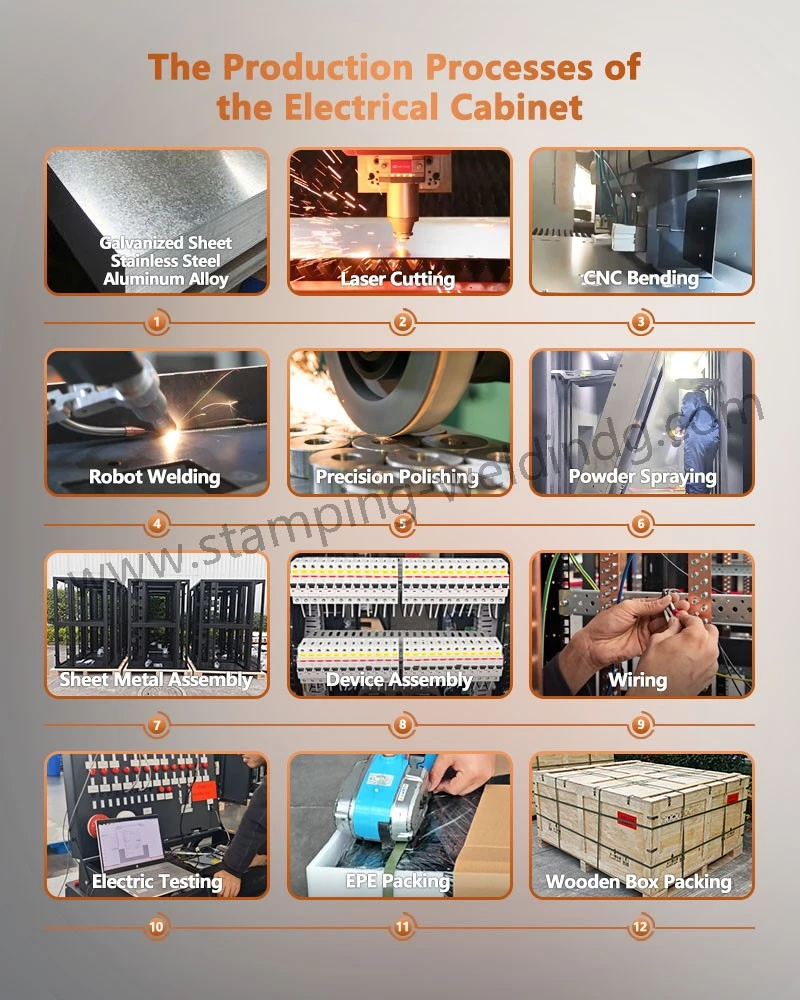
What factors must be considered for outdoor server cabinets?
When server equipment is installed outdoors, the cabinet must withstand rain, dust, solar radiation, and temperature fluctuations. Such applications differ significantly from standard indoor data center cabinets. These cabinets may require sealed doors, specialized anti-corrosion coatings, sunshades, filtration systems, and air conditioning or heat exchangers.
Consequently, the design of an outdoor server enclosure focuses not only on equipment mounting but also on the entire environmental control system.
What is the difference between a network cabinet and a server cabinet?
While server cabinets and network cabinets may look similar, their practical application requirements differ. Server cabinets typically need to accommodate deeper and heavier equipment and meet higher heat dissipation demands.
Network cabinets, on the other hand, house devices such as switches, routers, patch panels, and fiber optic equipment; they generally place greater emphasis on cable management and interfaces for communication equipment. Of course, the functional boundaries between the two are gradually blurring in modern data centers.
Therefore, purchasing decisions should be based on actual equipment dimensions, rack unit (U) capacity, depth, weight, heat dissipation needs, and cabling requirements.
Security is also a crucial function of server cabinets.
Since server cabinets house a vast amount of critical IT equipment, physical security cannot be overlooked. Cabinets mitigate the risk of unauthorized equipment tampering through features such as locking doors, removable side panels, internal structural protections, and access control systems. Some security-focused cabinets incorporate reinforced structures and specialized locking mechanisms to meet the demands of high-security environments.
Product specifications indicate that certain secure cabinets utilize reinforced locking mechanisms and metal door panels to satisfy requirements for controlling physical access to the equipment.
In what directions will network server racks evolve in the future?
The future development of in-wall network cabinets will keep pace with advancements in computing hardware. With the rise of AI servers, high-performance GPUs, and high-density computing platforms, enclosures are required to handle increasingly demanding thermal management tasks. At the same time, modularity, rapid deployment, cable management, energy management, and liquid cooling compatibility will become key design priorities.
Consequently, future server rack enclosures may evolve from being merely passive structural housings into integral components of data center infrastructure.
The design of server racks on wheels has evolved from simple equipment mounting cabinets into comprehensive infrastructure solutions.
For traditional server rooms, the focus tends to be on standard 19-inch mounting, load-bearing capacity, ventilation, and cable management. High-density data centers require additional considerations regarding airflow management, power density, and liquid cooling interfaces. Meanwhile, edge computing and outdoor deployments necessitate environmental protection and temperature control capabilities.
Therefore, when selecting a server enclosure, one should not focus solely on dimensions and price; instead, a holistic approach is required-taking into account server types, the installation environment, thermal management methods, cabling volume, and future expansion needs.
Contact Us