The knowledge of selecting Server Cabinets
Jan 16, 2026
Server Cabinets are a physical carrier used for centralized placement of key IT hardware such as cloud servers, network devices, storage devices, etc. It is an important component of building a cloud computing infrastructure. It is like a precise 'hardware container', providing a safe and stable operating environment for various devices. The intelligent service room complex is based on cloud server racks, integrating intelligent management systems, efficient refrigeration systems, reliable power supply and distribution systems, and comprehensive monitoring systems to form a highly integrated and intelligent large-scale computer room facility. It can achieve centralized management and efficient operation of a large number of cloud servers, providing comprehensive guarantees for the stable supply of cloud computing services.

How to choose the right cabinet
By selecting Server Cabinets with appropriate depth, two sets of devices can be installed face-to-face, maximizing the use of internal space and forming a layout where the front row can be loaded and unloaded from the front door and the rear row can be operated from the rear door. The cabinet needs to have adjustable installation positions, and after calculating the required space in units of "U" (1.75 inches), it is also necessary to reserve expansion space based on the actual area of the computer room. Due to the uncertainty of equipment procurement, it is recommended to reserve 20% -30% redundancy in cabinet height. This not only provides the possibility for subsequent expansion but also optimizes internal ventilation conditions to ensure equipment heat dissipation.
For devices that can be installed with brackets, there is no need to consider the width separately, as their design is already adapted to the standard width of the cabinet; But for non rack mounted Enclosed Server racks and peripherals, the width needs to be carefully checked to avoid any inability to adapt. The total weight of the equipment is usually large, and a cabinet with a load-bearing capacity of about 1500 pounds and a stable load-bearing structure should be selected. The weight of the equipment also determines the specification selection of the sliding frame and supporting accessories. Priority should be given to selecting products that meet or exceed all OEM manufacturers' Class III bracket specifications and are compatible with various servers. If tower or desktop equipment needs to be installed, the accompanying sliding frame and installation accessories are indispensable.
There are various types of cables inside the cabinet, including network cables, telecommunications cables, and power cables, which require the use of hook and loop or toothed straps for orderly fixation. If the cabinet comes with a cable management module, the cables can be directly fixed in the vertical device rails of the Vertical Server Rack for better optimization results. At the same time, the inner and upper walls of the cabinet should be equipped with sufficient fixing rings to protect cables, and the bottom of the cabinet can also be raised to provide convenience for bottom wiring.

Classification of Cabinet Levels
Although they have similar appearances, cabinets can be divided into different types according to their purposes. Common ones include a Network Rack for wiring and a Data Cabinet for server placement. The wiring cabinet mainly houses multiple terminal switches and requires a large number of network cables to be led out. It usually has no cabinet door design and is closer to the rack in appearance. Some manufacturers also refer to it as a wiring rack; the Network Cabinet is equipped with lockable cabinet doors to protect valuable internal servers, routers, firewalls, and other devices, providing stronger security.
The Server Rack Cabinet itself has a grade difference. Ordinary models often use glass cabinet doors, with four cooling fans on the top and a hollow bottom design to assist ventilation, which can effectively ensure the heat dissipation of top devices. However, the heat dissipation effect of the middle and lower devices is not satisfactory. The high-end models achieve full area ventilation through dense air vents on the front and rear doors, which can evenly distribute the cold air of the computer room air conditioning around each device, resulting in more balanced heat dissipation performance. At the same time, high-end cabinet materials are more refined, with excellent anti-corrosion and rust prevention performance, and better load-bearing capacity.
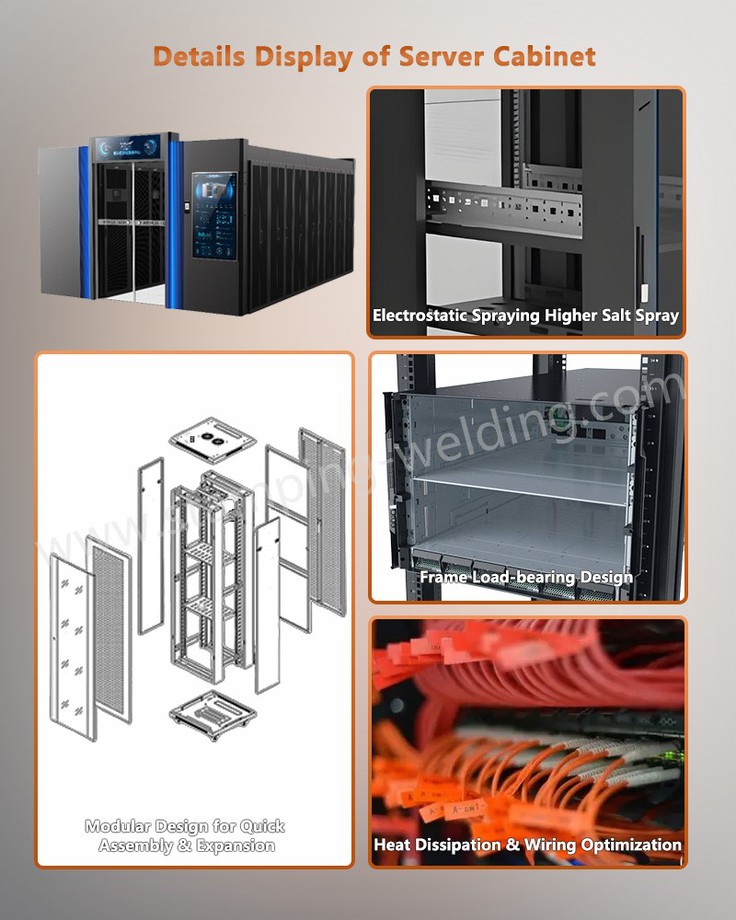
Core considerations for cabinet selection
Firstly, reliable quality assurance is essential. Choosing the appropriate cabinet is the foundation for ensuring the safe operation of equipment. Quality defects may cause significant losses, so quality should be the primary consideration. Next is the load-bearing capacity. As the density of equipment inside the cabinet continues to increase, a qualified Rack Cabinet must have sufficient load-bearing performance to avoid affecting the stability of the entire system due to insufficient cabinet quality.
The temperature control system is crucial, and the Network Rack Cabinet needs to have good temperature and humidity regulation capabilities to prevent equipment from affecting operational efficiency due to overheating or overcooling. Depending on the usage environment, it can choose a fully ventilated series, equipped with long-lasting fans, or install independent air conditioning and heating insulation systems. Anti-interference and additional functions cannot be ignored. A fully functional cabinet should have anti-interference performance, such as dust, water, and electronic shielding. At the same time, supporting accessories and installation accessories should be provided to simplify the wiring process and improve management efficiency.
High-quality after-sales service can provide great convenience for Server Cabinets installation and maintenance, and comprehensive equipment protection solutions provided by enterprises can effectively reduce later operation and maintenance costs. The power distribution system is the key to coping with high-density installation of IT equipment. With the increasing trend of equipment miniaturization, the demand for power supply in cabinets has greatly increased. Taking the 42U Server Rack as an example, if 8 7U blade servers are built in, the total power distribution demand can reach 24kVA, posing a severe challenge to the power distribution system. A reasonable power distribution system should prioritize reliability, be closely aligned with the load layout to reduce fault points, support local and remote monitoring and control, and be integrated into the intelligent management system of the computer room.
The cable layout directly affects the operation and maintenance efficiency. In large computer rooms, Comms Cabinet's cable management capability is the core evaluation indicator. The cabinet needs to provide sufficient cable channels to support the top and bottom incoming lines. Internal cables should be laid in an orderly manner, close to equipment interfaces, shorten wiring distance, and avoid interference with equipment installation, maintenance, and heat dissipation airflow. At the same time, it is necessary to be able to quickly locate cables in case of faults to improve maintenance efficiency. Although the value of cabinets and racks is much lower than that of internal equipment, they have a profound impact on system reliability, and strict control of various indicators is required when selecting.

contact us