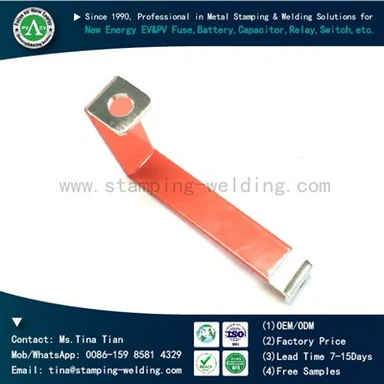
Why do Flexible Laminated Copper Busbar Copper Connector overheat during high-current operation?
Jul 27, 2026
Flexible Laminated Copper Busbar Copper Connector serve as critical interconnect components in electrical equipment for the new energy sector. Specifically, laminated flexible bars are widely used for circuit connections in high-power applications-such as new energy vehicles, inverters, power battery systems, and transformers-where their flexibility and excellent electrical conductivity allow them to accommodate complex routing requirements. However, under continuous high-current operation, these busbars are prone to abnormal overheating. This not only causes excessive temperature rise and accelerates the aging and cracking of the insulation layer but also compromises connection stability; over time, issues such as loose contacts and circuit failures can arise, directly impacting the safety, service life, and reliability of the entire electrical system.

Analysis of the Root Causes of Overheating Due to Sustained High Current
Improper load selection is a primary cause of overheating; copper foil busbars must align with the relevant current load standards. In some operating scenarios, designs feature insufficient copper foil cross-sectional areas or excessive current densities, and product selection fails to provide adequate overload margins. Consequently, prolonged operation at full or excessive loads generates continuous, substantial heat that exceeds the product's thermal dissipation capacity, leading to persistent overheating.
Defects in the diffusion welding process exacerbate heat generation issues. Multi-layer copper foil busbar flexible connections rely on diffusion welding to bond the layers; if the copper foil layers are unevenly aligned or suffer from localized weak welds or delamination during production, the internal conductive cross-section becomes inconsistent. This causes a sharp rise in internal contact resistance, creating localized "hot spots" where heat concentrates; prolonged energization intensifies this overheating, ultimately compromising electrical conductivity stability.
Abnormally high contact resistance at the terminals is another common cause of failure. If the terminal ends of flexible copper foil busbars (such as those used in EV battery packs) exhibit surface oxidation or contamination from oil and debris-or if insufficient bolt-tightening pressure is applied during installation-the contact interface fails to mate tightly. This leads to a surge in contact resistance, causing heat to accumulate when high currents flow and eventually triggering overheating across the entire busbar assembly.
Poor thermal dissipation conditions amplify the risk of overheating. Many electrical devices are installed in compact, enclosed spaces, subjecting laminated connectors to high-temperature, confined operating environments. Natural heat dissipation efficiency is extremely low; heat generated during operation cannot dissipate effectively and instead accumulates around the busbar, creating a vicious cycle that further exacerbates excessive temperature rise.
Targeted optimization and improvement solutions
Optimizing the product's structural design can prevent overheating caused by overloading at the source. For high-power applications, the overall conductivity of the flexible multi-layer copper foil assembly can be enhanced by increasing the number of copper foil layers and enlarging the conductive cross-sectional area. This ensures a precise match with the equipment's rated operating current, maintains an adequate current margin, and lowers current density per unit area, thereby eliminating overload-induced overheating through design.
Upgrading the diffusion welding process and strictly controlling quality throughout production ensures optimal performance. Thoroughly cleaning oil and oxide layers from the copper foil surfaces prior to production guarantees flat, uniform bonding. Standardized control of welding parameters ensures consistency across multiple layers, effectively reducing internal resistance, eliminating localized hotspots caused by welding defects, and improving conductive uniformity.
Optimizing terminal connection structures and surface treatment processes enhances contact surface flatness through precision terminal finishing. Surface treatments such as silver or nickel plating improve the conductive contact interfaces of the busbars. Additionally, standardized installation procedures and precise control of fastening pressure minimize terminal contact resistance and reduce heat loss at contact points.
Optimizing the installation environment for heat dissipation involves modifying the mounting structure to widen the clearance around the busbar, thereby increasing airflow and preventing heat accumulation associated with enclosed, high-temperature environments. For high-frequency applications that generate significant heat, auxiliary heat dissipation structures can be added to rapidly dissipate heat from the busbar and stabilize the equipment's operating temperature.

Our Manufacturing Capabilities and Quality Control
The manufacturing of high-reliability Flexible Laminated Copper Busbar Copper Connector involves multiple stages, including material processing, welding, surface treatment, and performance testing. Every step-from copper foil blanking and lamination to diffusion bonding, terminal forming, electroplating, and electrical performance testing-impacts the final current-carrying capacity.
Leveraging comprehensive manufacturing capabilities, it is possible to provide customized solutions ranging from laminated copper foils for connectors to bespoke flexible copper foil laminated busbars, thereby meeting diverse customer requirements regarding dimensions, current ratings, and mounting configurations.
Quality validation focuses on critical assessments such as DC resistance, temperature rise, insulation performance, and long-term reliability testing, ensuring the products meet the rigorous demands of high-reliability applications in new energy vehicles, battery systems, and inverters.
Contact Us
If your Flexible Laminated Copper Busbar Copper Connector experience issues such as excessive temperature rise, abnormal hot spots, or insufficient current-carrying capacity, we can provide structural optimization, process improvements, and mass production support to help enhance product stability and reliability.