Application And Manufacturing Technology Of Copper Part Stamping in High-Voltage Systems For New Energy Vehicles
Jul 23, 2026
The evolution of high-voltage architectures in new energy vehicles has imposed rigorous standardization requirements on conductive connection components, driving the widespread adoption of various high-precision stamped parts. High-voltage systems must meet three core performance criteria-high-current transmission, low resistive loss, and high operational reliability-to accommodate frequent charging and discharging, complex driving conditions, and long-term service requirements. Thanks to their precise forming accuracy and stable conductivity, Copper Part Stamping perfectly meet the stringent standards of new energy vehicle high-voltage circuits; they effectively mitigate safety risks such as overheating, poor connections, and open circuits, thereby ensuring the stable operation of the vehicle's electrical system.

Key Application Areas for Copper Stamped Parts
Copper stamped parts within the high-voltage systems of new energy vehicles primarily serve functions such as current transmission, structural connection and fixation, and signal conduction. Product structures and technical specifications vary depending on the specific application location.
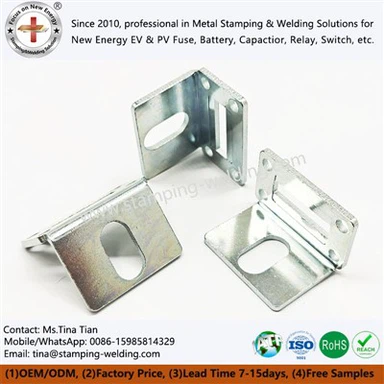
In the realm of high-voltage connectors, copper stamped and bent parts are commonly used to manufacture connection terminals, conductive strips, and mating components. Stamping and bending processes enable the integrated formation of complex geometries, meeting the high-voltage connector industry's stringent requirements for space efficiency and assembly precision.
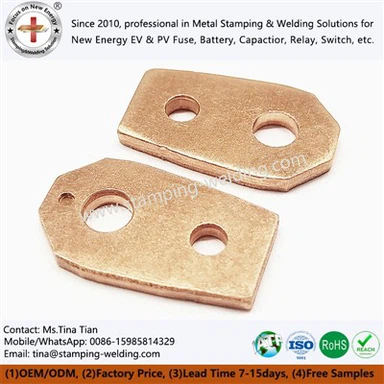
Battery systems represent a key application area for copper stamped parts in new energy vehicles. Battery Management Systems (BMS) rely on stable electrical connections to monitor cell status, manage current distribution, and ensure safety control; high-precision copper stamped components-such as battery interconnects, voltage sensing tabs, and conductive elements-are utilized here to enhance the operational stability of the battery system.
Additionally, copper stamping technology is widely employed for contact assemblies in relays and high-voltage power distribution modules. For instance, copper stamped parts for electric relays are primarily used for internal conductive structures, where precision stamping ensures consistent contact positioning and reliable electrical contact.

Advantages of Copper Materials
Copper has become a key choice for high-voltage components in new energy vehicles primarily due to its excellent overall performance.
First, copper possesses high electrical conductivity, which minimizes energy loss during current transmission and reduces component temperature rise. For the high-voltage circuits of new energy vehicles, stable current transmission capability directly impacts both vehicle safety and energy efficiency.
Second, copper exhibits excellent ductility and plasticity, making it well-suited for manufacturing processes such as stamping, bending, and drawing. For instance, precision stamped copper electrical parts can be manufactured with complex geometries through progressive stamping while maintaining high dimensional consistency.
Furthermore, copper and copper alloys offer great versatility in processing, allowing for the selection of specific material grades based on varying requirements for electrical performance and mechanical strength. Through material optimization and structural design, these materials can meet the application needs of diverse new energy vehicle platforms.

Our Manufacturing Processes and Customization Capabilities
Copper components for new energy vehicles typically undergo multiple processing stages, including material preparation, mold development, precision stamping, surface treatment, and quality inspection.
Integrated manufacturing methods-such as bending, laser cutting, and stamping-meet the requirements for parts with diverse structural designs, including complex connecting tabs, brackets, and custom-shaped conductive components.
For applications such as high-voltage connections and electrical contacts, stamped copper parts must demonstrate stable dimensional accuracy and reliable assembly performance. Precision mold design helps minimize production variances and ensures component consistency.
Regarding surface treatment, we offer processes such as nickel, tin, and silver plating-tailored to the operating environments of new energy vehicles-to enhance oxidation resistance and electrical contact performance. For instance, Copper Part Stamping often require specialized surface treatments to ensure stable contact during repeated make-and-break operations.

Contact Us
Please feel free to contact us for copper part stamping solutions tailored to high-voltage new energy applications, as well as detailed specifications and volume quotations. We offer comprehensive, one-stop customization services ranging from mold development and precision stamping to electroplating.