Copper Aluminum Welding Parts Manufacturer China: Laser Welding And Brazing Solutions For OEM Components
Aug 08, 2026
The core challenge in manufacturing welded assemblies of dissimilar copper and aluminum metals lies in ensuring joint strength while controlling the formation of intermetallic compounds, minimizing contact resistance, and maintaining long-term reliability. Due to the differences in melting points, thermal conductivities, and coefficients of thermal expansion between copper and aluminum, traditional welding methods often lead to the formation of brittle Cu-Al compounds, resulting in weld cracking, fatigue failure, and performance degradation.
As a Chinese OEM manufacturer specializing in precision metal stamping and welded assemblies, Xiamen Apollo Stamping Welding Technology Co., Ltd. focuses on the development and mass production of welded components made from copper, aluminum, brass, and steel. The company provides solutions-including laser welding, resistance welding, silver brazing, and hybrid metal joining-to sectors such as new energy vehicles, power electronics, energy storage systems, and industrial equipment.

Key Challenges in Welding Dissimilar Copper-Aluminum Joints: Controlling Intermetallic Compounds and Welding Defects
Copper and aluminum are both commonly used materials in industrial electrical components. Copper offers excellent electrical and thermal conductivity, while aluminum provides advantages such as light weight, high strength, and good corrosion resistance.
Consequently, copper-aluminum combinations in precision welded assemblies can simultaneously meet both electrical and structural requirements.
However, welding copper to aluminum is not a simple process of material fusion.
Given that the melting point of copper is approximately 1083°C and that of aluminum is around 660°C, imprecise control of heat input during welding can cause the aluminum side to melt prematurely while the copper side remains solid. Simultaneously, diffusion reactions between copper and aluminum elements lead to the formation of intermetallic compounds such as CuAl₂ and Cu₄Al₃.
These compounds are characterized by high hardness and low ductility; as the thickness of the compound layer increases, it becomes a zone of structural weakness within the welded joint.
Therefore, producing high-quality copper-aluminum welded components requires strict control over:
- Welding heat input, to minimize zones of excessive melting.
- The rate of elemental diffusion at the copper-aluminum interface.
- The thickness of the intermetallic compound layer (typically controlled to within 10 μm).
- Internal weld defects such as porosity, cracking, and incomplete fusion.
The properties of common materials are as follows:
| Material parameters | C1100 Oxygen-Free Copper | Aluminum alloy | Impact on the welding process | Typical application areas |
| density | 8.96 g/cm³ | 2.70 g/cm³ | Aluminum is suitable for lightweight design, while copper offers superior structural stability. | New Energy, Power Electronics, and Industrial Connectivity Components |
| Electrical conductivity | ≥99% IACS | ≥99% IACS | Copper offers superior electrical conductivity, whereas aluminum requires optimization of the connection interface. | Electrical connectors, conductive components |
| Melting point | 1083℃ | 600–660℃ | Heat input must be controlled to avoid overheating the aluminum side. | Dissimilar metal welded joints (copper-aluminum) |
| tensile strength | Approximately 200–250 MPa | Approximately 150–300 MPa (depending on the alloy type) | The strength of the welded joint needs to be verified. | Structural connectors, equipment assemblies |
| Key Advantages | High electrical and thermal conductivity | Lightweight and corrosion-resistant | Select material combinations based on performance requirements. | New Energy and Industrial Equipment Components |
During the development of welded components, potential failure risks can be identified early-and mass production stability enhanced-through metallographic cross-section analysis, welding parameter verification, and material compatibility testing.
Laser Welding vs. Resistance Brazing: How to Choose the Right Metal Welding Process
Welded components with different structural designs require specific manufacturing processes. Laser welding, resistance brazing, and resistance welding each possess distinct characteristics; the choice of method depends on factors such as material combinations, part geometry, production volume, and performance requirements.
Fiber Laser Welding
Fiber laser welding utilizes a high-energy-density beam to achieve rapid, localized heating, thereby minimizing the heat-affected zone and reducing product deformation.
This process is typically applied to:
- Dissimilar metal joints (e.g., copper-aluminum).
- High-precision electrical welded assemblies.
- Metal parts requiring high dimensional stability.
Typical control parameters include:
- Laser power: 500 W–3000 W.
- Welding speed: Adjusted based on material thickness and structure.
- Shielding gas: Argon.
- Control of intermetallic compound thickness in the weld zone.
Resistance Brazing
Resistance brazing generates heat via electric current and utilizes silver-based or other alloy filler metals to form the joint.
Key characteristics of this process:
- Suitable for welding joints with large contact areas.
- High stability in mass production.
- Applicable for joining copper, brass, and steel components.
A comparison of the different processes is as follows:
| Craftsmanship | Laser welding | Resistance brazing | Resistance welding |
| Heat input method | Localized laser heating | Resistance heating + brazing filler metal | Thermal effect of electric current |
| Heat-affected zone | Small | relatively large | medium |
| Filling material | Usually not necessary | need | Usually not necessary |
| Automation capabilities | high | high | high |
| Typical Applications | Precision copper-aluminum welded parts | Electrical connection assembly | Sheet metal welded structure |
For OEM welded component projects, the choice of process cannot be based solely on welding speed; a comprehensive evaluation is required, taking into account:
- The product's operating environment.
- Electrical performance requirements.
- Mechanical strength requirements.
- Annual production volume requirements.
Request Free Welding Process Evaluation

Material Selection and Application of Welded Components Made of Copper, Brass, Aluminum, and Steel
The choice of metal material determines the final performance of welded components. Selecting the right material can enhance electrical conductivity, mechanical strength, and product service life.
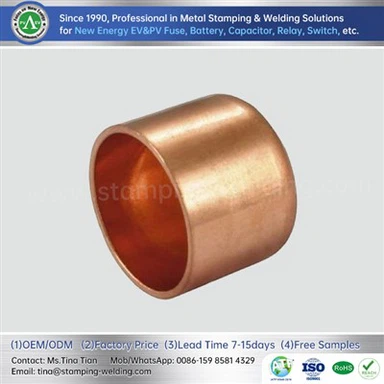
Welded copper components typically utilize C1100 pure copper, making them suitable for applications requiring high electrical conductivity. With a conductivity of ≥99% IACS, this material is widely used in power transmission, electrical connections, and electronic equipment.
Welded brass components often employ copper alloys such as C2680; these offer a balance of good mechanical properties and corrosion resistance, making them ideal for terminals, switch components, and industrial connectors.
Welded aluminum components are primarily used in structural applications where weight reduction is essential. Aluminum alloys have a low density-approximately 30% that of copper-and offer good corrosion resistance, making them suitable for structural components in new energy vehicles, electrical equipment, and electronic products.
Welded steel components prioritize mechanical load-bearing capacity and structural stability, making them suitable for industrial equipment, electrical enclosures, and high-strength connection structures.

OEM Welded Part Manufacturing Process: From Prototype Development to Mass Production
A professional supplier of welded components must possess comprehensive manufacturing capabilities rather than relying on a single welding process.
A complete OEM development process typically includes:
Product design evaluation → Material confirmation → Process validation → Prototype fabrication → Performance testing → Mass production.
During the initial development phase, DFM (Design for Manufacturability) analysis based on customer drawings is required to evaluate material combinations, weldment structures, and production feasibility.
Upon entering the production phase, stable manufacturing of welded assemblies is achieved through processes such as precision metal stamping, laser welding, resistance welding, silver brazing, and surface treatment.
For projects related to the automotive and new energy sectors, the manufacturing process typically must comply with:
- ISO 9001 Quality Management System.
- IATF 16949 Automotive Quality System.
- PPAP Level 3 documentation requirements.
- Product process control plans.

Quality Inspection of Welded Parts: Metallographic Analysis, CMM Measurement, and Performance Verification
The quality of welded components cannot be assessed based on appearance alone; professional testing is required to verify internal structure and long-term reliability.
Metallographic analysis is used to examine weld penetration, bonding characteristics, and the thickness of intermetallic compounds; mechanical testing verifies weld strength; and CMM (Coordinate Measuring Machine) inspection ensures dimensional accuracy.
Key testing items include:
| Testing Items | Purpose of testing |
| Metallographic analysis | Inspect weld structure and defects. |
| CMM Inspection | Control dimensional accuracy |
| Tensile test | Verify connection strength |
| Shear test | Verify welding reliability |
For precision stamped and welded assemblies, dimensional tolerances can be controlled to ±0.01mm according to product requirements, with batch consistency ensured through comprehensive quality management.
Guide to Selecting OEM Manufacturers of Copper-Aluminum Welded Parts in China
When selecting a supplier for welded components, key factors to evaluate include material handling capabilities, the range of welding processes, inspection capabilities, and experience with mass production.
Xiamen Apollo Stamping Welding Technology Co., Ltd. specializes in the manufacturing of precision metal stamped and welded assemblies, offering:
- Copper welded components.
- Aluminum welded components.
- Brass welded assemblies.
- Steel welded structural components.
- Customized metal connecting assemblies.
With integrated manufacturing capabilities-including laser welding, resistance welding, brazing, and stamping-the company provides OEM services ranging from engineering validation to mass production, tailored to specific customer product requirements.

Frequently Asked Questions
Q: Can copper-aluminum welded parts be produced using laser welding?
A: Yes. Laser welding is suitable for joining dissimilar copper and aluminum metals; by controlling heat input and welding parameters, the risk of forming brittle intermetallic compounds can be minimized.
Q: How is consistent quality ensured during the mass production of welded parts?
A: Product consistency is guaranteed through the control of welding parameters, metallographic analysis, CMM dimensional inspection, electrical resistance testing, and process quality management systems.
Q: Can OEM suppliers of welded parts support the development of small-batch prototypes?
A: Yes. Professional manufacturers typically support the entire development process, ranging from DFM (Design for Manufacturability) assessment and prototype validation to the transition into mass production.
Supported by full‑set DFM solutions for die & tooling, we conduct manufacturability review, die development and die try‑out to efficiently deliver prototypes of stamped & welded parts for smooth mass‑production transition.

Contact Us
If you require a customized solution for copper-aluminum welded components, please contact us for professional welding process assessment, product development support, and OEM volume manufacturing services.