Selection Guide For Copper Foil Laminated Flexible BusBars: Balancing Cost, Flexibility, And Temperature Resistance
Oct 09, 2026
Copper Foil Laminated Flexible BusBars are widely used in new energy vehicles, battery energy storage systems, inverters, and industrial electrical equipment, particularly in applications requiring high-current transmission, flexible compensation, or compact installation. When selecting these components, procurement and engineering teams should look beyond unit price and comprehensively evaluate factors such as electrical conductivity, structural flexibility, operating temperature, and long-term operational reliability. Taking flexible copper busbars for automotive power distribution as an example, a sound design determines the copper content, foil structure, and welding zones based on actual operating conditions, thereby balancing performance requirements with manufacturing costs.
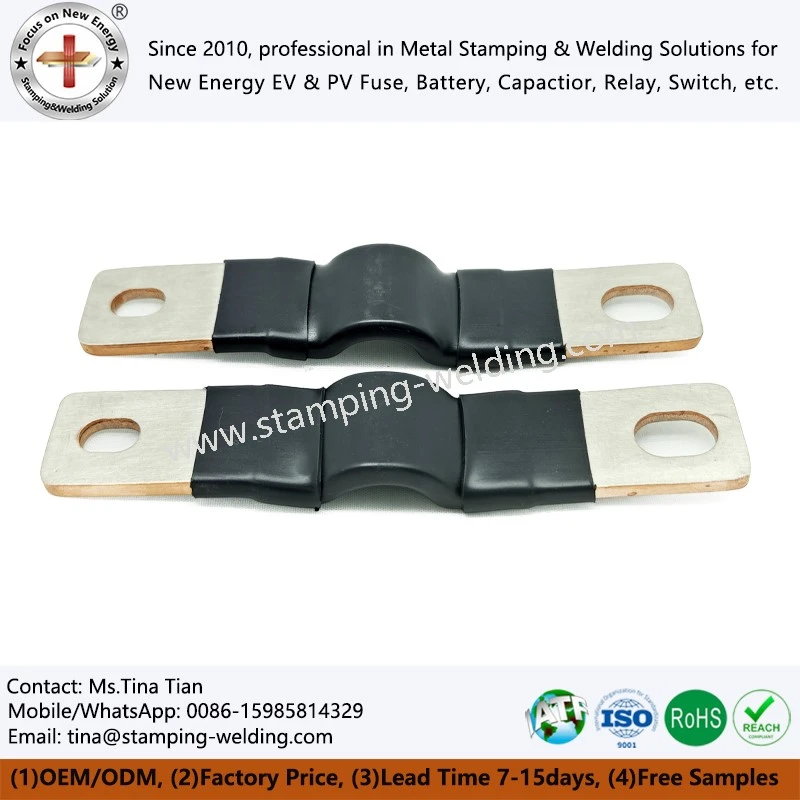
What factors affect the cost of diffusion-bonded copper foil busbars?
The cost of diffusion-bonded copper foil busbars is typically determined by factors such as materials, structural design, the welding process, and quality verification. For laminated flexible busbars used in new energy vehicles, procurement professionals can focus their evaluation on the following aspects:
| Cost factors | Key impacts | Selection Recommendations |
| Copper consumption | Affects raw material costs | Determine the conductive cross-sectional area based on current requirements |
| Copper foil thickness and layer count | Affects material usage and manufacturing complexity | Requires balancing flexibility and conductivity requirements |
| Diffusion welding zone | Affects the welding process and processing time | Designed based on terminal connection requirements |
| Terminal and profile machining | Affects downstream processing costs | Prioritize defining hole locations, dimensions, and mounting methods |
| Inspection requirements | Affects verification costs and lead times | Determined based on application risks and customer specifications |
Reducing costs does not simply mean using less copper foil or shrinking the welding area. For copper foil laminated flexible busbars, a more effective approach-while meeting requirements for current, temperature rise, and mechanical performance-is to optimize material utilization, terminal dimensions, and manufacturing processes, thereby minimizing unnecessary structural complexity and downstream assembly costs.
How can flexibility and electrical conductivity be balanced?
Flexible copper foil busbars can accommodate certain installation misalignments, vibrations, and displacements caused by thermal expansion; however, their flexibility is not determined solely by the number of copper foil layers. When designing copper foil busbars for high-current/high-voltage applications, engineers must consider the conductive cross-sectional area, the length of the flexible section, the direction of bending, and the available installation space.
Key factors influencing flexibility include:
- Thickness of individual copper foil layers: Thinner individual layers generally offer greater flexibility, though this must be evaluated in the context of the overall structure and operating conditions.
- Number of copper foil layers: The layer count affects the total cross-sectional area, overall thickness, and structural deformability; it should be determined in conjunction with current-carrying requirements.
- Length of the flexible section: The length and shape of the bendable zone influence installation adaptability and stress distribution.
- Installation and vibration conditions: Factors such as the distance between connection points, the direction of displacement, and potential mechanical loads during equipment operation must be clearly defined.
When selecting busbars-such as those featuring laminated copper shunts-decisions should be based on specific connection functions and drawing specifications, rather than attempting to resolve conductivity or flexibility issues simply by increasing the number of copper foil layers.
Request a Custom Busbar Design Review
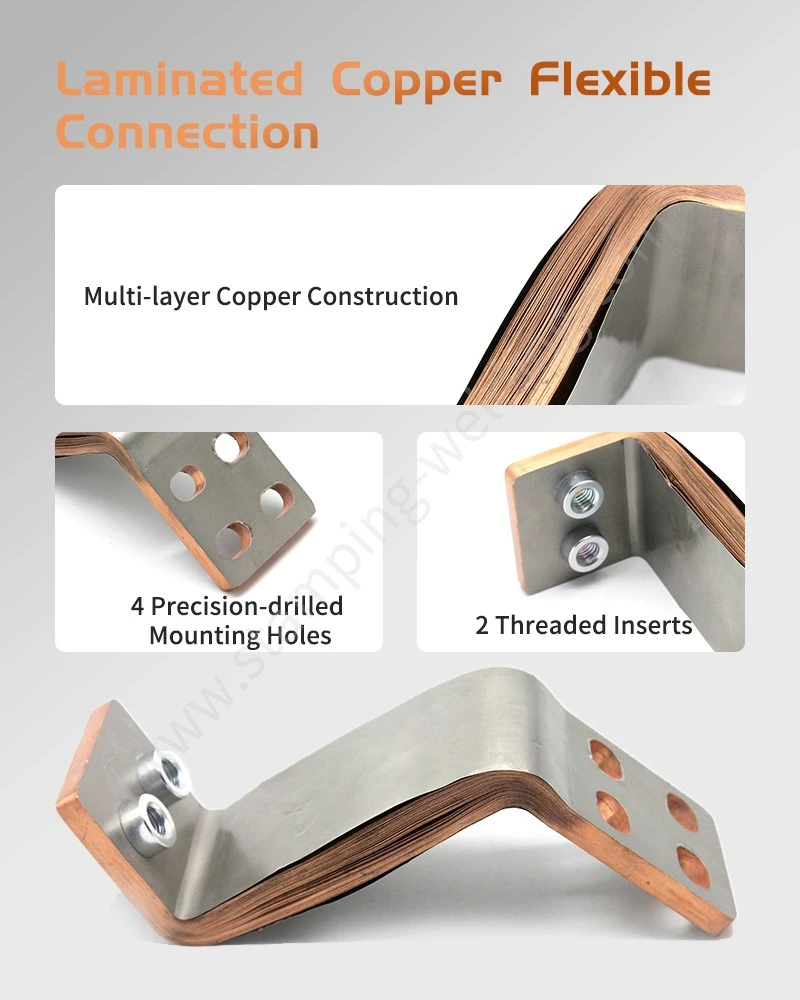
How is the temperature resistance of diffusion-bonded copper foil busbars evaluated?
While copper itself possesses excellent electrical conductivity, the operating temperature of the entire connection assembly is also influenced by factors such as current load, contact resistance, heat dissipation conditions, welding quality, and surrounding insulation materials. When dealing with laminated copper foil connectors, engineers should distinguish between ambient temperature and the temperature rise resulting from current flow, and determine the permissible temperature range based on the equipment's actual operating conditions.
Temperature resistance assessments should focus on the following aspects:
- Operating current: Continuous current, peak current, and duty cycle all influence heat generation.
- Resistance and temperature rise: The resistance of the conductor and the connection interface affects Joule heating; this should be evaluated through actual testing.
- Welded joints: The quality of the connection in the diffusion-welded zone impacts electrical performance and long-term operational reliability.
- Insulation system: If the assembly includes an insulation layer, the temperature rating of the insulating material must be verified to ensure it meets application requirements.
- Heat dissipation environment: Enclosed spaces, nearby heat sources, and mounting methods can all alter the actual temperature rise.
For laminated copper busbars used in inverters, temperature resistance capabilities should not be judged solely based on copper foil thickness or material designation. A more appropriate approach is to determine the performance metrics requiring verification based on operating current, ambient temperature, installation conditions, and permissible temperature rise.
How can cost, flexibility, and temperature performance be comprehensively optimized?
Actual component selection should be based on the equipment's operating conditions, systematically addressing electrical requirements, mechanical constraints, and manufacturing specifications, rather than prioritizing the lowest price, maximum flexibility, or highest temperature resistance in isolation. For multi-layer copper busbar foil flexible connections, the following evaluation process is recommended:
- Define electrical parameters: Confirm rated current, peak current, duty cycle, and permissible temperature rise.
- Determine structural dimensions: Select copper foil thickness, number of layers, and flexible section length based on installation space, connection point locations, and displacement requirements.
- Evaluate connection specifications: Define diffusion welding zones, terminal shapes, mounting hole locations, and connection interface requirements.
- Verify actual performance: Conduct necessary validation tests for electrical resistance, temperature rise, and connection reliability based on the intended application and customer specifications.
- Compare total costs: Consider materials, processing, testing, assembly, and service life holistically, rather than simply comparing unit prices.
For flexible copper foil busbars used in EV battery packs, design priorities may center on current transmission within confined spaces and assembly adaptability; conversely, for industrial electrical equipment, the focus may shift to continuous operation, connection reliability, and ease of maintenance. Therefore, the final solution should be determined by the specific operating conditions.
Request a DFM Evaluation & Quote
What technical information needs to be provided when requesting a price quote?
Clear inquiry documentation helps manufacturers assess process feasibility, minimize the need for repeated clarifications, and improve the accuracy of quotations. For custom Copper Foil Laminated Flexible BusBars, it is recommended that the procurement team prepare the following information:
| Inquiry information | Suggested content |
| Product drawings | CAD drawings, 3D models or dimensional sketches |
| Electrical requirements | Rated current, peak current, working cycle |
| Temperature requirements | Ambient temperature, allowable temperature rise and related specifications |
| copper foil structure | Single layer thickness, number of layers, cross-sectional area and overall size |
| Flexibility requirements | Flexible segment length, bending direction, installation displacement |
| Terminal design | Hole location, contact area, surface treatment requirements |
| Quality requirements | Resistance, temperature rise and other specified test items |
| Procurement plan | Sample quantity, estimated annual demand and target delivery date |
If the design has not yet been finalized, you may initially provide details regarding the application scenario, installation location, current range, and spatial constraints, and then confirm the structural parameters step-by-step. For connectors designed for specific equipment-such as flexible copper foil connectors for transformer components-it is also essential to specify the equipment interface and relevant industry standards to prevent subsequent design changes caused by the omission of critical requirements.

Common Selection Issues
Not necessarily. The number of layers affects overall thickness, conductive cross-sectional area, and structural deformability; actual flexibility also depends on the thickness of individual layers, the length of the flexible section, and the shape of the connectors.
Not necessarily. While increasing the conductive cross-sectional area may lower conductor resistance, the actual temperature rise also depends on the current, contact interface resistance, and heat dissipation conditions; assessment based on specific operating conditions is required.
Costs are influenced by the welding area, terminal design, processing requirements, and quality verification methods. The structure should be optimized to meet connection performance requirements rather than simply reducing the welding area.
Resistance, temperature rise, connection reliability, and necessary environmental verification tests should be evaluated based on application conditions and customer specifications. The specific scope of testing should be determined by the product's intended use and acceptance criteria.
Contact Us
If you are evaluating options for diffusion-bonded copper foil flexible connectors, please provide product drawings, current parameters, operating temperatures, and installation requirements. This information will facilitate further assessment regarding structural design, performance verification, and cost optimization.