Laminated Busbar: An Innovative Solution in The Field Of Power Transmission
May 16, 2025
Technical characteristics and core advantages
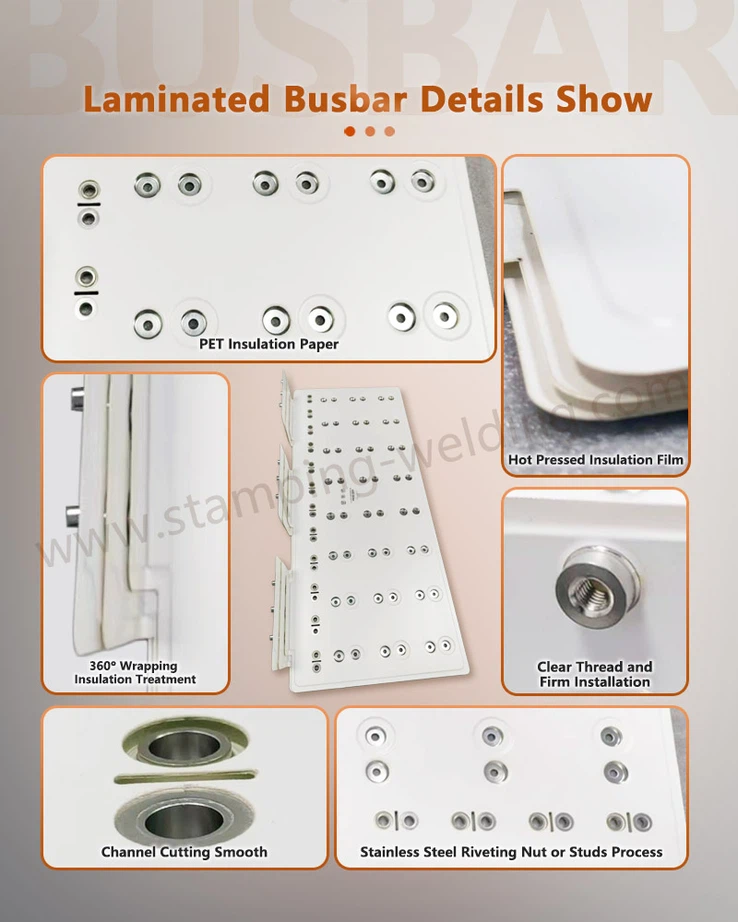
As a multi-layer composite structure connecting bar, the laminated busbar achieves a performance breakthrough that is difficult to achieve with traditional busbars through the alternating lamination process of copper/aluminum conductive layers and insulating materials. Its core advantages include:
Low inductance and high reliability: The multi-layer parallel conductive layer design can reduce the stray inductance to below 0.3nH, effectively suppress the surge voltage when the IGBT is turned off (the reduction is more than 75%), and significantly improve the stability of power electronic equipment. For example, in an 800V high-voltage fast charging system, the Laminated BusBars can control the voltage spike within 107V, which is more than 70% lower than the traditional busbar.
High power density and heat dissipation efficiency: The flat structure increases the current density to more than 40A/mm², and the thermal conductivity design of the multi-layer insulation layer (thermal conductivity ≥2W/m·K) can control the temperature rise within 30K, meeting the heat dissipation requirements of new energy vehicle battery modules under 500A high current conditions.
Space optimization and modular design: The integrated structure with a thickness of only 1-3mm can save more than 40% of the installation space and supports customized shapes (such as arc-shaped connections), which is suitable for compact scenarios such as energy storage distribution cabinets.
Market growth and application scenarios
The global Laminated BusBar for Mersen market size will reach US$821.5 million in 2023 and is expected to increase to US$1.18 billion in 2030 at a compound annual growth rate of 5.3%. This growth is mainly driven by the following areas:
1. New energy vehicles: In the battery management system (BMS), the Laminated Flexible BusBar achieves a high-reliability connection between battery modules through a flexible braided design, and global demand in 2024 will increase by 28% year-on-year. The fast charging interface of a certain model adopts a double-layer insulation lamination process to maintain stable conductivity in the temperature range of -40℃ to 125℃.
2. Renewable energy: In photovoltaic inverters and wind power converters, the low inductance characteristics of Laminated Copper Bars can improve energy conversion efficiency by 1.5%-2%, and the relevant market size will exceed US$250 million in 2024.
3. Industry and communications: The RF module of 5G base stations uses Laminated Busbar Connectors to achieve high-frequency signal transmission (attenuation ≤3dB). At the same time, in the joint connection of industrial robots, its flexible design with a bending radius of only 3mm can withstand more than 100,000 mechanical vibrations.

Technological innovation and process breakthroughs
1. Material and structural upgrade
Nanocomposite plating technology (such as nickel-phosphorus alloy + PTFE) improves the wear resistance of the busbar at a high temperature of 150℃ by 50%, which is suitable for high-frequency friction scenarios.
The copper-aluminum composite busbar uses metallurgical bonding technology to reduce the weight by 18% and the cost by 12%-15% while maintaining the conductivity of copper. It has replaced some pure copper components in the high-voltage wiring harness of electric vehicles.
2. Manufacturing process optimization
The cyanide-free pulse plating process improves the uniformity of the coating to ±5%, reduces the cost of wastewater treatment by 20%, and meets the EU RoHS directive's limit on lead content.
3D printing technology realizes the one-piece molding of complex structures, shortens the processing cycle by 40%, and is suitable for small-batch customization needs.
3. Intelligent integration
The intelligent busbar system with integrated temperature sensors and IoT modules can monitor the busbar temperature (accuracy ±1°C) and current load (accuracy ±2%) in real time and shortens the fault response time to 1/5 of the traditional system.

Industry challenges and response strategies
1. Raw material cost fluctuations: Nickel prices will rise by 22% year-on-year in 2024. Enterprises will ease the pressure by signing long-term procurement agreements (covering more than 60% of demand) and developing recycled nickel applications (currently accounting for 35%, expected to exceed 50% in 2030).
2. Environmental regulations pressure: The EU's "New Battery Regulation" requires that the battery material recycling rate exceed 70% by 2030, and encourages enterprises to adopt disassembled design and closed-loop recycling technology. A case shows that the use rate of recycled materials has increased to 42%, and energy consumption has decreased by 30%.
3. Competition of alternative materials: Aluminum-based busbars still have advantages in cost-sensitive scenarios, but Laminated Busbar Design have significant performance barriers in high-frequency transmission (such as 5G communications) and high-temperature stability (such as aircraft engines). The market position is consolidated by developing nickel-cobalt alloy plating (current density increased by 15%).
Future trends and development directions
1. High frequency and high speed: For in-vehicle Ethernet and autonomous driving systems, the new nickel-palladium alloy busbar can increase the signal transmission frequency to more than 10GHz while reducing signal reflection by optimizing the surface flatness (roughness Ra≤0.1μm).
2. Sustainable manufacturing: The application ratio of cyanide-free electrolyte and closed-loop electroplating systems has increased from 25% in 2020 to 45% in 2024, and the recycling rate of wastewater exceeds 90%.
3. Full life cycle management: The intelligent busbar system uses blockchain technology to achieve full-process traceability from raw materials to recycling. A certain enterprise case shows that the product's carbon footprint is reduced by 28%, which meets the requirements of the EU CBAM mechanism.

Conclusion
Laminated busbars are becoming the core connection solutions in new energy vehicles, renewable energy, and other fields with their low inductance, high power density, and modular design. Despite the challenges of raw materials and environmental protection, the industry continues to make breakthroughs through material innovation, process optimization, and intelligent integration, and the market size is expected to exceed US$1.18 billion by 2030. In the future, high-frequency signal transmission, sustainable production, and full life cycle management will become the focus of competition, promoting the development of Laminated Bus Bars for Computers of higher quality.
contact us