Multi-layer Copper Foil Stacking Design Enables New Energy Battery Copper Foil Flexible Connector To Upgrade Bending Performance
May 30, 2026
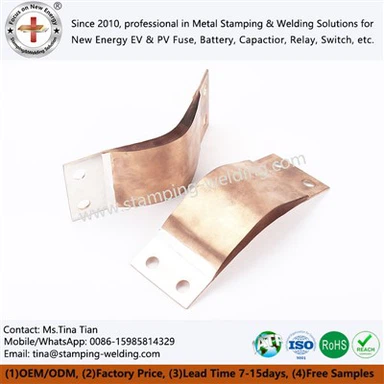
In the process of optimizing the structure of new energy battery systems, upgrading the mechanical stability and adaptability of flexible connecting components has become a key focus of industry research and development. The New Energy Battery Copper Foil Flexible Connector, as a core battery connecting component, features an innovative multi-layer copper foil stacked structure design. This design overcomes the shortcomings of traditional copper busbars in terms of bending performance from a mechanical principle perspective, effectively adapting to the complex operating conditions of new energy batteries and providing crucial support for the safe and stable operation of the battery system. Compared to traditional integral thick copper busbars, Laminated Flexible Copper Busbars, through layered structural modifications, significantly optimize the bending tolerance of components, efficiently absorbing the expansion displacement generated during cell charging and discharging, and completely avoiding the common industry problem of frequent breakage at battery connections.

Thickness reduction and stress reduction
From the perspective of core mechanical principles, the performance advantages of multi-layer copper foil structures primarily stem from the optimization of the thickness of a single layer of material. The stress generated during material bending is highly correlated with the material thickness. Under the same bending angle and stress conditions, the smaller the material thickness, the lower the surface deformation and bending stress. By disassembling traditional thick copper busbars into multi-layer ultra-thin copper foil stacked structures, the industry has significantly reduced the stress load on a single layer of copper foil, fundamentally reducing stress concentration during material bending, avoiding problems such as yielding and fracture due to deformation overload, and significantly improving the repeated bending resistance of components.
Interlayer decompression buffer
Meanwhile, the interlayer sliding characteristics of Flexible copper foil connectors result in excellent buffering and vibration reduction, creating a mechanical effect similar to a leaf spring. Conventional rigid copper busbars, under bending and vibration conditions, concentrate stress at a single point, making them prone to fatigue damage over long-term operation. In contrast, the copper foil layers of the Laminated Foils Flexible Copper Busbar are not fully rigidly cured, allowing for minute interlayer relative sliding during bending and vibration. This evenly distributes concentrated stress across each layer, achieving comprehensive stress relief and making the bending process smoother and damage-free, perfectly suited for the continuous vibration conditions encountered during the operation of new energy vehicles.

Balance between performance and space
While optimizing mechanical performance, the multi-layer copper foil stacking design does not sacrifice core conductivity, balancing product practicality and adaptability. Copper Foil Flexible Busbar Connectors ensure the overall conductive cross-sectional area through multi-layer copper foil stacking, allowing the component to maintain stable high-voltage, high-current transmission capabilities, with current-carrying performance consistent with traditional thick copper busbars. At the same time, the flat, layered structure is more suitable for the narrow and complex installation space inside new energy battery packs, allowing for flexible layout and installation.
Adapt to battery operating conditions
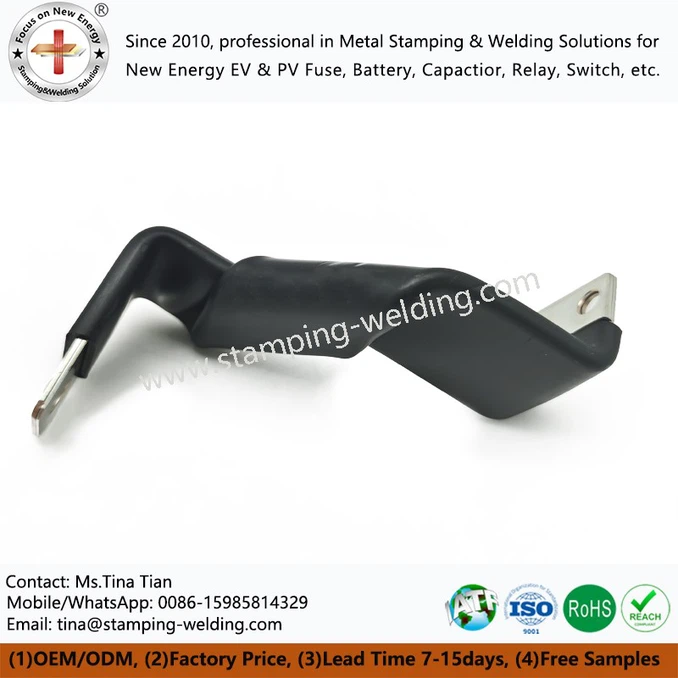
Designed specifically for the operating conditions of new energy batteries, the New Energy Battery Copper Foil Flexible Connector can precisely adapt to the "breathing effect" of the battery cells, perfectly coping with the continuous expansion and contraction deformation during battery charge and discharge cycles. Its flexible deformation offsets the tensile stress caused by cell displacement. This structural design allows copper foil flexible connectors to break free from the limitations of traditional rigid components, combining high conductivity, high flexibility, and high stability. It has become the mainstream technology for optimizing the connection structure of new energy battery systems, laying a solid structural foundation for the long-term safe operation of power batteries.
Contact Us
If you require a highly flexible and stable New Energy Battery Copper Foil Flexible Connector solution, please feel free to contact us for assistance.